
July 2024 Methodology Updates (2/n)
This article is an automatically translated version of the original Japanese article. Please refer to the Japanese version for the most accurate information.
This is the Sustainacraft Inc. newsletter.
"Methodology Updates" is a series that covers methodologies for Carbon and Biodiversity Credits. This time, we will introduce the developments regarding Verra's VCS approval for use in CORSIA Phase 1.
Before we dive into the main topic, here's an announcement.
The Paris 2024 Olympics are said to be the most environmentally friendly games to date. Given that they are being held in Europe, where Green Claims Directives are emerging, this event offers significant insights from the perspective of Carbon Credit handling and environmental claims. We will be holding a seminar as detailed below, so please join us.
- Title: Learning from the Paris 2024 Olympic Organizing Committee / Sponsor Companies: The Right Way to Make Environmental Claims Using Carbon Credits
- Date & Time: August 9, 2024 (Friday) 13:30-14:30 (Archive recording will be available)
- Venue: Online
- Registration URL: https://lp.sustainacraft.com/ja/webinar_20240809
Now, let's get to the main topic.
At the ICAO (International Civil Aviation Organization) committee meeting held this past March, the approval of several major Voluntary Carbon Credit standards, including VCS, for eligible Credits in CORSIA Phase 1 was once again deferred. The primary barrier to approval appears to be insufficient measures to address Double Counting of Credits. Following the release of ICAO's report in March, Verra swiftly published a document outlining its policy to address these concerns at the end of April.
While it remains difficult to predict the outcome of ICAO's decision, in this newsletter, we would like to provide an overview of Verra's proposed responses, particularly at the project Methodology level (REDD+, IFM, and ARR), as outlined in their published document.
Furthermore, we will present an analysis of how this situation might impact the supply of CORSIA-eligible Credits. Currently, only ACR and ART-TREES Credits are eligible for CORSIA Phase 1. However, over 97% of ACR projects are U.S.-based, implying a considerably high hurdle for Corresponding Adjustment.
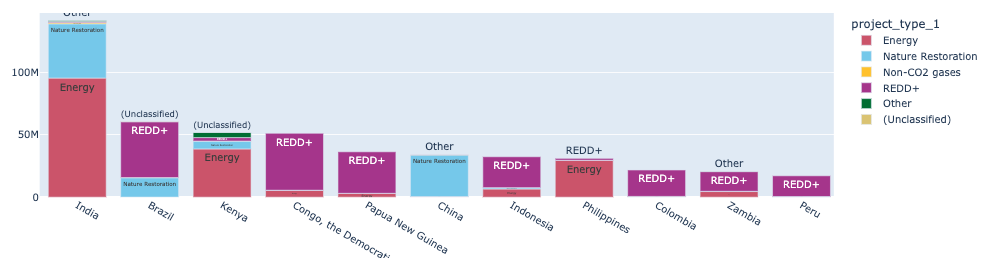
For VCS and Gold Standard, which have not yet received final approval, two key points are crucial for assessing supply potential: "Methodology" and "Corresponding Adjustment." While neither can be definitively stated yet, the following graph is important for considering the outlook (showing only top countries by estimated supply for VCS and GS combined). This is based on estimated annual Issuance from existing Pipeline projects using Methodologies deemed to have a reasonably high likelihood of becoming CORSIA-eligible, taking into account the IC-VCM's Core Carbon Principles (CCP) assessment status. Further details will be provided below.
Regarding the Methodology-level responses, details are provided below. As Jurisdictional REDD+ (J-REDD+) is being implemented in several countries/sub-national jurisdictions, the treatment of Leakage has become more stringent, focusing on the entire system rather than just the project level. Under TREES, the standard for J-REDD+, the policy is not to account for the outcomes of ARR activities if Deforestation is not halted relative to the Baseline (i.e., if Emission Reductions are not achieved). This appears to signify a rejection of self-serving activities that simultaneously advance ARR (Afforestation, Reforestation and Revegetation) while increasing logging intensity overall. While incorporating such a perspective into an influential framework like CORSIA is expected to enhance integrity, it also leads to decreased predictability for Project Developers conducting afforestation activities on a project-by-project basis, as it introduces factors beyond their control.
Regarding CORSIA eligibility, Verra, Gold Standard, and CAR are scheduled for re-assessment in September 2024. We will share any updates here as soon as they become available.
For inquiries, please contact us here.
VCS Moves Towards CORSIA Certification
(Source: CORSIA Eligible Emissions Unit Programme Change Notification Form, 2024/04/30)
At the International Civil Aviation Organization (ICAO) Technical Advisory Body (TAB) committee meeting held this past March, it was expected that an expansion of Voluntary Credits eligible for use in CORSIA Phase 1 (2024-2026) would be decided. However, approval for major registries including Verra's Verified Carbon Standard (VCS), Climate Action Reserve (CAR), and Gold Standard was ultimately deferred. Consequently, the situation persists where only American Carbon Registry (ACR) and ART-TREES remain CORSIA-eligible registries.
The conditions for CORSIA eligibility are outlined in the document CORSIA Emissions Unit Eligibility Criteria, available here. Particularly important points include:
- Reliability and Conservativeness of the Baseline (Criterion 2)
- Assurance of Permanence (Criterion 5)
- Mitigation and Consideration of Leakage (Criterion 6)
- Avoidance of Double Counting (Criterion 7)
Here, Double Counting collectively refers to the following:
- Double Claiming: Counting a Credit twice as an Emission Reduction contribution in the originating country, even after it has been used for Offset in CORSIA (i.e., without Corresponding Adjustment).
- Double Issuance: Issuance of two or more Credits for a single unit of Emission Reduction or Sequestration effect.
- Double Use: Using a single Credit more than once.
The primary reason for the deferral of approval this time appears to be insufficient measures to address Double Counting (particularly Double Claiming) (Reference: TAB Evaluation Report).