August 2024 Methodology Updates (2/n)
This article is an automatically translated version of the original Japanese article. Please refer to the Japanese version for the most accurate information.
sustainacraft Inc.'s newsletter. "Methodology Updates" is a series covering carbon and biodiversity credit Methodologies. This time, we will introduce Gold Standard's Agricultural Land Management Methodology.
The Gold Standard (GS) Methodology for GHG Emission Reduction and Removal projects through improved Agricultural Land Management is called the Soil Organic Carbon Framework Methodology (SOCFM). This Methodology includes multiple modules, each defining the method for calculating Credits for specific activities. Last week, a new module, "Managed Pasture," was added, bringing the number of activity types covered by this Methodology to five. A module related to Cover Crops use is also under development, and it is expected that the scope of eligible activities will expand further in the future. As this newsletter has not previously introduced the GS Agricultural Land Management Methodology, we would like to take this opportunity to introduce an overview of SOCFM, not limited to the Managed Pasture module. In particular, we will organize its characteristics by comparing it with VM0042, the VCS Agricultural Land Management Methodology.
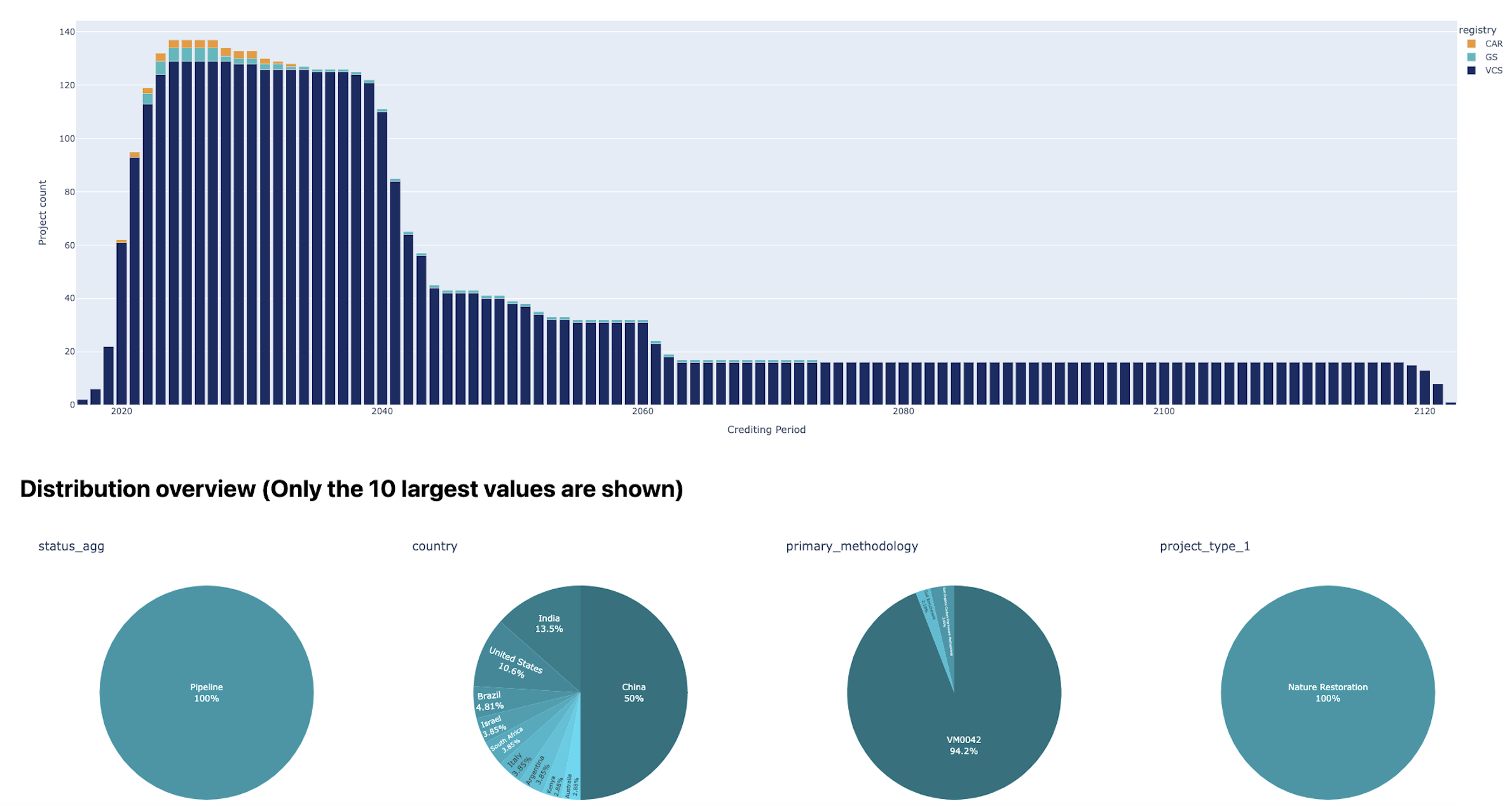
As of the end of August 2024, the Agricultural Land Management-related Methodologies that are subject to IC-VCM's CCP eligibility assessment are VCS's VM0042, CAR's U.S. Soil Enrichment Protocol, and the GS SOCFM, which we are covering this time. The graph below shows the number of projects in the Pipeline (= pre-official Registration) using these Methodologies, and it can be seen that the majority are VM0042 projects. In that sense, SOCFM's presence is not significant.
However, as will be discussed below, VM0042 is quite complex, and preparing a PDD in compliance with it is not easy, whereas SOCFM is relatively simple. What we often hear when talking with Project Developers is that "they originally planned to Register a project under VCS, but due to Methodology revisions, they are considering switching to GS" (this is not limited to Agricultural Land Management projects). Changes in registry or Methodology can affect Credit generation and costs, and in that sense, especially when considering investment in early-stage projects, it is important to have a comprehensive understanding of the Methodologies for the target project type.
Please contact us here for inquiries.
Introduction to Gold Standard's Agricultural Land Management Methodology
(Source: Gold Standard Soil Organic Carbon Framework Methodology, Accessed on 2024/08/22)
The Soil Organic Carbon Framework Methodology (hereinafter, SOCFM) is a Gold Standard (hereinafter, GS) Methodology that has been in operation since 2020. SOCFM primarily targets agricultural practice improvement projects, setting out general requirements for them (e.g., applicability conditions, eligible projects, Emission Reduction quantification approach). Under SOCFM, modules for specific activities are defined, providing detailed guidance tailored to each activity type.
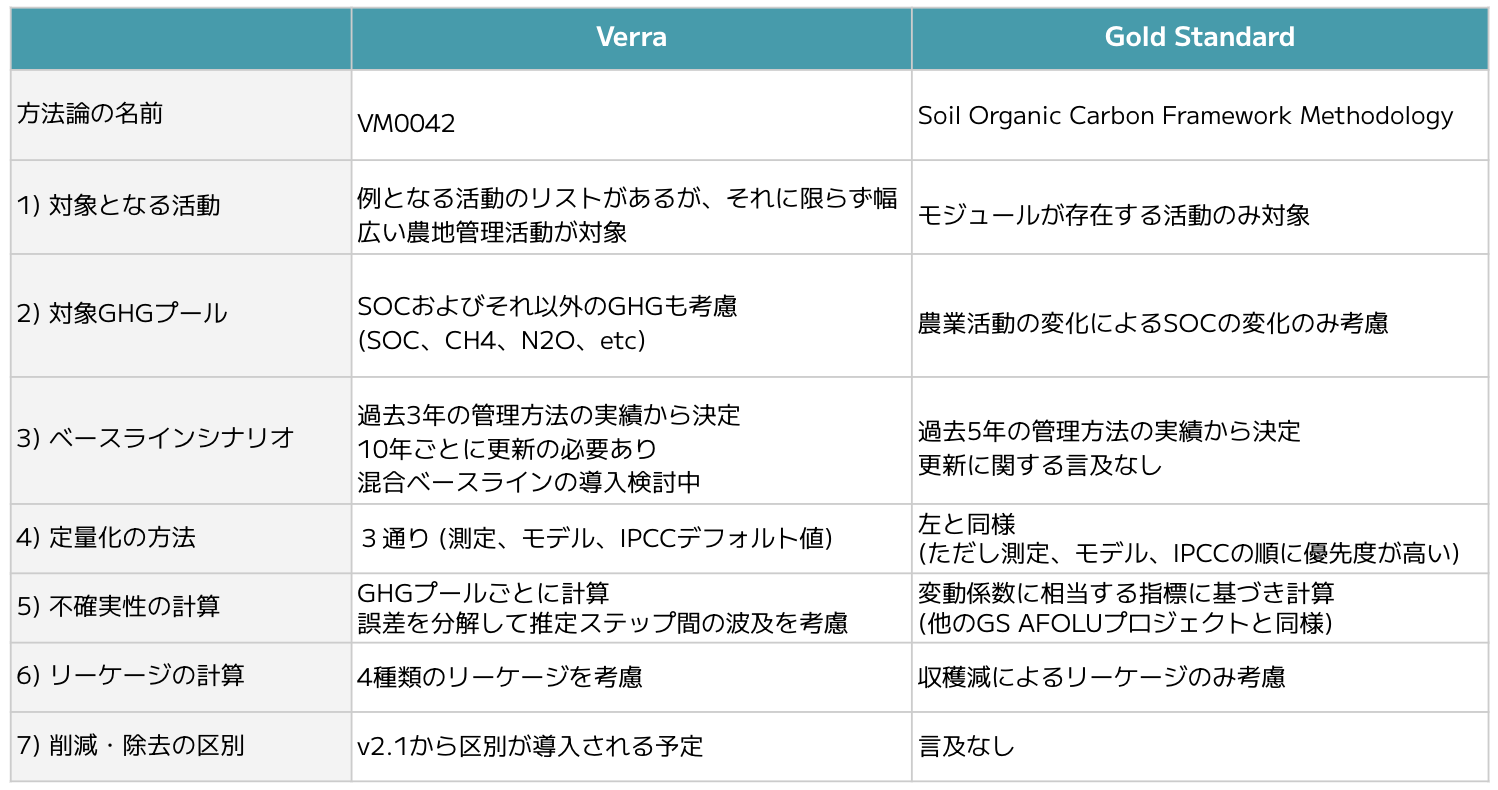
Below, we will introduce the characteristics of SOCFM through a comparison with VCS's ALM (Agricultural Land Management) Methodology VM0042. This time, we will compare it across seven axes: 1) Eligible Activities, 2) Target GHG Pools, 3) Baseline Scenario, 4) Quantification Methods, 5) Uncertainty Calculation, 6) Leakage Calculation, and 7) Distinction between Reduction and Removal. The table below summarizes the subsequent comparison, but in a nutshell, SOCFM is more limited in its eligible projects and target GHG pools compared to VM0042, and its calculation methods are simpler.