
September 2024 Methodology Updates (1/n)
This article is an automatically translated version of the original Japanese article. Please refer to the Japanese version for the most accurate information.
Sustainacraft Inc. Newsletter.
Methodology Updates is a series that covers Carbon Credit and Biodiversity Credit Methodologies. This article introduces updates regarding Verra's Biodiversity Credit Methodology, the SD VISta Nature Framework.
As introduced multiple times in our past newsletters (Reference 1, Reference 2, Reference 3), the development of Biodiversity Credit Methodologies has been progressing from last year to this year. Particularly active are Verra's Nature Framework, which we are introducing this time, and Plan Vivo's PV Nature. While Plan Vivo only targets net biodiversity gains from project activities for Credits, the Nature Framework reflects experience gained in developing REDD+ Methodologies and uniquely targets Avoided losses for Credits. There are various other differences in approaches; please refer to the articles linked above for details.
Regarding the Nature Framework, since the draft (v0.1) was released last year, public consultations and pilot projects have been conducted, and a summary of their results was published in May this year. The SD VISta newsletter published last month summarizes related information.
Among these, we will introduce the challenges identified through the pilot projects1. While Verra recognizes the need to address many challenges, it has not yet clarified specific measures. Biodiversity projects have a shorter history compared to carbon projects, but beyond that, it seems the results have re-emphasized the difficulties in quantification and project design.
For inquiries, please contact us here.
Lessons Learned from Nature Framework Pilots (Verra)
(Source: Verra SD VISta Newsletter, August 2024, accessed September 24, 2024)
Verra's Nature Framework is a Methodology for crediting the outcomes of positive biodiversity activities and is positioned within the Sustainable Development Verified Impact Standard (SD VISta) program. Compared to the Verified Carbon Standard (VCS), SD VISta is a standard specifically designed to certify Co-benefits derived from social and environmental projects, such as gender equality, economic development, affordable clean energy, and wildlife protection. The method for quantifying biodiversity in the Nature Framework draft was explained in detail in the following newsletter.
The results summarizing the public consultation mentioned above and feedback from pilot projects were announced in May this year. The public consultation aggregated opinions gathered from representatives of 10 pilot projects, 42 general responses, and consultation events with 67 Indigenous Peoples and Local Communities (IPLCs). Currently, the Methodology is being updated based on this feedback, with a formal version scheduled for release within 2024.
In this newsletter, we will primarily focus on feedback from pilot projects, discussing specific issues identified during the practical application of the draft Methodology and directions for improvement (In addition to pilot projects, there were many interesting points in the feedback provided during public comments and consultation events with Indigenous Peoples and Local Communities; however, due to the breadth of information, we will omit them from this article. For these points, please also see here.)
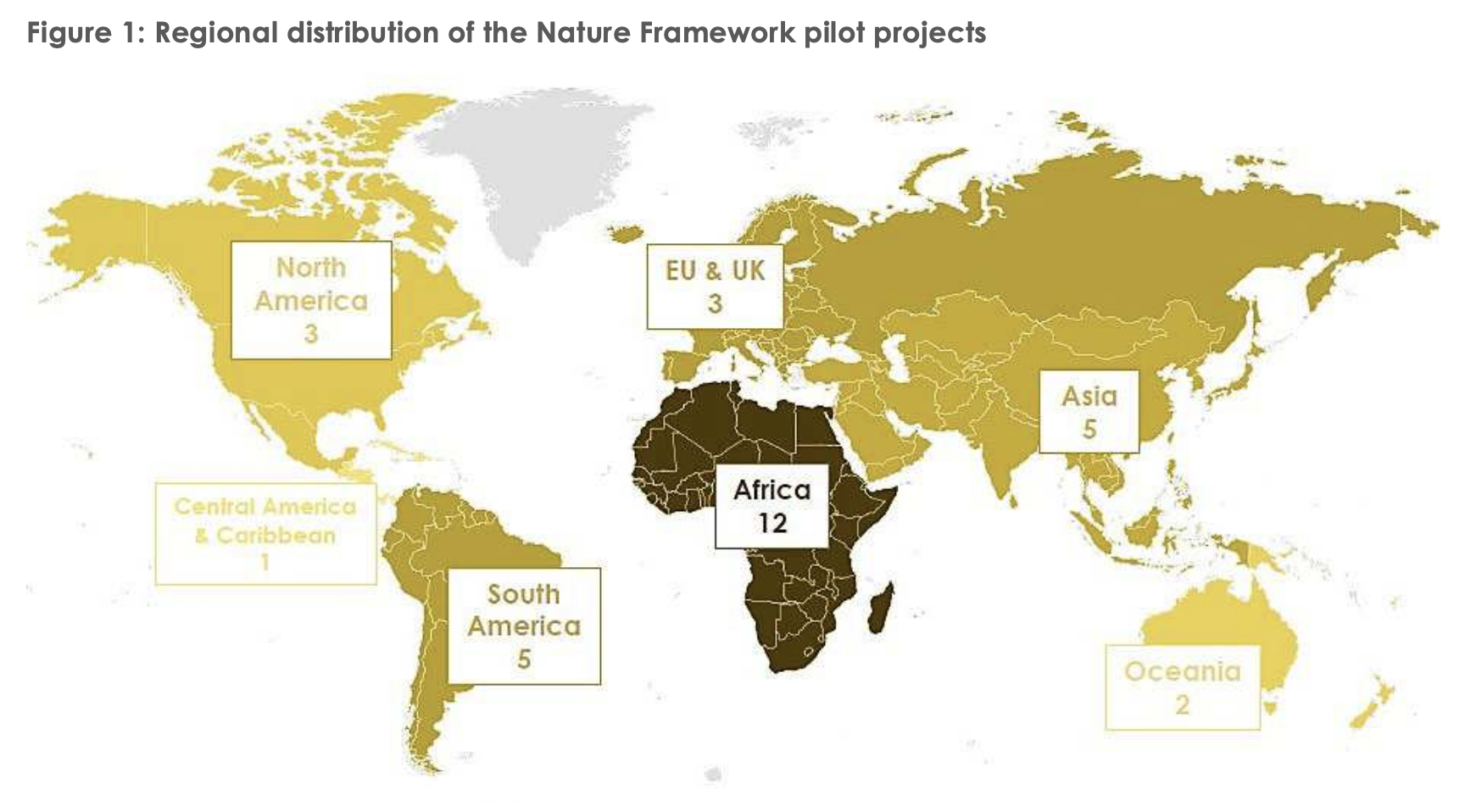
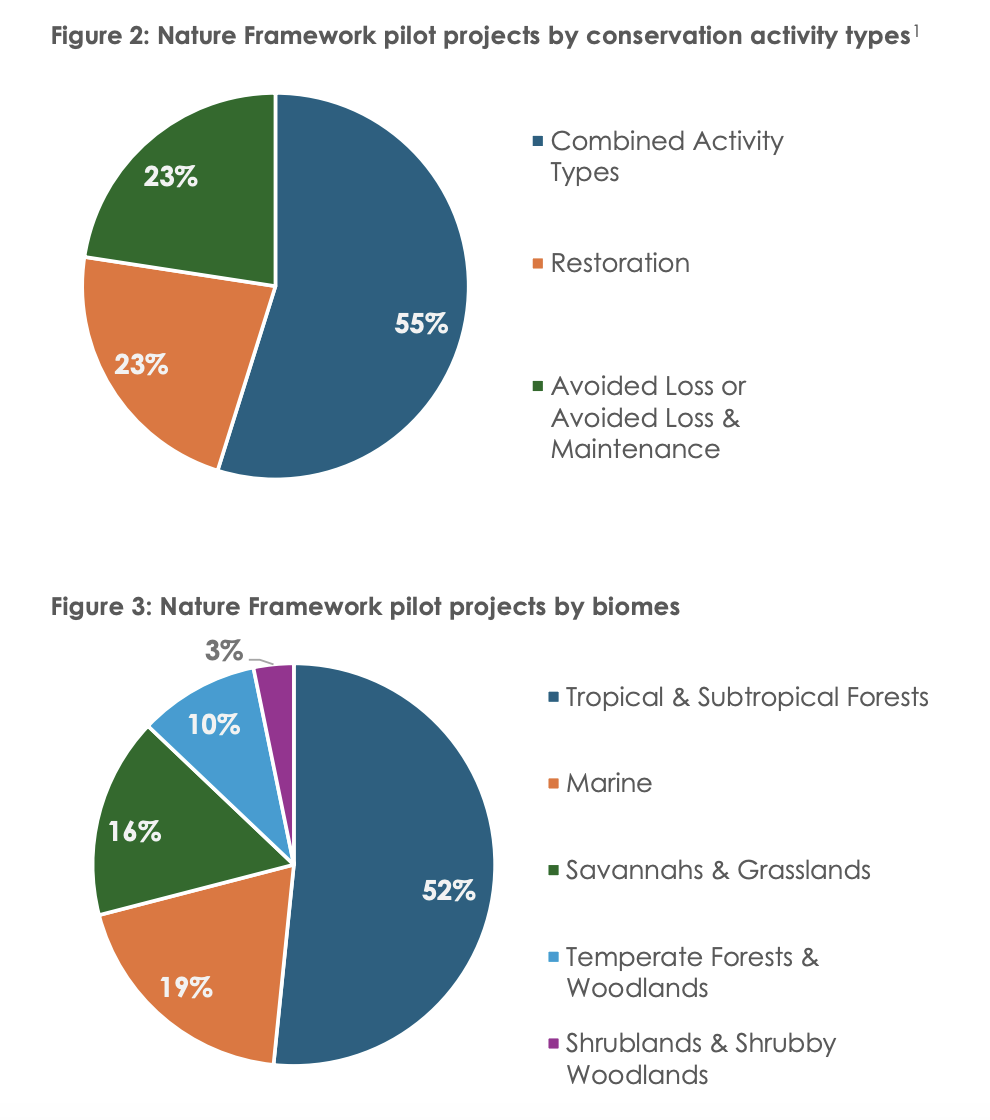
Before delving into detailed introductions, let's look at what kind of projects were included in the pilots. For these pilots, 31 pilot projects were selected from 179 candidates, with consideration given to including various types regarding activity (e.g., conservation and restoration), geographical region, biome, project scale, land use (e.g., protected areas, forestry, agriculture, tourism, fisheries), and the involvement of Indigenous Peoples and Local Communities. As the figures below show, Africa was the most frequent geographical region. Also, in terms of project types, terrestrial forest projects seemed to be numerous. Over half of the projects included both restoration and Avoidance of loss in their activities. Participating projects were required to attend an initial webinar, submit a draft PDD, and participate in video conferences with Verra (to discuss PDD content, share project information, and provide feedback on SD VISta and Nature Framework rules and requirements).
Feedback from these pilot projects seemed to be diverse, but below, we will introduce five topics that received particularly insightful feedback: 1. Benefit Sharing, 2. Condition indicator, 3. Monitoring challenges, 4. Baseline quantification, and 5. The value of the Nature Framework.