
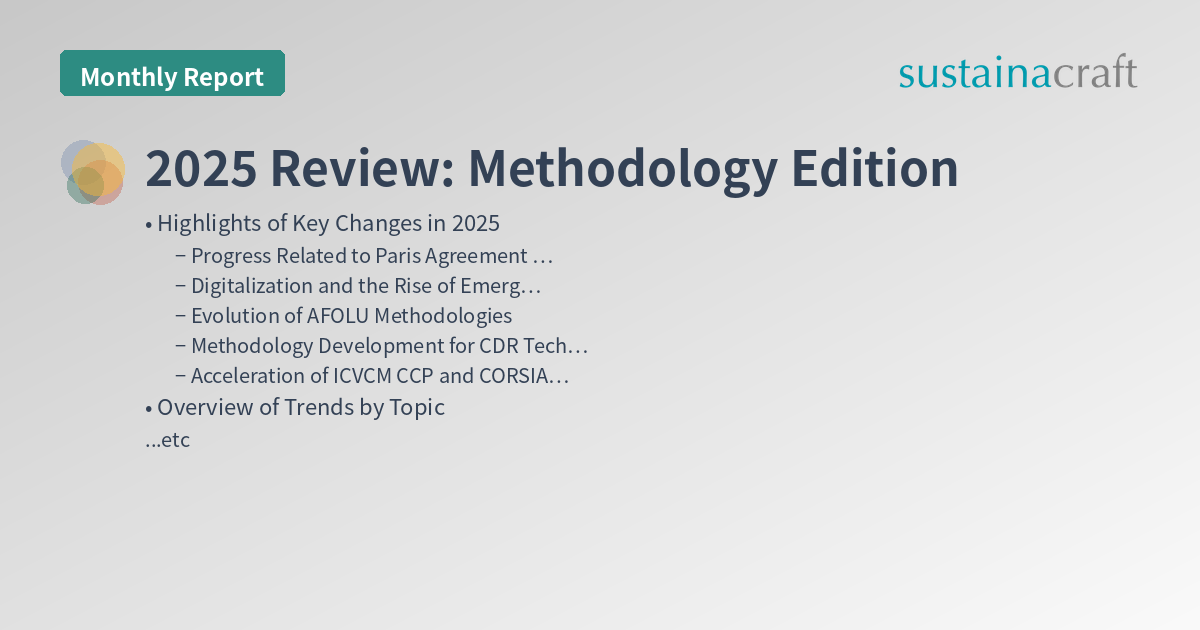
2025 Review: Methodology Edition
This article is an automatically translated version of the original Japanese article. Please refer to the Japanese version for the most accurate information.
sustainacraft Inc. newsletter.
Methodology Updates is a series that covers methodologies for carbon and biodiversity credits. This time, as the final Methodology Updates for the year, we will summarize the evolution of methodologies and market changes this year, focusing on key topics covered in Methodology Updates from January to December 2025. We hope this review helps you look back on the movements in the carbon market this year.
For inquiries, please contact us here.
Highlights of Key Changes in 2025
2025 was a year of significant progress in concrete rulemaking to ensure alignment with the Paris Agreement in the Carbon Credit market. With the adoption of baseline and leakage criteria by the Paris Agreement Article 6.4 Supervisory Body and Gold Standard becoming the first Voluntary Carbon Standard to publish its Paris Agreement Alignment (PAA) guidance, the entire market saw a movement towards convergence with stricter international rules.
At the same time, in the AFOLU sector, Soil Organic Carbon (SOC) measurement and modeling technologies advanced significantly, and the wave of digitalization spread across the entire VCM with the introduction of Verra's Digital MRV and the emergence of new registries like Isometric. Methodology development for innovative CDR technologies such as biochar, enhanced weathering, and TSB also accelerated, making 2025 a year where the definition of high-quality Carbon Credit became more multifaceted.
Progress Related to Paris Agreement Article 6
- Full-scale rulemaking for the Article 6.4 Mechanism: Baseline setting criteria and leakage criteria were adopted at the SBM016 meeting in May, and a draft of the Reversal handling criteria was released in August. Particularly for Reversal criteria, the balance between scientific rigor and feasibility became a major point of discussion.
- Gold Standard's PAA Guidance Release: As the first Voluntary Carbon Standard, Gold Standard developed comprehensive Paris Agreement alignment rules, introducing the DAF tool (downward adjustment factor) and CPA tool (Common Practice Analysis).
- Article 6.2 Crediting Protocol (ACP) Released: The Singapore government, Verra, and Gold Standard jointly announced a standardized framework for utilizing the VCM under Article 6.2.
Digitalization and the Rise of Emerging Registries
- Isometric's Rapidly Growing Presence: As a CDR-focused registry, Isometric successively released Methodologies for ARR, IFM, agroforestry, and enhanced weathering, also obtaining ICVCM CCP approval.
- VCS Standard Version 5 Public Comment: Expectations for digitalization are high, with 90% in favor of high-frequency Credit Issuance through dMRV (Digital MRV).
Evolution of AFOLU Methodologies
- Digitalization of Soil Organic Carbon (SOC): With Verra's VT0014 (DSM tool) and Gold Standard's SOC model requirements, SOC estimation using Remote Sensing and machine learning has become full-scale.
- Updates for Afforestation, Reforestation and Revegetation (ARR) and Improved Forest Management (IFM): VM0047 v1.1 allowed the use of Remote Sensing, and VT0015 unified Carbon accounting for IFM Methodologies. Isometric released new IFM and agroforestry Methodologies.
- Refresh of Rice Paddy Methane Methodology (AWD): VM0051 was announced as a new rice paddy methane Methodology, replacing the CDM Methodology.
Methodology Development for CDR Technologies
- Diversification of Biochar Permanence Evaluation: Different Permanence evaluation approaches among registries became clear, with Puro.Earth (200+ years), Verra (100 years), and Isometric (200 years / 1,000 years).
- New Developments in Enhanced Weathering: Isometric released the Closed Engineered System (EW-CES) module, offering a solution to the MRV challenges faced by traditional EW-Ag.
- Rise of TSB (Terrestrial Storage of Biomass): Isometric and Puro.Earth are developing TSB Methodologies with their respective unique approaches.
Acceleration of ICVCM CCP and CORSIA Approvals
- CCP Approval Rush in Late 2025: ICVCM's CCP (Core Carbon Principles) approvals significantly accelerated, with numerous Methodologies approved, including 3 biochar Methodologies (Isometric, CAR, VM0044), 2 IFM Methodologies (VM0045, ACR IFM), 2 ARR Methodologies (ACR ARR Methodology, VM0047 v1.1), and VM0042 for ALM (the first for ALM).
- Isometric CORSIA Full Approval (November 2025): Transitioned from conditional to full approval, enabling the CDR-focused registry to supply Credits for the aviation industry.
Overview of Trends by Topic
1. Paris Agreement Article 6 and Market Alignment
- January 2025: Emerging Carbon Standard Isometric obtained three major certifications (ICVCM CCP, CORSIA (conditional), ICROA) and began developments with an eye towards compatibility with the Article 6.4 Mechanism (🔗).
- April 2025: We compared and explained the Issuance processes and requirements for Article 6 and CORSIA labels across six major registries (VCS, Gold Standard, ACR, CAR, Isometric, Puro.earth). We reported that the deadline for submitting evidence of Corresponding Adjustment ranged from 3 months for GS to 2 years for VCS, and that as of the end of 2024, approximately 8.5 million Article 6-labeled Credits and 92.7 million CORSIA-labeled Credits had been Issued (🔗).
- April 2025: Oxford University published "The Oxford Principles for Responsible Engagement with Article 6." This is a specialized version of the existing Oxford Principles for Article 6 market mechanisms, recommending strict requirements for Article 6.2, such as stricter Additionality proof, Benefit Sharing with host countries, and voluntary application of OMGE/SOP (🔗).
- May 2025: At the Paris Agreement Article 6.4 Supervisory Body meeting (SBM016), baseline setting criteria and leakage criteria were adopted (🔗).
- Baseline setting criteria require a downward adjustment of Baseline Emissions by at least 1% every three years.
- Leakage criteria adopted a three-stage approach (identification, avoidance/minimization, calculation/deduction) considering both Activity Shifting and Market Leakage, including international leakage.
- August 2025: A draft of the Reversal handling criteria for the Article 6.4 Mechanism was released for public comment (🔗).
- The MEP could not reach a consensus, presenting two options: a strict Approach 1 (indefinite Monitoring) and a relatively simpler Approach 2 (Monitoring for 45+ years).
- Streck et al. of Climate Focus criticized Approach 1 for effectively excluding NbS projects from the market, and Approach 2 received overwhelming support in public comments.
- October 2025: Gold Standard, as the first Voluntary Carbon Standard, announced its comprehensive Paris Agreement Alignment (PAA) guidance (🔗).
- Introduction of the DAF tool (downward adjustment factor), setting default values for 188 countries, and automatically reducing Baseline Emissions based on each country's NDC/Net Zero targets.
- CPA tool (Common Practice Analysis) quantifies Additionality thresholds based on technology maturity using diffusion of innovation theory (S-curve).
- Future introduction of a two-category Credit classification ("Authorized" and "Mitigation Contribution") based on the presence or absence of Corresponding Adjustment.
- December 2025: The Singapore government, Verra, and Gold Standard jointly announced the "Article 6.2 Crediting Protocol (ACP)" (🔗).
- The ACP is a standardized framework for managing and tracking Credits Issued by existing independent Credit programs (ICPs) under Paris Agreement Article 6.2.
- Unlike the JCM, it does not require creating new, unique Methodologies for each host country, allowing for broad application of existing VCM Methodologies.
2. Digitalization and Emerging Registries
- January 2025: Introduced Isometric, an emerging Carbon Standard (🔗).
- A digital-first Carbon Credit standard and registry established in 2022.
- Specializes in Carbon Dioxide Removal (CDR), focusing on high Permanence (1,000+ years) protocols.
- Its first ARR protocol, announced in December 2024, utilizes LiDAR models and third-party AGB maps.
- Obtained three major certifications: ICVCM CCP, CORSIA (conditional), and ICROA.
- February 2025: Reported the results of the initial public comment on the draft VCS Standard Version 5 (🔗).
- 1,943 comments from 61 stakeholders (62% Project Developers).
- 90% in favor of high-frequency Credit Issuance through dMRV (Digital MRV).
- 70% conditionally approved Buffer Pool contributions through optional VCU Credits.
3. Deepening and Diversification of AFOLU Methodologies
Advances in Soil Organic Carbon (SOC) Measurement and Modeling Technologies
- February 2025: Verra conducted a public consultation for its new tool, "CN0137 draft tool," utilizing Digital Soil Mapping (DSM) technology (🔗).
- High-resolution SOC mapping using Remote Sensing and machine learning.
- Intended for use with the VM0042 Methodology, complementing traditional labor-intensive soil sampling methods.
- April 2025: Verra released VMD0053 v2.1. This module specifies calibration and Validation methods for biogeochemical (BGC) models in ALM projects, and v2.1 made it available for the rice paddy Methodology VM0051 (🔗).
- September 2025: Verra officially released VT0014 (DSM tool), and Gold Standard also published "SOC Model Requirements and Guidelines." These developments further promote the use of Remote Sensing and models in Soil Organic Carbon projects (🔗).
- VT0014 provides guidance for SOC estimation using Remote Sensing and machine learning, mandating re-Verification with actual measurement data every 5 years.
- Gold Standard offers three quantification strategies: "design-based," "model-assisted," and "model-based," and introduces safety discounts (0-50%) based on data source quality.
- November 2025: Verra revised VM0042 v2.2 (IALM Methodology) (🔗).
- Additionality assessment standardized to VT0008, and a 20% threshold introduced for Common Practice tests.
- Digital Soil Mapping (DSM) for SOC Monitoring is now officially available through VT0014.
ARR (Afforestation, Reforestation and Revegetation)・IFM (Improved Forest Management)
- June 2025: Verra's ARR Methodology VM0047 received a minor update to v1.1 (🔗).
- Allowed Natural Regeneration (ANR) activities in existing forests (under the condition of no timber management or harvesting in the past 10 years).
- Permitted initial Biomass estimation using Remote Sensing (using the 90% confidence interval upper bound).
- Clarified the application criteria for Census-based and Area-based approaches, setting a planting density of 50 trees/ha as the threshold.
- June 2025: Gold Standard newly released an SOC module for "Utilization of Orchard Wood Chip Residues." This targets activities that apply wood chip residues from orchards as soil amendments to increase SOC (🔗).
- July 2025: Verra updated VM0045 (IFM Methodology) to v1.2. Guidance for de minimis determination (less than 5% of total Emissions can be ignored) was strengthened, providing clearer application criteria.
- October 2025: Isometric released its Reforestation Protocol v1.1.
- Introduced new afforestation restriction requirements for water resource protection (to ensure afforestation-induced evapotranspiration increase does not adversely affect watershed water balance).
- Adopted the Trees for Sustainable Savanna (TFSS) method for Carbon stock estimation.
- October 2025: Isometric released a new IFM Methodology, the "I-IFM Protocol" (🔗).
- Features a two-layer structure consisting of a common protocol and independent modules, adopting a modular architecture similar to Gold Standard's SOC Methodology.
- Baseline setting by the Isometric registry itself (not by the Project Developer).
- The first module, "DHSL (Delayed Harvesting for Smallholder Loggers)," introduces a Permanence factor based on contract duration and quantifies Market Leakage using GTM.
- October 2025: Isometric released a draft of its new agroforestry Methodology (🔗).
- Maintenance of agricultural production as a prerequisite (at least 50% of the project area or a minimum of 500 ha dedicated to non-timber product production).
- Introduced Leakage assessment using Net Project Productivity (NPP).
- Mandated a minimum of 40 years of Monitoring after the end of the Crediting Period (maximum 40 years).
- Adopted a Dynamic Baseline and used a specific indicator called Carbon Proxy.
- November 2025: Verra released VT0015 IFM Carbon Accounting Tool (🔗).
- Provides a unified Carbon accounting framework for the four existing IFM Methodologies (VM0003, VM0005, VM0012, VM0034), enabling clear distinction between reductions and Removals.
AWD (Alternate Wetting and Drying) for Rice Paddy Methane
- February 2025: An AWD (Alternate Wetting and Drying) Methodology was approved between the JCM (Joint Crediting Mechanism) and the Philippines. This was the first Methodology in the agricultural sector for JCM, paving the way for methane Emission Reduction Credit Issuance in Southeast Asian rice paddies.
- March 2025: Verra announced a new VCS rice paddy methane Methodology, "VM0051 Improved Management in Rice Production Systems, v1.0" (🔗).
- Developed to replace the CDM rice paddy methane Methodology (AMS-III.AU.) which was Cancelled in 2023.
- Set a 20% adoption rate threshold for Additionality proof.
- Mandatory Monitoring and quantification of N2O Emissions.
- Adoption of a Dynamic Baseline.
- Allowed modeling in addition to direct measurement for quantifying Emission Reductions.
REDD+
- June 2025: Verra officially released Deforestation risk maps for Pará and Mato Grosso states in Brazil. High-resolution risk assessment improved the accuracy of REDD+ project Baseline setting.
- October 2025: ART (Architecture for REDD+ Transactions) concluded the public comment period for TREES 3.0.
- The introduction of a new FCPF (Forest Carbon Partnership Facility) pathway facilitates migration for existing FCPF projects.
- The deadline for subnational participation was extended, allowing more regions to join ART-TREES.
- As of autumn 2025, the number of Jurisdictional REDD+ registered with ART expanded to 26, covering over 440 million hectares of forest.
- November 2025: Verra officially released Deforestation risk maps for Peru. Detailed mapping of Deforestation risk across Peru, including the Amazon region, supports REDD+ project planning and evaluation.
4. Methodology Development for Carbon Dioxide Removal (CDR) Technologies
Biochar
- June 2025: Verra made a minor revision to VM0044 (Biochar Methodology) to v1.2. Investment Analysis using VT0008 became mandatory for Additionality assessment, making the proof of financial Additionality more stringent.
- July 2025: We provided an overview of biochar projects and compared Methodologies from Puro.Earth, Verra, and Isometric (🔗).
- Verra (VM0044): 100 years of Permanence, uses standardized decay coefficients based on IPCC guidelines.
- Puro.Earth (2025 Edition): "CORC200+" for 200+ years of Permanence, project-specific decay model using H:Corg ratio and soil temperature.
- Isometric: Two Permanence options: 200 years and 1,000 years. The 1,000-year option adopts the Inertinite model by Sanei et al. (2024) and conducts direct Permanence evaluation through random reflectance (Ro) measurement.
- August 2025: Isometric certified its Biochar Construction Materials module. This new approach allows for over 1,000 years of Carbon Sequestration by mixing biochar into construction materials such as concrete and asphalt.
- August 2025: ICVCM granted CCP approval to three biochar Methodologies (Isometric Biochar Protocol, CAR Biochar Protocol, Verra VM0044). This significantly enhanced the market credibility of biochar Credits.
- November 2025: Isometric updated its Biochar Protocol to v1.2. The soil environment module was expanded, allowing biochar application in a wider variety of soil conditions.
Enhanced Weathering
- January 2025: Isometric released its Enhanced Weathering Protocol v1.1. Sampling requirements were made more flexible, reducing barriers to implementing enhanced weathering projects in agricultural lands.
- August 2025: Isometric released the "Enhanced Weathering in Closed Engineered Systems (EW-CES)" module (🔗).
- Accelerates weathering reactions by contacting concentrated CO2 with mineral raw materials in controlled reactors.
- Potentially solves MRV challenges of traditional EW-Ag, such as heterogeneity of reaction rates due to site-specific factors, measurement costs, and difficulty in quantifying downstream Carbon loss.
- However, it also faces challenges of high cost due to the need for dedicated infrastructure and high energy demand.
- Capture6, Limenet, pHathom, Planeteers, etc., included in Frontier Climate's portfolio, provided feedback for module development.
- November 2025: Puro.earth officially released ERW Edition 2025.
- Offers seven different measurement approaches, allowing flexible MRV according to project scale and conditions.
- A comprehensive framework that includes agricultural application (EW-Ag) and considers application in coastal and marine environments.
TSB (Terrestrial Storage of Biomass)
- June 2025: We provided an overview of TSB and compared Methodologies from Isometric and Puro.Earth (🔗).
- Isometric: A stringent approach that only allows shallow subsurface burial in dry, oxygen-free environments, aiming for over 1,000 years of Permanence.
- Puro.Earth: Allows multiple storage methods (above-ground, underground, injection) but limited to woody Biomass (C:N ratio > 80) with 100 years of Permanence.
- Isometric has Graphyte Carbon's Loblolly Project (2,227 tCO2e Issued), and Puro.Earth has 4 projects (total 3,952 tCO2e Issued) registered.
- October 2025: ICVCM granted CCP approval to Isometric TSB Protocol. This was the first CCP approval in the TSB sector.
5. Focus on Wetlands Ecosystems
- May 2025: Verra released sea level rise risk assessment guidance for Wetland restoration and conservation projects (🔗).
- Supplements the sea level rise risk calculation section in the AFOLU Non-Permanence Risk Tool (NPRT) v4.2.
- Risk assessment based on four factors: coastal inundation, coastal erosion, ecosystem degradation, and salinization.
- Recommends using digital tools such as DEM, Google Earth, and Global Surface Water Explorer.
- September 2025: Introduced the "Global Wetland Outlook 2025 (GWO2025)" report (🔗).
- Since the 1970s, global natural Wetlands have been lost at an average annual rate of -0.52%, with over 411 million hectares cumulatively destroyed or converted.
- The remaining 1.425 billion hectares of Wetlands provide approximately $8 trillion annually in ecosystem service value.
- Peatland and Wetland projects have a high Emission Reduction potential of 40-50 tCO2e/ha per year.
This concludes this month's newsletter on Carbon Credit Methodologies.
Disclaimers:
This newsletter is not financial advice. Please do your own research and due diligence.
If you are an academic institution or NGO/NPO interested in subscribing to the paid version, please contact us individually.