
Oxford Principles for Ideal Use of Paris Agreement Article 6
This article is an automatically translated version of the original Japanese article. Please refer to the Japanese version for the most accurate information.
Sustainacraft Inc. Newsletter. This article is published as a special edition, separate from our usual VCM and Methodology updates, and is open to the public.
This article explains the background and features of "The Oxford Principles for Responsible Engagement with Article 6" (hereinafter, the "Article 6 Principles"), newly released last month by the University of Oxford, and what they mean for companies and governments utilizing the market mechanisms of Paris Agreement Article 6 (hereinafter, Article 6).
The Joint Crediting Mechanism (JCM), an Article 6.2 mechanism, has recently garnered significant attention from many companies in the context of GX/ETS initiatives. These new Article 6 Principles **set a high level of stringency even for Article 6.2**, which allows for flexible bilateral arrangements.
Announcement
Partnering with Regrow and ATOA Carbon for Joint Development of Model-Based AWD Methodology for JCM (link)
The Joint Crediting Mechanism (JCM) is expected to contribute to Japan's Nationally Determined Contribution (NDC), with the Japanese government aiming for cumulative **Credit Issuance of 200 million tCO2e by 2040**. Among agricultural activities with significant Greenhouse Gas (GHG) Reduction potential, Alternate Wetting and Drying (AWD) is particularly promising in Southeast Asian countries. In February 2025, the first JCM AWD Methodology was formally approved in the Philippines, and similar project developments are anticipated in the future.
To this end, we have commenced joint development of a model-based AWD Methodology in collaboration with **Regrow**, which holds an exclusive license for the DNDC biogeochemical model, a promising tool for quantifying AWD activity effects, and **ATOA**, the proponent of the latest AWD Methodology "VM0051" under Verified Carbon Standard (VCS)1.
In this initiative, we are seeking **local partners who can cooperate in promoting model-based quantification**, primarily in Southeast Asian countries (especially those with JCM partnership agreements). Companies engaged in rice cultivation in these regions, or those promoting or interested in generating Credits through AWD, are encouraged to contact us at press[at]sustainacraft.com.
For more details, please refer here.
Introduction
In last month's newsletter, we introduced the adoption of several important guidelines by the Supervisory Body Meeting (SBM) for Paris Agreement Article 6.4, including those pertaining to Credit Baseline setting and Leakage treatment. These rules form a high-level rulebook for the operation of Article 6.4 mechanisms, providing a foundation for enhanced market transparency and environmental integrity.
 sustainacraft
However, these UN-led rules are often described as a "floor" due to the need for agreement from all signatory parties. Concerns exist that they may not always be sufficient as an "ideal target" or "ceiling" to raise climate action ambition (example article). Furthermore, Article 6.2, which is based on bilateral arrangements, offers greater flexibility compared to UN-supervised Article 6.4, raising concerns about a higher risk of Greenwashing.
Against this backdrop, a group of researchers at the University of Oxford released new Article 6 Principles as guidance for a more reliable and ambitious application of Article 6. These principles are a specialized and developed version of the "Oxford Principles for Net-Zero Aligned Carbon Offsetting, 2024 revised" (hereinafter, the "Offset Principles"), which have become widely known in the Voluntary Carbon Market (VCM). While the Offset Principles outlined how companies should use Credits to achieve Net Zero targets, the Article 6 Principles aim to present a "ceiling" for responsible conduct for governments and companies participating in the Article 6 market.
This article will first provide an overview of the foundational Offset Principles, then elaborate on the specific content of the newly announced Article 6 Principles, focusing on their most noteworthy requirements.
What are the Offset Principles?
To understand the Article 6 Principles, let's briefly review the Offset Principles, which serve as their foundation. First published in 2020 and revised in 2024, these principles have established a standard for discussions in the VCM, guiding companies and organizations in integrating Carbon Credits into their Net Zero strategies. The details of the revision were also covered in the following newsletter:
 sustainacraft
The Offset Principles set four criteria:
Prioritize reducing your own emissions:
Prioritize all possible Emission Reduction efforts across your entire Value Chain before relying on Credit purchases.
Credits utilized must meet stringent environmental integrity criteria, such as demonstrated Additionality (that the investment would not have occurred otherwise), measurability, verifiability, and no adverse social or environmental impacts.
Disclose information transparently regarding your own emissions, reduction targets, and the types of Credits used and the selection process.
Shift to Carbon Dioxide Removal (CDR):
Transition from using Emission Reduction Credits to Carbon Removal Credits that directly remove CO2 from the atmosphere.
Shift to Long-lived storage:
Transition from projects with a risk of short-term CO2 re-release to those that can stably Sequestrate carbon for hundreds of years or more (e.g., biochar, DACCS).
Support the formation of Net Zero-aligned markets:
Actively support the development of a high-quality Removal Credit market through long-term contracts and other means, as it is still underdeveloped.
It is also recommended to provide additional funding for climate action projects (Beyond Value Chain Mitigation) separate from Offsets for achieving your Net Zero targets.
These principles aim to prevent the easy use of Credits as an indulgence and encourage actions that genuinely contribute to the global Net Zero transition, serving as a reference for many companies and initiatives.
All four points above are also aligned with the revisions in Version 2 of the recent SBTi Corporate Net Zero Standard. Specifically, these include **setting interim targets for Removal** and **setting an Interim Removal Factor** within those targets. For details, please refer to this seminar content previously held.
Overview of the Article 6 Principles
The newly released Article 6 Principles are designed to address the unique challenges of Article 6 as an intergovernmental mechanism, building upon the ideas of the Offset Principles. Similar content to the four criteria of the Offset Principles is mentioned under "1. Prioritize reducing your own emissions," while other parts focus on the rules related to international transactions under Article 6.
A characteristic feature is that it views the officially agreed UN rules as a "floor" and then provides an "ideal standard" or "ceiling" to ensure environmental integrity, transparency, and equity. These are not mandatory rules to comply with but rather best practices (aspirational goals) that governments and companies considering using Article 6 should voluntarily adopt.
In particular, it is crucial that **a high level of stringency is set for Article 6.2**, which allows for flexible bilateral arrangements. In Japan, the JCM is attracting high interest, but a feature of the JCM is that it does not use a uniform Methodology for each project type; instead, Methodologies are formulated for each signatory country and project type. Consequently, it offers more flexibility compared to Voluntary Credit Methodologies, and there can be significant differences between projects. Therefore, assessing them against the Article 6 Principles could be a useful evaluation axis.
Characteristic Requirements of the Article 6 Principles
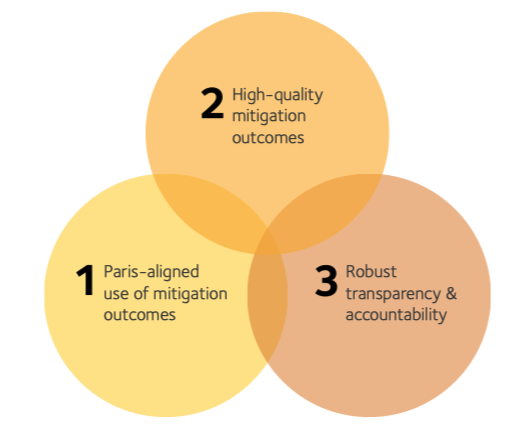
The Article 6 Principles set out the following three principles:
- Principle One: Paris-Aligned use of mitigation outcomes
- Principle Two: Generation of high-quality mitigation outcomes
- Principle Three: Robust accounting and transparency in engaging in Article 6
These three principles are not independent but are interconnected.
Each principle has further detailed requirements. The table below summarizes their overview and relation to the Offset Principles.
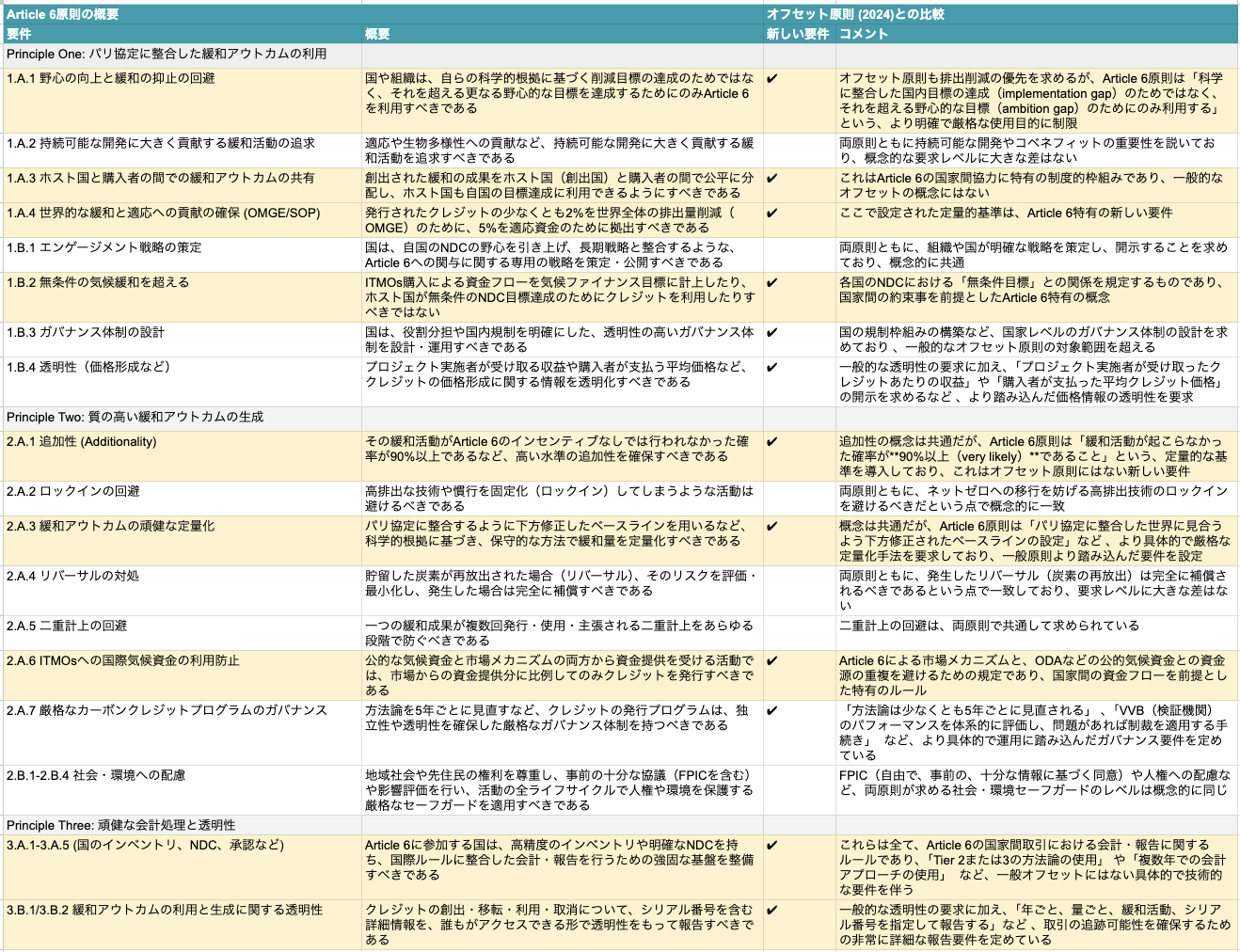
Below, we introduce several points from this table that are clear and characteristic differences from the Offset Principles.
Principle One: Paris-Aligned use of mitigation outcomes
1.A.1 Enhancement of ambition and avoidance of mitigation deterrence
The use of Article 6 should accelerate global Emission Reduction efforts and should not serve as an excuse for participating countries (Purchasing Countries/Host Countries) to delay their domestic Emission Reduction efforts. It is suggested that Article 6 mechanisms **should be used to incentivize additional actions beyond existing initiatives**, rather than replacing them.
The Offset Principles also call for prioritizing internal Emission Reduction before purchasing Credits. The Article 6 Principles apply this idea to the national level, specifically pointing out the risk of "mitigation deterrence," where the use of Article 6 leads to a reduction in a country's climate policy ambition.
1.A.3 Sharing of mitigation outcomes between Host Countries and Purchasers
It is proposed that the Emission Reduction outcomes (ITMOs) generated from projects should not be 100% acquired by the Purchaser, but rather a portion should be shared with the Host Country. For example, a method could involve not transferring a portion of the issued Credits to the Purchasing Country but instead using them for the Host Country's NDC achievement. This ensures that not only the Purchasing Country providing the funding but also the Host Country undertaking the project receives direct mitigation benefits, thereby ensuring equity. This requirement is specific to intergovernmental transactions under Article 6 and has no corresponding element in the Offset Principles.
1.A.4 Ensuring contributions to overall mitigation in global emissions and adaptation (OMGE/SOP)
It strongly recommends voluntarily applying the two contribution mechanisms mandated by Article 6.4 to Article 6.2 transactions as well:
- OMGE (Overall Mitigation in Global Emissions): A mechanism to ensure a definite reduction in overall global emissions by not Retiring a certain percentage (minimum 2%) of the issued Credits, instead Cancel them.
- SOP (Share of Proceeds): A mechanism to contribute a certain percentage (minimum 5%) of the issued Credits to an adaptation fund that supports developing countries vulnerable to the adverse effects of climate change.
1.B.2 Beyond unconditional climate mitigation
Projects under Article 6 must generate additional Emission Reductions that go beyond the unconditional NDC targets that the Host Country has committed to achieve without international support. This aims to prevent the sale of Credits for reductions that would have been achieved anyway.
This applies the concept of Additionality more stringently to national-level commitments. While the Offset Principles require project-level Additionality, this demands a higher level of Additionality by basing it on the Host Country's national commitments.
Principle Two: Generation of high-quality mitigation outcomes
2.A.1 Additionality
Projects must meet rigorous Additionality criteria, demonstrating that they would not have been implemented without the Credit revenue. Specifically, it requires showing a probability of 90% or more (IPCC's "Very likely" standard) that the project would not have occurred without the Credits.
2.A.3 Robust quantification of mitigation outcomes
The quantification of Emission Reductions and Removals must be based on scientific evidence and employ conservative Baselines2. It also requires robust methods to address Leakage of emissions outside the project boundary and the risk of re-release of Sequestrated carbon (Non-Permanence), such as securing Buffer Credits.
While the demand for robust quantification is common with the Offset Principles, the Article 6 Principles are more prescriptive, citing specific tools developed under Article 6.4 for Baseline setting (e.g., downward adjustments) and Non-Permanence risk assessment as references.
2.A.6 Prevention of the use of international climate finance for ITMOs
For activities receiving funding from both public climate finance and market mechanisms, Credits should only be Issued proportionally to the market-based funding component. This provision aims to avoid duplication of funding sources between Article 6 market mechanisms and public climate finance such as Official Development Assistance (ODA). This rule regarding public financial flows is a specific issue for Article 6, involving nations and international organizations, and is not included in the Offset Principles, which primarily focus on private sector actions.
Principle Three: Robust accounting and transparency
3.A.1-3.A.5 Institutional arrangements and processes for countries engaging in Article 6.2
Countries participating in activities under Article 6.2 should establish domestic institutional arrangements to properly manage and track the generation, transfer, and use of ITMOs. Specifically, this includes developing GHG Inventories (e.g., types of GHGs to be accounted for), clarifying NDCs, establishing formal processes for authorizing ITMO transactions, and operating a registry to track Corresponding Adjustments to prevent Double Counting.
3.B.1/3.B.2 Transparency in the use and generation of mitigation outcomes
Host Countries, Purchasing Countries, and other relevant parties must comprehensively and timely make publicly available information regarding the generation, transfer, and use of ITMOs. This requires transparently demonstrating, in a way that can be verified by a third party, how many ITMOs were generated from which projects, to whom they were transferred, for what purpose they were used, and how Corresponding Adjustments were applied.
This concludes this month's newsletter (special edition).
Our company profile document is available here for your reference.
Disclaimers:
This newsletter is not financial advice. Please do your own research and due diligence.

Academic institutions and NGOs/NPOs interested in subscribing to the paid version, please contact us individually.
For VM0051, please refer to the previous article below. ↩
March 2025 Methodology Updates (1/n)This is Sustainacraft Inc.'s newsletter.
As introduced in previous newsletters, the Baseline criteria adopted in SBM016 include a requirement to reset downward by at least 1% each time. Regarding this, one of the authors of the Article 6 Principles has expressed the view that 1% is insufficient, and 2% or more is desirable (reference). However, this is not explicitly stated in the text of the Article 6 Principles. ↩