
Global Wetland Outlook 2025: Wetlands as Investable Natural Infrastructure
This article is an automatically translated version of the original Japanese article. Please refer to the Japanese version for the most accurate information.
This is a newsletter from Sustainacraft Inc.
Methodology Updates is a series covering methodologies for Carbon Credits and Biodiversity Credits. This newsletter article introduces the findings and assessments of the recently published "Global Wetland Outlook 2025" report[1], explaining the current state of wetland conservation and what it means for stakeholders involved in Nature-based Solutions (NbS).
*This article was written by Nick Lau. As an Applied Scientist, Nick is involved in satellite data analysis and model development for various NbS project analyses.
1. Introduction
The Global Wetland Outlook 2025 (hereinafter referred to as "GWO2025" in this article) is a global assessment report issued by the Scientific and Technical Review Panel of the Convention on Wetlands (commonly known as the Ramsar Convention, ratified by 172 countries), a legally binding treaty body for the conservation and sustainable use of wetlands. By integrating recent scientific research and economic evaluations, this report presents a stark assessment of the world's wetlands. The accelerating degradation of wetlands is not only an environmental issue but also a significant economic and social liability.
GWO2025 not only documents ecosystem decline but also presents wetlands as high-value natural capital that makes measurable contributions to the global economy, climate change mitigation, and water security. It also quantifies the costs of inaction, highlights financing gaps related to global biodiversity targets, and proposes pathways to transform how wetlands are valued and financed. These findings are crucial for NbS stakeholders as they directly link ecological science to financial and policy frameworks.
This newsletter will first explain the scientific insights and economic observations of GWO2025 in Section 2. Next, Section 3 will describe how national standards, the Voluntary Carbon Market (VCM), and compliance frameworks are beginning to realize GWO2025's recommendations for public-private investment, based on current market information. Finally, Section 4 will, building on this, compare implementation costs and Emission Reduction potential across different project types, revealing how wetland projects can yield cost-effective returns per ton. The maturing frameworks, existing VCM projects as demonstration examples, and the growing recognition of wetlands' economic value indicate that wetlands are evolving into viable opportunities for both ecological resilience and sustained economic returns.
2. The State of Wetlands – GWO2025 Findings
The following assessment of wetlands is directly quoted from GWO2025. This chapter summarizes the report's central findings regarding ecosystem changes, economic valuation, and financing needs, which will serve as the basis for subsequent discussions.
2.1 Scientific Assessment
GWO2025 integrates the latest scientific papers and global databases to provide a comprehensive assessment of wetland extent and condition. According to the report, global natural wetlands span approximately 1.425 billion hectares across 11 major environments, with inland marshes, lakes, and Peatlands accounting for the largest areas. GWO2025 back-calculates historical wetland extents using reliable data sources such as the Wetland Extent Trends Index, providing a Baseline for understanding long-term environmental changes. The results show that since the 1970s, wetlands across all natural wetland types have been lost at an average annual rate of -0.52%. Over the past 50 years, a total of more than 411 million hectares of wetlands have been destroyed or converted, with lakes and inland marshes accounting for the highest proportion of loss.
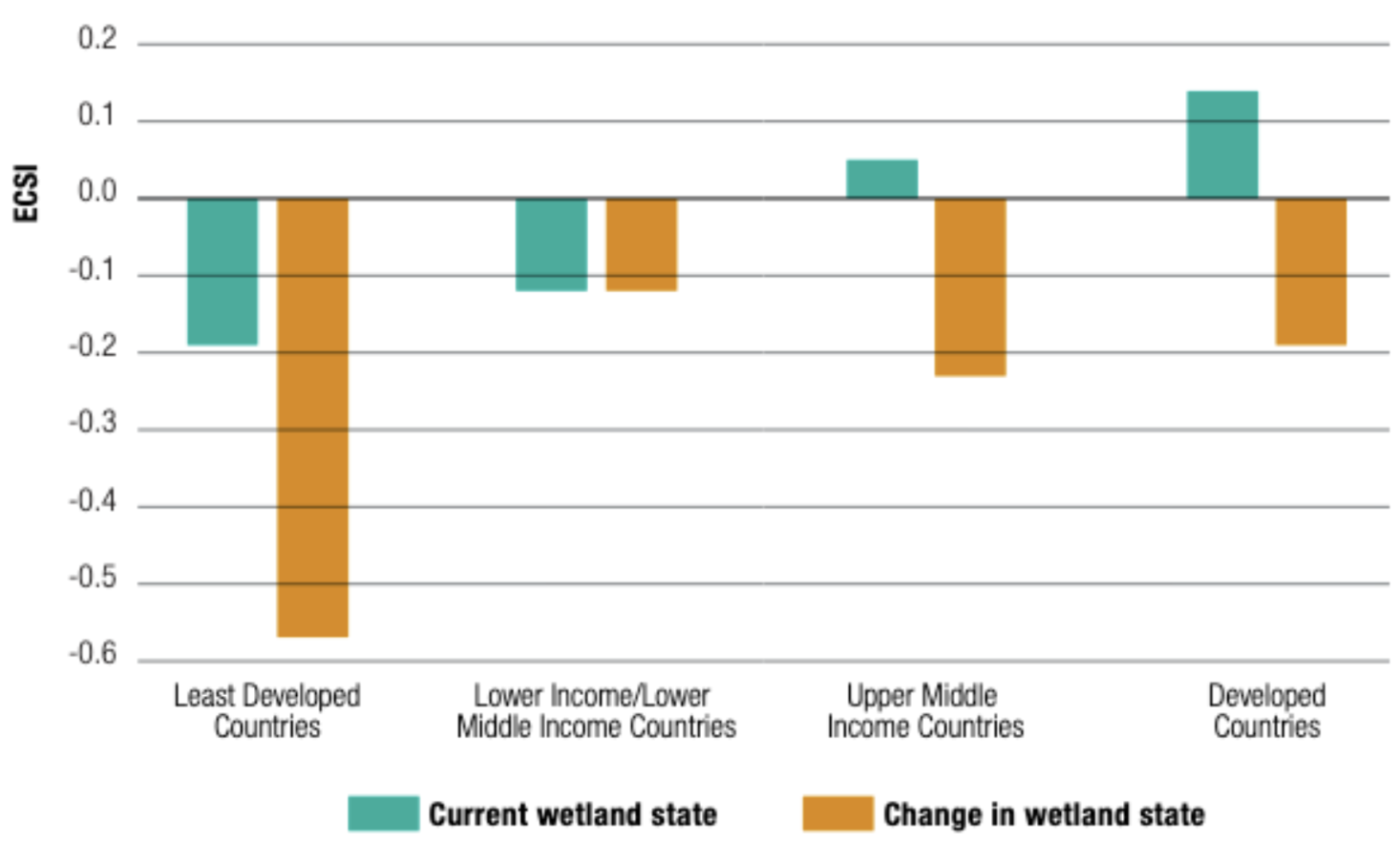
GWO2025 also tracks trends in ecological characteristics using data from national reports, academic studies, and citizen science surveys, documenting widespread degradation of remaining wetlands. Analysis indicates that the proportion of degraded wetlands is higher than that of improving wetlands, a trend that continued from 2011 to 2021. Furthermore, a direct correlation is observed between a country's economic status and the condition of its wetlands, with the worst wetland conditions found in Least Developed Countries (Figure 1). These findings suggest that the primary drivers of current wetland loss are region-specific; while developed countries have historically already lost most of their wetlands, developing countries are experiencing rapid degradation due to ongoing economic development.
The main drivers of this decline are identified as land-use change due to agriculture and urbanization, as well as industrial pollution. Water abstraction from industrial and agricultural activities accounts for nearly 90% of global water withdrawals, directly contributing to wetland loss and degradation. The compounding effects of climate change, exacerbating droughts and floods, further accelerate these negative impacts on wetland conditions.
2.2 Economic Assessment
GWO2025 redefines wetlands as valuable natural capital, thereby presenting a compelling economic case for wetland conservation. It integrates over 1,500 economic valuation estimates from the Ecosystem Services Valuation Database to quantify the immense benefits provided by wetlands.