
Guardian Article on Forest Credits
This article is an automatically translated version of the original Japanese article. Please refer to the Japanese version for the most accurate information.

This is Sustainacraft Inc.'s 10th newsletter.
Recently, The Guardian published the following article claiming that over 90% of forest Carbon Credits issued by Verra are worthless, which has become a major topic of discussion in the industry (Verra itself has also issued a rebuttal to this).
Revealed: more than 90% of rainforest carbon offsets by biggest provider are worthless, analysis showsOnly a handful of Verra’s rainforest projects showed evidence of deforestation reductions, according to two studies, with further analysis indicating that 94% of the credits had no benefit to the climate.The threat to forests had been overstated by about 400% on average for Verra projects, according to analysis of a 2022 University of Cambridge study.Gucci, Salesforce, BHP, Shell, easyJet, Leon and the band Pearl Jam were among dozens of companies and organisations that have bought rainforest offsets approved by Verra for environmental claims.
In this newsletter, we would like to explain the article's overview and raise several points of caution. While this article references several academic papers,
- it highlights only the extreme parts of what these papers demonstrate,
- and it has limitations in evaluating Baselines with a uniform approach.
For these two reasons, we believe that caution is needed in interpreting this article.
We at Sustainacraft also agree that in some projects, forest Carbon Credits may be issued excessively beyond their actual environmental impact, and Buyers of Credits should be aware of this.
However, on the other hand, it is crucial to avoid a situation where such extreme claims halt the flow of funds to vital nature conservation activities essential for climate change countermeasures, which could, as a result, accelerate Deforestation. To halt Deforestation, external funding is necessary, and for that purpose, economic incentives like Carbon Credits should play a crucial role.
Although not mentioned in The Guardian article, the papers it references contain important information beyond just the Verification results of project effects. We will also introduce this at the end.
Premise: Carbon Credit Quality and Baselines in REDD
Before delving into the article's content, let's briefly organize the discussion on Carbon Credit quality and the topic of Carbon Credits for REDD (Reducing Emissions from Deforestation and Forest Degradation).
Discussions on Carbon Credit quality are underway in various international initiatives. They are required to be additional, permanent, have sufficiently conservative Baselines, avoid Double Counting, and have no negative social or environmental impacts. Among these, The Guardian article primarily concerns Baselines.
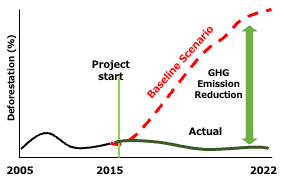
REDD projects involve activities such as, in areas experiencing Deforestation and Forest Degradation, preventing conversion to planned agricultural land or commercial plantations (APD: Avoided Planned Deforestation), or preventing illegal logging through enhanced patrols (AUD: Avoided Unplanned Deforestation). Therefore, the Baseline in REDD refers to the "counterfactual scenario" of how much Deforestation and Forest Degradation would have occurred in that location if the project had not taken place.
The volume of Carbon Credits generated in REDD is generally issued based on a comparison between this Baseline and actual outcomes—that is, the degree of Deforestation and Forest Degradation that was prevented due to the project (In practice, quantities related to Leakage and Permanence risk are deducted from this, but we will omit that here).
Consequently, depending on the Baseline setting, a large volume of Credits can be issued, and since a Baseline is a scenario that cannot actually be observed and is difficult to Verify, REDD Credits have often been a target of criticism.
Regarding The Guardian Article's Claims
This article claims that most forest Carbon Credits are largely worthless, primarily by referencing three papers. The three papers are as follows:
[3] Overstated carbon emission reductions from voluntary REDD+ projects in the Brazilian Amazon
Paper [1] is referred to as "a University of Cambridge study" in the article, and Papers [2] and [3] are West et al.'s research, corresponding to what is described as "internationally based".
Two different groups of scientists – one internationally based, the other from Cambridge in the UK(Excerpt from The Guardian article)
Without going into detailed explanations, both studies selected areas similar to the project's target region, analyzed "what happened in similar areas," and statistically calculated the Baseline—what would have happened in the target area if the project (i.e., human intervention) had not existed—thereby Verifying the project's effectiveness12.
By comparing the Baseline derived from this with the actual Deforestation rate, these studies essentially assess the project's contribution.
If the Baseline and actual outcomes are the same, it implies that the project contributed little to Deforestation reduction, and if the actual Deforestation rate is lower than the Baseline, the difference is interpreted as the project's effect.