
Introduction to the Isometric Biochar Methodology

This is a new issue of newsletter from sustainacraft, Inc.
Methodology Updates is a series covering carbon and biodiversity credit methodologies. This article examines Isometric’s biochar protocol and introduces two modules that were updated recently.
For inquiries, please contact us here.
Author: Nick Lau (Applied Scientist)
Summary
In a previous newsletter, we introduced biochar as a carbon dioxide removal (CDR) pathway and compared methodologies across registries. This article focuses on Isometric’s Biochar Production and Storage v1.2 protocol, with particular attention to how it handles different types of production systems.
Biochar is a carbon-rich material produced by heating biomass in a low-oxygen environment. It is used as a way to store carbon over long periods by slowing down how biomass decomposes. However, biochar is not produced in a single standardized setup. Some projects use large-scale industrial facilities with controlled reactors and continuous monitoring (“controlled systems”). Others rely on many small units operating near farms or forestry sites, where biomass feedstock is available locally (“distributed systems”). These systems are largely different in how consistently they operate and how much monitoring data can realistically be collected.
To address these differences and accommodate a range of biochar production environments, Isometric separates the methodology into two parts. The protocol defines how carbon removal is calculated, while the individual modules specify how different systems should generate the data required for that calculation. This distinction reflects differences in how reliably data can be collected across systems.



1. Carbon Storage Mechanism in Biochar Systems
Biochar stores carbon by changing how biomass behaves in the carbon cycle.
Under normal conditions, plant material decomposes or is burned, and most of its carbon returns to the atmosphere as carbon dioxide or methane over relatively short timescales. When biomass is heated in a low-oxygen environment (pyrolysis), part of that carbon is converted into a solid form with a more stable chemical structure known as biochar. This process slows down how quickly that carbon breaks down.
As a result, biochar shifts carbon from a fast cycle, where it would typically return to the atmosphere within years or decades, into a much slower one, where a portion can remain stored for centuries or longer. This shift is what allows biochar to function as a carbon removal pathway.
Not all of the carbon is equally stable. Some fractions will still degrade over time, while others persist much longer depending on how the biochar is produced. The overall climate benefit therefore depends on the balance between:
- carbon retained in biochar,
- the fraction of that carbon that is durable,
- and emissions during biochar production and logistics handling.
Carbon removal must therefore be demonstrated by quantifying both durable carbon and lifecycle emissions, an approach formalized in the protocol described below.
 sustainacraft Newsletter
2. Isometric Biochar Protocol v1.2
2.1 System Boundary and Lifecycle Emissions
Carbon removal is expressed as:
Net CO₂e removal = durable carbon stored − total lifecycle emissions
To calculate carbon removal, the protocol looks at the full lifecycle of the project rather than only the biochar itself. This includes everything from sourcing of raw materials to production of biochar:
- upstream processes (biomass cultivation, harvesting, preprocessing, transport)
- operational emissions (fuel use, electricity consumption, incomplete combustion),
- downstream handling (transport, storage, application),
- and embedded emissions (equipment manufacturing, construction, decommissioning).
Figure 1 illustrates the system boundary and key emission sources. Auxiliary energy inputs are particularly important, as pyrolysis systems often require external fuels (e.g., diesel, LPG) during startup or under suboptimal conditions. These emissions must be accounted for even in systems designed to be autothermal. This ensures that carbon removal reflects the net impact of the full system rather than the carbon content of biochar alone.
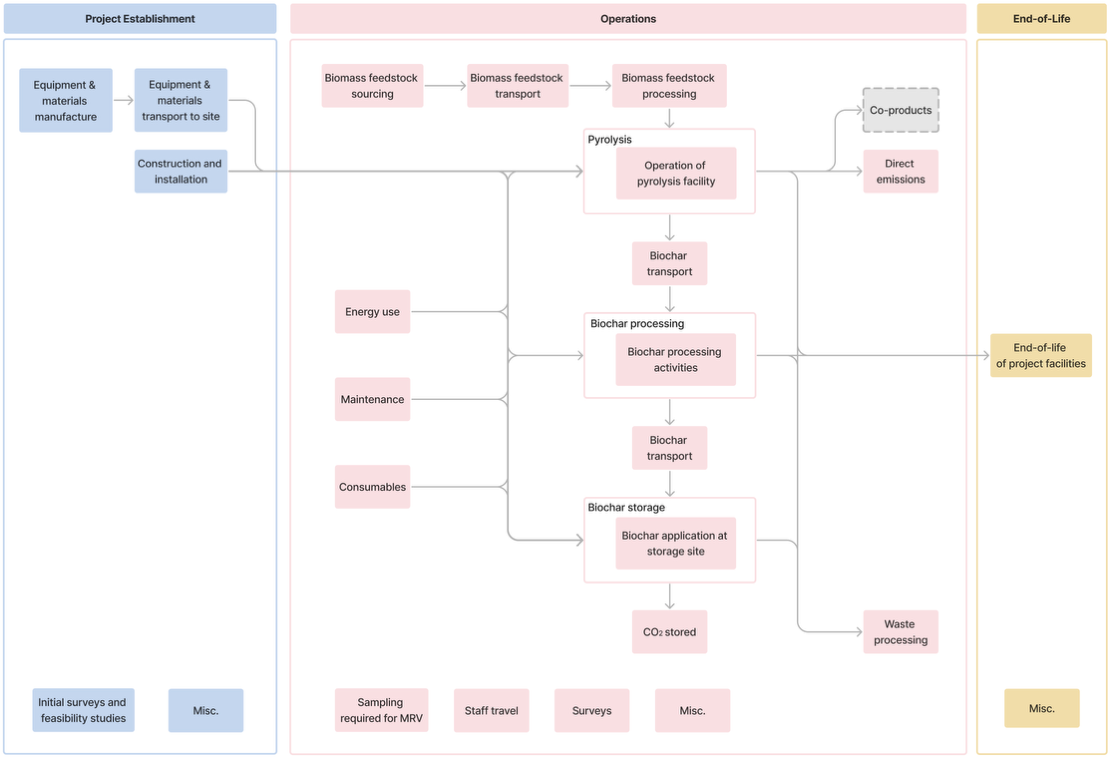
Figure 1: Process flow diagram showing system boundary for biochar projects.
2.2 Determining Long-Term Carbon Storage
Biochar does not store carbon permanently in a fixed way. Instead, the amount of stored carbon declines gradually over time. The protocol starts by measuring the amount of carbon at initial production and then estimates how that amount decreases using a decay-based modelling approach. Materials that are more stable lose carbon more slowly, while less stable materials decline more quickly.
The rate of decline depends on how the biochar is produced and what it is made of. For example:
- certain chemical properties indicate how stable the carbon structure is (hydrogen-to-carbon, H/C ratio),
- and production conditions such as temperature and residence time influence how that structure forms (higher temperatures and longer residence times generally promote the formation of these stable carbon structure).
Durability is also influenced by storage context. Biochar applied to soils, for example, may experience different degradation pathways compared to biochar stored in controlled environments. These factors must be considered when assigning durability timeframes and corresponding crediting periods.
2.3 Baseline and Counterfactual Storage
The baseline scenario assumes that biochar production does not occur. Moreover, the protocol refines this further by requiring estimation of counterfactual carbon storage. In many cases, biomass would not immediately release all its carbon even without the project. For example:
- woody biomass may decay slowly over years,
- some residues may be incorporated into soils,
- or biomass may enter alternative use pathways.
The portion of carbon that would have remained stored under these scenarios is excluded from crediting. This ensures that removal reflects additional storage created by the project rather than reclassification of existing carbon stocks.
2.4 Uncertainty, Sensitivity, and Conservative Quantification
Some inputs to the carbon removal calculation are inherently uncertain and cannot be measured precisely. This includes:
- laboratory measurements (e.g., carbon content, elemental composition),
- emissions estimates (e.g., methane release, fuel consumption),
- and modeled parameters (e.g., degradation rates, baseline assumptions).
Projects must test how sensitive the results are to these uncertainties. If small changes in an input lead to large changes in results, the estimates must be adjusted conservatively. Very small sources can be ignored, but larger ones must be included and justified. Projects are therefore required to:
- define parameter ranges representing plausible minimum and maximum values,
- and perform sensitivity analysis to determine which variables most strongly influence net removal.