Monthly: Methodology Updates (March)
This article is an automatically translated version of the original Japanese article. Please refer to the Japanese version for the most accurate information.
This is the Sustainacraft Inc. newsletter. Starting this month, we will deliver the following content once a month in the form of a **Monthly Update**:
- **Monthly Methodology Update**: Primarily an overview of revisions to VCS Methodologies.
- **Monthly VCM Update**: An overview of the Voluntary Carbon Market and international regulations.
This newsletter corresponds to the first item, the Monthly Methodology Update.
In conjunction with this, we recently launched two types of plans for this newsletter: free and paid. Going forward, the Monthly Update content and some individual articles will be included in the paid plan (academic institutions and NGOs/NPOs interested in subscribing to the paid version are encouraged to contact us individually).
Furthermore, we will be launching a new web service for Voluntary Carbon Credits at the end of this month, and its plan will include a subscription to this newsletter. Pre-registration is now open, so please feel free to contact us if you are interested. Our company website was also renewed recently.
Monthly Methodology Update
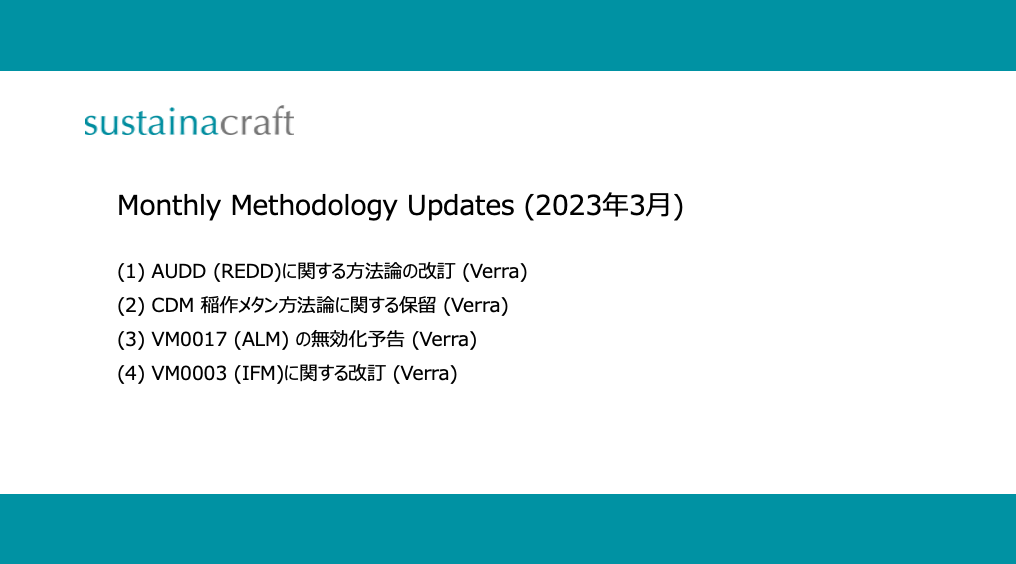
This month, we cover the following revisions:
(1) Revisions to AUDD (REDD+) Methodologies (Verra)
(2) Hold on CDM Rice Cultivation Methane Methodology (Verra)
(3) Notice of Invalidation for VM0017 (ALM) (Verra)
(4) Revisions to VM0003 (IFM) (Verra)
(1) Revisions to AUDD (REDD+) Methodologies (Verra)
(link)
A significant revision is underway to consolidate multiple AUDD Methodologies (VM0006, VM0007, VM0009, VM0015, VM0037) into a single methodology.
For AUDD in REDD+, a major point of discussion is how to establish the Baseline (the extent of Deforestation and Forest Degradation that would have occurred in the project area if the project had not been implemented). The Baseline is generally estimated as follows:
- Identify a Reference Area (Reference Region)
- Predict future trends based on past Deforestation trends in the Reference Region
- Prepare a risk map indicating areas with high Deforestation risk for each year within the area including the project area
- Integrate future predictions into the risk map
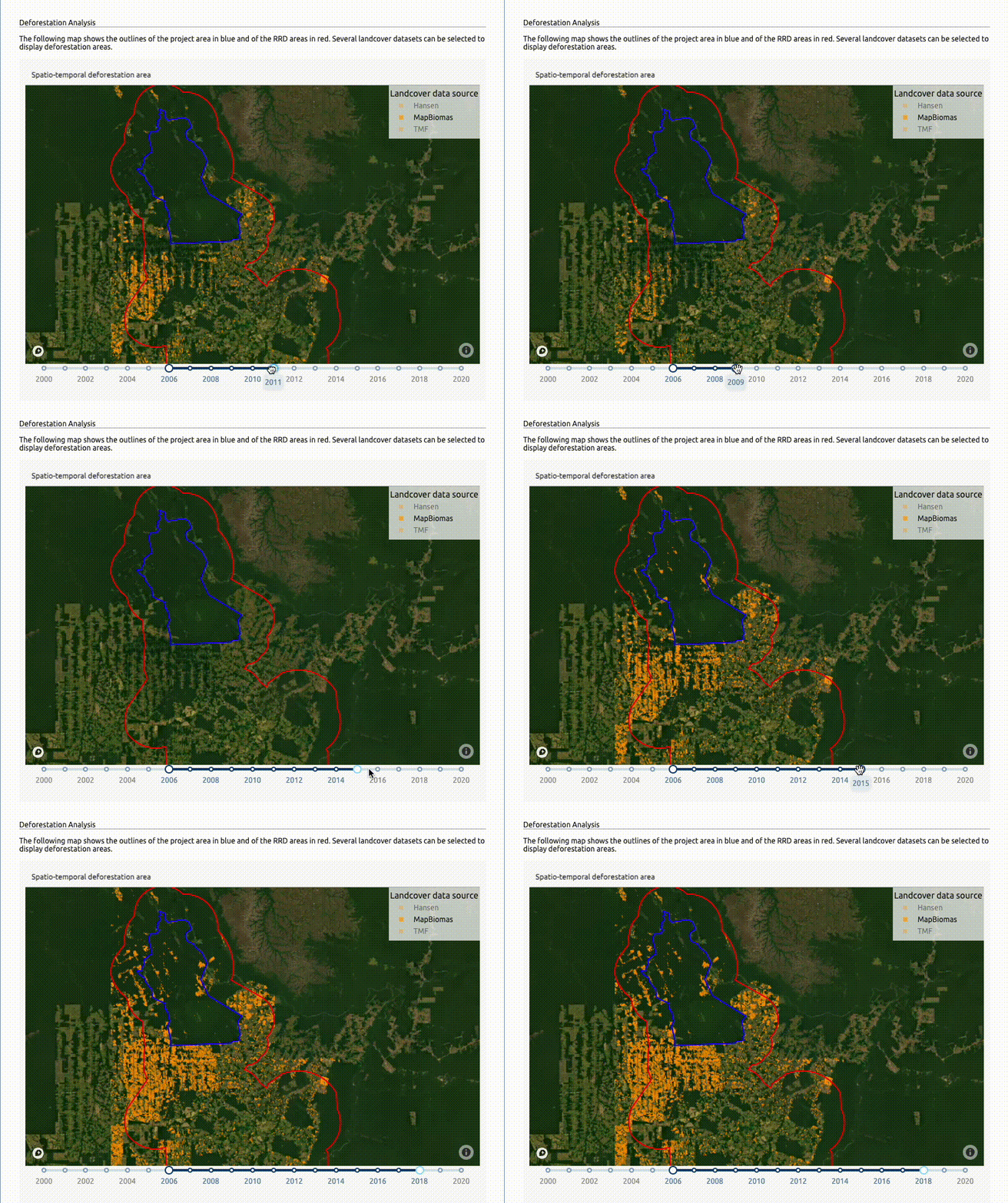
In the video below, blue represents the project area and red represents the Reference Area. The process described involves spatially and temporally predicting future outcomes based on the time-series changes in Deforestation shown here to calculate the Baseline.