
Monthly Methodology Updates (October)
This article is an automatically translated version of the original Japanese article. Please refer to the Japanese version for the most accurate information.
This is sustainacraft's newsletter. This edition is a Monthly Methodology Update, focusing on news primarily related to VCS Methodologies announced in October 2023.
Monthly Methodology Updates
This month, we cover the following topics:
- Release of a new ARR Methodology: VM0047 (Verra)
- First VCS Project using a new ALM Methodology completed Registration (Verra)
- Corrections and additional clarifications announced related to the VCS Standard (Verra)
- Verra's Response to Haya et al. (2023) (Verra)
- Verra's Response to the New Yorker article dated October 16, 2023 (Verra)
Regarding the Kariba (VCS902) project, please contact us separately if you are interested in a more detailed explanation of our views.
### (1) Release of a New ARR Methodology: VM0047 (Verra)
(link)
VM0047 Afforestation, Reforestation, and Revegetation, a significant revision to the ARR Methodology, was officially released last month. For the first time within a VCS Methodology, VM0047 adopts a method called Dynamic Performance Benchmark. This method is based on a causal inference technique called Matching, and estimates the Baseline using ex-post observations from Reference Areas outside the project. Furthermore, ex-post changes in vegetation are assumed to be monitored using satellite imagery.
Our newsletters have previously discussed the necessity of introducing causal inference approaches. Although there are differences between REDD and ARR, their fundamental concepts are shared. This appears to be an important revision aimed at reducing the survey burden on Project Developers while enhancing the reliability of the Baseline.
Below, we will explain some key concepts in VM0047 (the source of images and graphs is the Webinar slides).
#### Methodology Structure
Figure 1 below illustrates the structure of VM0047.
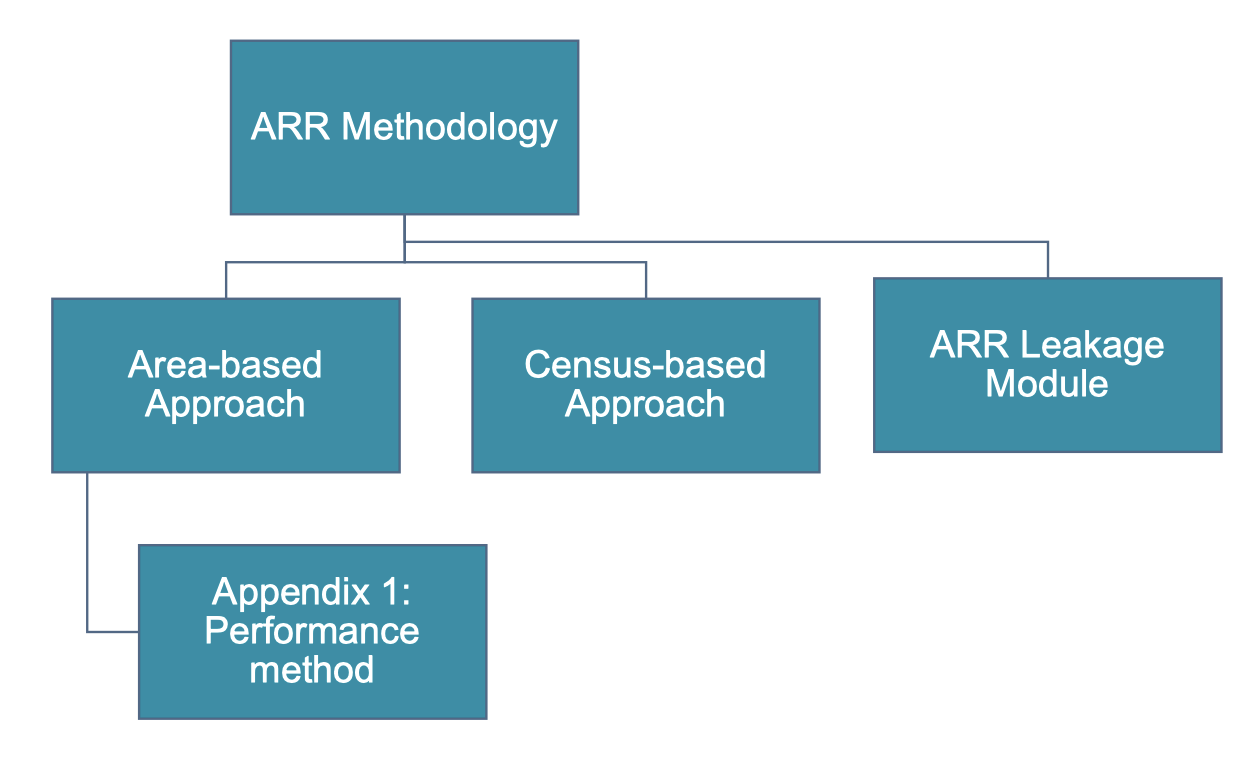
For calculating Baselines and Sequestration amounts, there are two types of approaches: Area-based approach and Census-based approach. The Area-based approach adopts the Dynamic Performance Benchmark, which is the main subject of this revision, and we will primarily explain this approach below. The Census-based approach is designed for small-scale landowners to perform simpler calculations, and it assumes on-site surveys. Under this approach, if certain conditions are met, the Baseline is considered zero (we will not cover the Census-based approach in this issue).
Regardless of which method is adopted, Leakage assessment is required, and this is detailed in the relevant module, VMD0054 Module for Estimating Leakage from ARR Activities. This will also be explained later.
As a note on its application, this Methodology does not cover projects in tidal wetlands, such as Mangrove reforestation. For projects in tidal wetlands, VM0033 Methodology for Tidal Wetland and Seagrass must be used. There are also other applicability conditions, but for details, please refer to the Methodology document itself.