December Monthly Methodology Updates
This article is an automatically translated version of the original Japanese article. Please refer to the Japanese version for the most accurate information.
This is the sustainacraft, Inc. newsletter. This edition provides Monthly Methodology Updates, focusing primarily on news related to Verra's Methodologies announced in December 2023.
Announcements
This is a re-announcement. We will be holding a webinar jointly with SDG Impact Japan on Tuesday, December 26th, starting at 13:00. Registration is still open, so please join us here if you are interested!

Monthly Methodology Updates
This month, we will introduce the following topics:
(1) Formal Release of the Consolidated REDD+ Methodology VM0048 (Verra)
(2) First Application of Paris Agreement Article 6 Labels to VCS Projects (Verra)
(3) Development of New Rice Methane Methodology Initiated (Verra)
(4) Other Updates on IFM and Monospecies ARR Projects with Non-Native Species (Verra)
(1) Formal Release of the Consolidated REDD+ Methodology VM0048 (Verra)
At the end of last month, the formal version of the Consolidated REDD methodology, which integrates multiple Methodologies related to REDD+ Avoided Unplanned Deforestation (AUD), was released as VM0048 Reducing Emissions from Deforestation and Forest Degradation, v1.0.
This is a highly impactful revision to existing REDD+ Methodologies, and we have introduced related information multiple times in previous editions of this newsletter.
While some parts may overlap with previous discussions, let's review the key points again in light of the formal release. The following content is primarily based on the Methodology document, Verra's FAQ, and an article by Trove Research.
First, the two particularly important changes in VM0048 are:
- Baseline calculations will be performed by Verra, not by the Project Developer.
- Baseline calculations will first be conducted at the jurisdictional level and then allocated to individual projects based on deforestation risk within that jurisdiction.
Under existing Methodologies, Baseline calculations were performed by individual Project Developers, which led to significant criticism regarding arbitrary Baseline setting. The limitations of accounting for Leakage at the individual project level were also pointed out. VM0048 aims to overcome these criticisms through the changes mentioned above. Furthermore, allocating Baselines at the jurisdictional level is important as it ensures consistency between the sum of individual project Baselines and the calculated values at the jurisdictional level.
Deforestation risk is estimated using activity data (deforestation data for a specific period) and auxiliary data related to deforestation. The preparation of activity data is progressing sequentially, and the status can be checked here. An allocation tool for assigning Baselines to individual projects is expected to be released around the first quarter of 2024.
Furthermore, the frequency of Baseline updates has been shortened from the previous 10 years to 6 years. While more frequent updates lead to more accurate assessments, they can also destabilize Project Developers financially due to constant changes, so the new setting aims to strike a balance.
Next, we will introduce three key points for understanding the implementation of VM0048.
Point 1) Currently only AUD projects are covered, but the scope will be expanded in the future.
As the heading indicates, currently, VM0048 applies only to Avoided Unplanned Deforestation (AUD) project types. For projects encompassing multiple types, only the AUD-related portion will be subject to the new Methodology. However, the scope is expected to gradually expand in the future.
Specifically, Verra plans to release a module for Avoided Planned Deforestation (APD) around 2024. Additionally, projects in wetlands are expected to be covered by updates to VM0033 and the tropical peatlands Methodology currently under development. These are being developed and revised in alignment with VM0048.
Ultimately, the goal is for VM0048 to cover all projects stipulated under VM0006, VM0007, VM0009, VM0015, and VM0037.
Point 2) All AUD projects, existing and new, must comply with VM0048.
All AUD projects are required to comply with VM0048 within a 6-month grace period after the activity data for the jurisdiction where the project is located becomes available. The fact that this applies retroactively to existing projects is a significant departure from previous Methodology changes.
Projects using VM0009 are particularly affected. Verra requires Project Developers to compensate for the difference if the Baseline is set lower than the existing one due to the transition to the new Methodology, using one of the following methods (Methodology document, p. 12):
Cancel credits that have not yet been sold or have not yet become active VCUs in the registry. If credits have already been sold (but not yet Retired), cancel them with the Buyer's consent.
Cancelation of VCUs from the project in the project proponent’s Verra Registry account that have not been used for offsetting purposes (“active VCUs”), or of already issued active VCUs where the project proponent gains the consent of the current owner
Allocate a portion of future Credit Issuances to compensate for the difference.
Replacement of the emission reductions through immediate cancelation from subsequent issuances of VCUs to the project
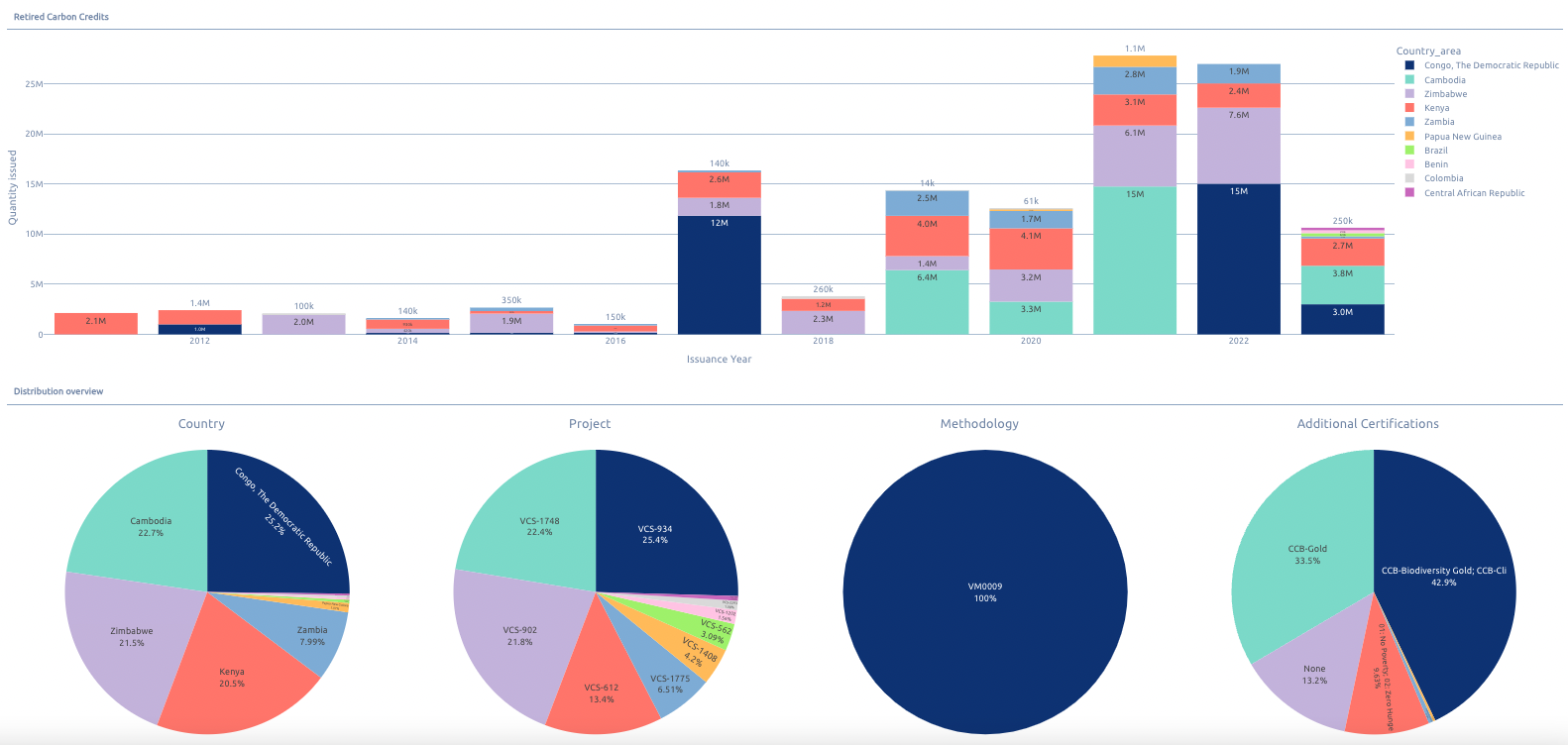
Currently, including those on hold, nine projects using VM0009 are registered, with a total of 124 million tonnes of Credits issued, and 53 million tonnes already Retired (the graph below shows the historical Issuance record).
A recently published study compared the Baselines calculated using existing Methodologies with those calculated using methods similar to VM0048 for the following four VCS projects: Agrocortex (VCS 1686), Tumring (VCS 1689), Kulera (VCS 1168), and Caribbean Guatemala (VCS 1622). As a result, the reduction volumes for Agrocortex significantly decreased from 2.7 million tonnes to 0.54 million tonnes (80% reduction), Tumring from 2.8 million tonnes to 1.9 million tonnes (32% reduction), and Caribbean Guatemala from 11 million tonnes to 0.7 million tonnes (94% reduction) (all units are CO2e). Conversely, Kulera reported a 65% increase from 3.1 million tonnes to 5.1 million tonnes.
While the aforementioned compensation rules currently apply only to VM0009, other AUD Methodology projects may also be affected in the future.
Point 3) VM0048 is not J-REDD+
J-REDD+ (Jurisdictional REDD+) is a related framework to VM0048. While both share the commonality of allocating Baselines at the jurisdictional level, it is important to note the difference: under VM0048, the implementing entity remains an individual project, whereas J-REDD+ involves national or sub-national jurisdictions as the primary entities managing the program.
However, VM0048 explicitly aims for consistency with J-REDD+. As mentioned above, while VM0048 generally uses Baselines calculated by Verra, it is also possible to use Baselines set as part of a J-REDD+ program by the country or sub-national jurisdiction where the project is located.
This point was also touched upon in our previous newsletter, so please refer to it as well.
Additionally, developments concerning ART, one of the J-REDD+ frameworks, are introduced below.