
Monthly Methodology Updates (January 2024)
This article is an automatically translated version of the original Japanese article. Please refer to the Japanese version for the most accurate information.
sustainacraft Inc. Newsletter. This month, there wasn't much news regarding VCS methodologies. Therefore, following our VCM Updates newsletter this month which focused on demand-side topics related to Biodiversity Credits, this Methodology Updates will also cover topics related to Biodiversity Credits (specifically trends in scheme development).
Monthly Methodology Updates
This month's content includes:
(1) Pilot launch for a remote sensing-based verification method for rice methane projects (Verra)
(2) Development trends of Biodiversity Credit schemes (Pollination)
(3) Plan to strengthen IFM methodologies disclosed (Verra)
(4) Call for public comments on minor revisions to IFM methodology VM0045 (Verra)
* (3) and (4) were briefly mentioned at the end of last month's issue, but will be elaborated on and reintroduced.
(1) Pilot Launch for a Remote Sensing-Based Verification Method for Rice Methane Projects (Verra)
(link)
Verra announced a collaboration with Mantle Lab, a UK startup, to review Validation/Verification results for rice paddy management projects using Remote Sensing technology.
The pilot targets five registered projects selected from those using the CDM methodology AMS-III.AU. The main objective of these projects is to reduce methane emissions by extending the mid-season drainage period in rice paddies.
The purpose of this pilot is to objectively evaluate existing rice paddy management practices and whether projects are being managed as planned, using Remote Sensing for monitoring, thereby ensuring the validity of Validation/Verification.
As introduced in previous newsletters, we would like to reiterate the background to this news.

Issues related to the content and operation of AMS-III.AU had been raised (quotes below are from the aforementioned newsletters):
Regarding Content
Insufficient guidance on land stratification
Insufficient consideration and monitoring methods for Nitrous Oxide emissions and changes in Soil Organic Carbon accumulation
Lack of standardized guidance for methane measurement
Regarding Operation
Potential failure to meet regulatory surplus requirements
Many projects skip common practice analysis for Additionality
In addition, a review of VVBs involved in AMS-III.AU projects revealed the existence of VVBs with issues concerning the reliability of results, and a list of these was published.
In response, Verra permanently ceased the use of AMS-III.AU and halted consideration of AMS-III.AU projects involving the problematic VVBs (link). Furthermore, for AMS-III.AU projects that requested listing on the registry by February 3, 2023, and were not involved with the aforementioned VVBs, Verra required Validation to be completed by September 20, 2023, and for any identified issues to be addressed appropriately.
This latest news involves objectively conducting Validation for projects that completed Validation by September 20 using Remote Sensing technology. While this pilot's scope is limited to five sampled projects, Verra states that consideration and Credit Issuance for all the above projects will be halted until all potential issues discovered during this process are resolved, and similar measures are completed for the remaining projects.
Actively utilizing external objective data sources such as Remote Sensing to ensure project transparency is consistent with our company's initiatives, and we believe it is important to continue to actively promote this.
(2) Development Trends of Biodiversity Credit Schemes (Pollination)
(link)
We introduce a report on trends in Biodiversity Credits published by Pollination Group in October 2023.
Since 2020, following the establishment of international standards such as TNFD (Taskforce on Nature-related Financial Disclosures), SBTN (Science Based Targets Network), and the Kunming-Montreal Post-2020 Global Biodiversity Framework, numerous initiatives for developing Biodiversity Credit schemes have been launched (see figure below).
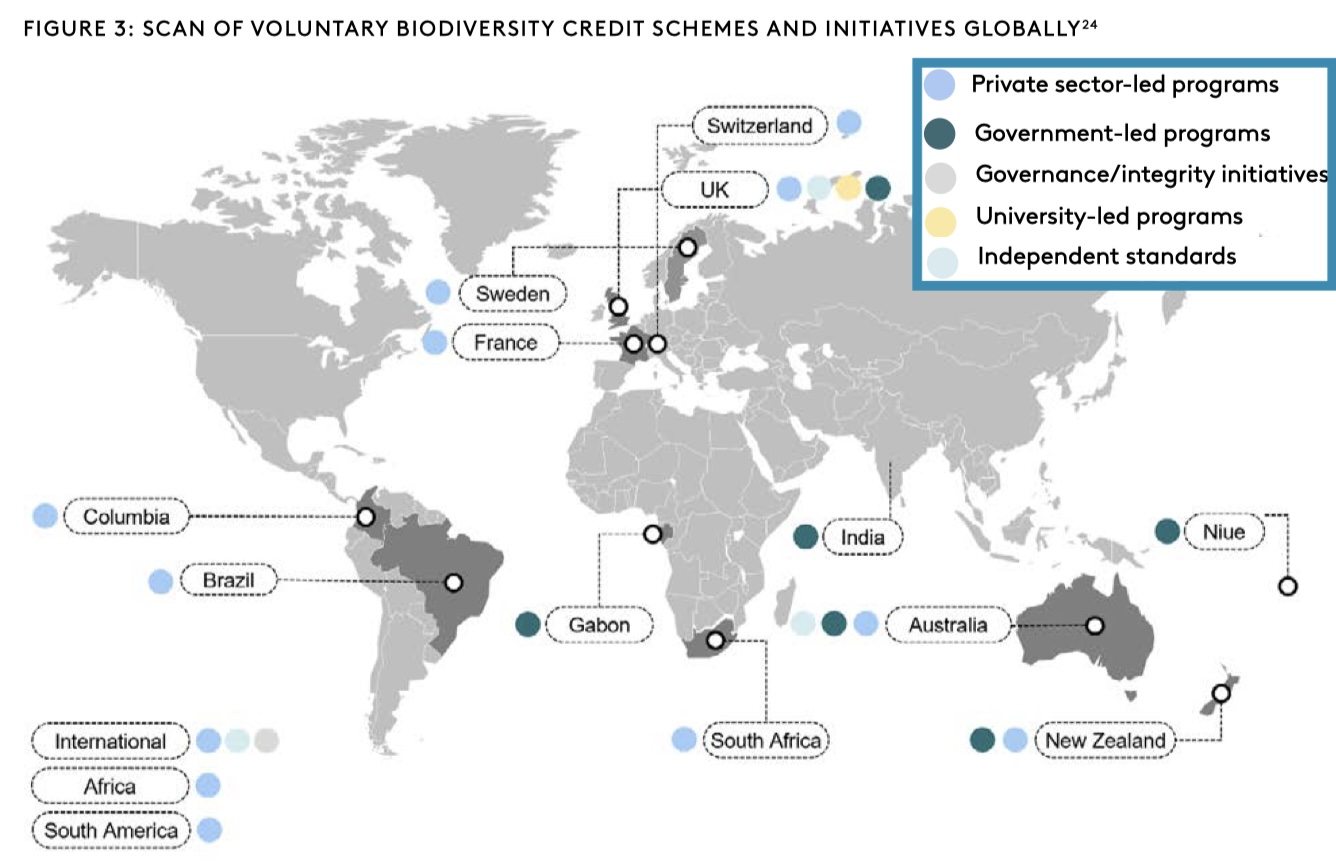
While the increase in Biodiversity Credits itself is welcome, some schemes have unclear transparency and technical requirements, necessitating careful handling.
This report reviews currently developing and operating Biodiversity Credit schemes, presenting 1) four perspectives useful for analyzing these schemes, and 2) an outlook on future development directions.
Below, we will briefly introduce these two points. Additionally, we would like to touch upon the technical challenges of methodologies that are not extensively discussed in the report.