
Monthly Methodology Updates (March 2024)
This article is an automatically translated version of the original Japanese article. Please refer to the Japanese version for the most accurate information.
This is Sustainacraft Inc.'s newsletter. This issue primarily focuses on the new Methodology for mangrove afforestation projects currently under development by Gold Standard. Recently, interest in mangrove afforestation projects, especially among Removal / Sequestration-based Carbon Credit projects, has surged, with Credits from high-quality projects reportedly trading at premium prices. While our previous coverage has mostly featured Verra's Methodologies, we believe that understanding diverse Methodologies can broaden one's perspective on Carbon Credit quality. We will also briefly share a few updates related to VCS Methodologies.
Monthly Methodology Updates
This month, we will cover the following topics:
(1) Call for public comments on the new mangrove Methodology (Gold Standard)
(2) Disclosure of project processing times and setting of target values (Verra)
(3) Integration of SOC analysis tools into ALM Methodology (Verra)
Call for public comments on the new mangrove Methodology (Gold Standard)
(link)
Gold Standard is inviting public comments on its "Methodology for sustainable management of mangroves v1.0," a Methodology for mangrove afforestation projects currently under development, from March 7 to April 5, 2024.
While mangrove afforestation is covered by Gold Standard's existing ARR (Afforestation, Reforestation and Revegetation) project Methodology, Methodology for A/R Greenhouse gases (GHGs) Emission Reduction and Sequestration v2.0 (hereinafter referred to as the A/R Methodology), the goal appears to be to develop a specialized Methodology that considers conditions specific to mangroves. A key point is the proactive use of Remote Sensing data, driven by the understanding that for mangrove afforestation, 1) identifying eligible areas for planting is crucial, and 2) access within the forest becomes difficult after growth, leading to a high burden for field surveys.
Below, we will describe the characteristics of this new Methodology, focusing on the two points mentioned above, while also comparing it with Verra's mangrove project Methodology, VM0033 Methodology for Tidal Wetland and Seagrass Restoration, v2.1.
(All quotes and images for which no specific source is given are from the Methodology document linked at the beginning.)
Identifying Eligible Areas for Planting
This Methodology targets the afforestation of native mangrove species or species deemed equivalent:
Eligible activities include:Reforestation (planting) of native mangrove trees.Reforestation (planting) of mangrove-associate tree species that have been identified as historically related to native mangroves in the project area (based on peer-review information, global datasets or participatory historical land-use analysis).
Therefore, planting is restricted to land where natural mangrove forests historically existed.
This Methodology introduces four land-related concepts:
Project area: The area under the control of the Project Developer / Proponent. It is divided into eligible areas and non-eligible areas.
Eligible areas: Areas within the project area suitable for planting.
Non-eligible areas: Areas within the project area unsuitable for planting.
Reference area1: An area where natural mangrove forests existed at least 10 years prior to the project start. Must include eligible areas within the project area.
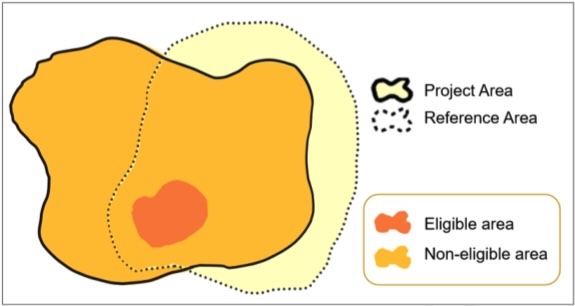
Remote Sensing data is used to identify eligible areas. Specifically, the following five steps are executed.