
Consideration of Albedo Change in Revegetation Projects
This article is an automatically translated version of the original Japanese article. Please refer to the Japanese version for the most accurate information.
This is a newsletter from sustainacraft Inc.
Methodology Updates is a series that covers carbon and biodiversity credit methodologies. This article introduces an article published by the carbon credit standard Isometric on considering albedo in reforestation projects, and the research behind it.
For inquiries, please contact us here.
(Source: Isometric Blog: Why albedo matters for reforestation projects,
Hasler et al. (2024): Accounting for albedo change to identify climate-positive tree cover restoration. Unless otherwise specified, the information source is this article and paper.)
Introduction
Forests have garnered significant attention in carbon markets as a means to absorb and sequester Carbon Dioxide (CO2) from the atmosphere. However, the impact of forests on the climate extends beyond just carbon sequestration. Forests also play a crucial role in surface energy and water cycles. Among these feedbacks, albedo change has recently gained particular attention. The carbon credit standard Isometric recently published an article introducing its incorporation of albedo change as an eligibility requirement in its reforestation and agroforestry protocols, and the rationale behind it. This article will introduce Isometric's initiatives and the research that underpins their decisions. Please also refer to the following newsletter for information on the agroforestry protocol mentioned above.
 sustainacraft Newsletter
What is Albedo?
Albedo refers to the proportion of solar energy that reaches the Earth's surface and is reflected back into space. Generally, light-colored surfaces (such as snowfields, deserts, and bare ground) have high albedo, reflecting a large portion of solar energy. Conversely, dark-colored surfaces (such as forests) have low albedo, absorbing more solar energy. Since absorbed energy is converted into heat, a low albedo (meaning more solar energy absorption) tends to increase Earth's temperature. This is the same principle as feeling hotter when wearing dark clothes on a warm day.
Impact of Reforestation on Albedo
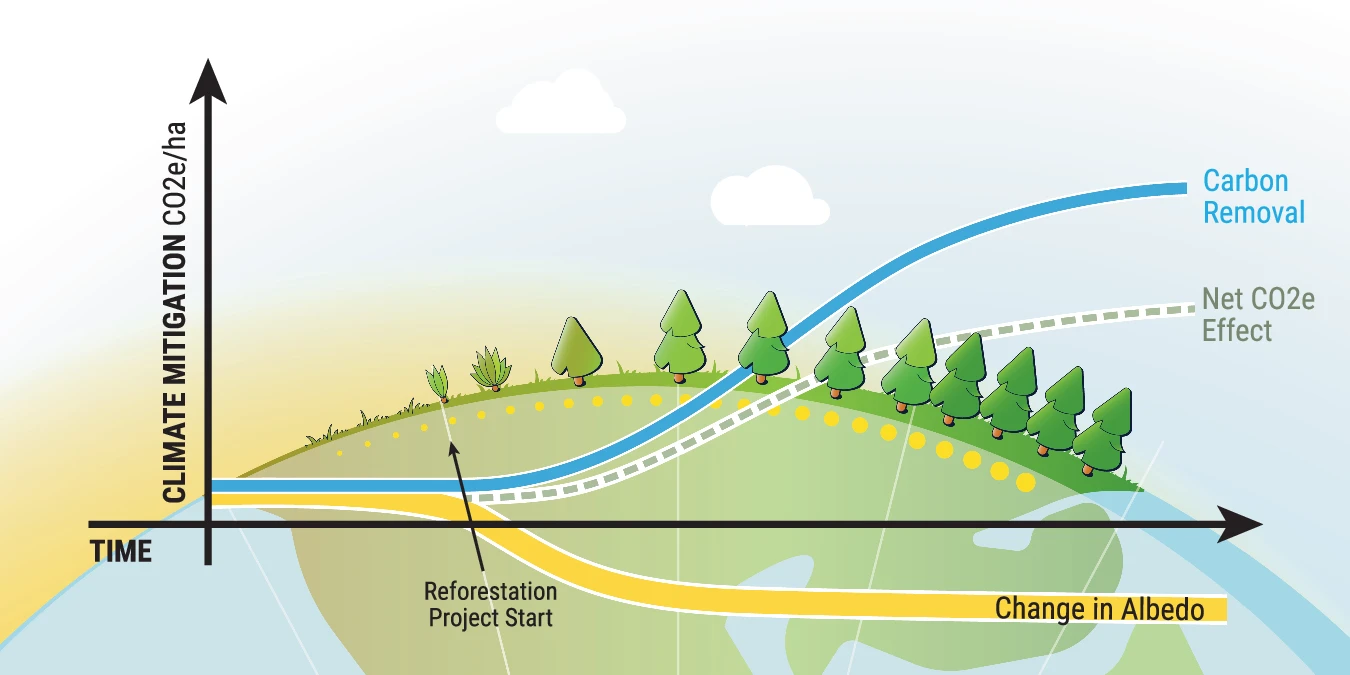
In reforestation projects, trees are planted on grasslands, bare ground, or snow-covered land. Forest canopies are often darker than these surfaces, so reforestation darkens the land surface, leading to the absorption of more solar energy. This effect contributes to warming.
In other words, while reforestation provides a cooling effect by absorbing CO2, it simultaneously creates a warming effect due to decreased albedo. The actual contribution of a project to climate change mitigation depends on the balance between these two effects. The study by Hasler et al. (2024), discussed later, reports that in up to 16% of the reviewed reforestation projects, albedo change could potentially completely offset the cooling effect from carbon sequestration.
Reforestation's Climate Impact is Not Limited to Albedo (Supplement)
As a supplement, it should be noted that reforestation has multiple climate impacts beyond albedo, and the actual situation is quite complex. For example, forests release water vapor into the atmosphere through evapotranspiration, influencing cloud formation and precipitation patterns. Xu et al. (2022) globally analyzed the impact of forests on cloud cover using satellite data, showing that its effects vary significantly by region. While clouds tend to increase over temperate and boreal forests, a contrasting pattern of cloud reduction has been observed over forests in the Amazon, Central Africa, and the southeastern United States. Increased cloud cover provides a cooling effect by reflecting sunlight, but decreased cloud cover conversely contributes to warming. It is important to note that a comprehensive assessment, including the impacts of these non-radiative processes, is not yet fully established in current science.
Isometric's Approach to Albedo Consideration
Isometric is the first certification body to introduce albedo change as an eligibility requirement in its reforestation protocols. Their approach is based on the following three principles:
1. Mitigating climate change
The ultimate goal of Carbon Credit projects is climate change mitigation. Isometric's policy is to issue Removal Credit certificates only to projects that have a net cooling effect on the overall climate. If the warming effect from albedo change is predicted to completely offset the cooling effect from carbon sequestration, it is difficult to say that the project contributes to climate change mitigation, and therefore such areas cannot be included in the project.
2. Globally accessible but locally relevant
Isometric's approach utilizes the global dataset developed by Hasler et al. (2024), which will be discussed later. This dataset characterizes the net climate impact, considering both carbon sequestration and albedo change due to reforestation. Isometric has integrated this dataset into a tool called Area Suitability Check, allowing Project Developers to instantly verify if any areas are predicted to have a net warming effect by simply uploading their project boundaries.
However, it is recognized that global datasets may not always adequately address areas with complex topography or diverse land cover. Therefore, the reforestation protocol also allows for demonstrating a positive climate effect based on regional or local scientific evidence. Even if the initial screening indicates net warming, there is a mechanism to verify whether the land cover changes modeled by the Hasler data adequately represent the project site and to refine the analysis as needed.
3. Evolving with the science
Given the utilization of the latest peer-reviewed datasets, the existence of scientific uncertainty is also acknowledged. In the initial screening using the Hasler et al. dataset, Isometric sets uncertainty-aware thresholds for each ecosystem type. This ensures that only areas where climate benefits from carbon sequestration are strongly suggested to be fully offset by albedo change are excluded from operation. Going forward, as new research and data become available, the approach will be re-evaluated and refined to include feedbacks beyond albedo.
Market Trends
Isometric's initiatives align with requests from the scientific community and demand within the market. The Symbiosis Coalition, a Buyer group focused on nature-based Carbon Removals, has also made a similar decision to include albedo effects in its project quality criteria.
Introduction to the Research Estimating Albedo Change: Hasler et al. (2024)
From here, we will introduce in more detail the content of Hasler et al. (2024): Accounting for albedo change to identify climate-positive tree cover restoration (Nature Communications), which forms the basis for Isometric's albedo consideration.