
October 2024 Methodology Updates (2/n)
This article is an automatically translated version of the original Japanese article. Please refer to the Japanese version for the most accurate information.
sustainacraft Inc. newsletter.
Methodology Updates is a series covering methodologies for carbon and biodiversity credits. In this article, following on from the previous one, we will introduce the draft content of Version 5, a major update to Verra's VCS Standard.
This time, we will focus on 1) strengthening safeguards and stakeholder engagement requirements, and 2) transparency and data. In particular, the proposal for "Credit Issuance through Digital Measurement, Reporting, & Verification (DMRV)" within section 2) seems to have a significant impact on both Project Developers and investors. Carbon Credit Issuance is fundamentally based on results (result-based payment). Therefore, currently, each time Credit Issuance is applied for, a process involving field surveys (Measurement), compiling results into a Monitoring Report (Reporting), and having it Verified separately by a third-party organization (Verification) is required. This series of processes is time-consuming and costly, so many projects issue Credits at a frequency of approximately once every 3-5 years. The idea of DMRV is to reduce the burden of field surveys by utilizing Remote Sensing and other technologies, allowing for more frequent (e.g., monthly) and lower-cost Credit Issuance. If this is realized, Project Developers would see a reduction in operational financing barriers, and investors could benefit from shorter payback periods.
Please contact us here for inquiries.
Initial Public Consultation on the Major Update to the VCS Standard (Continued) (Verra)
(Source: Initial Consultation on Version 5 of the VCS Program, accessed October 23, 2024; unless otherwise specified, image sources are from the linked document)
Below is an overview of the changes being considered in this draft. As this is a major update, the items cover a wide range of topics. For basic information regarding this draft, please refer to our previous newsletter.
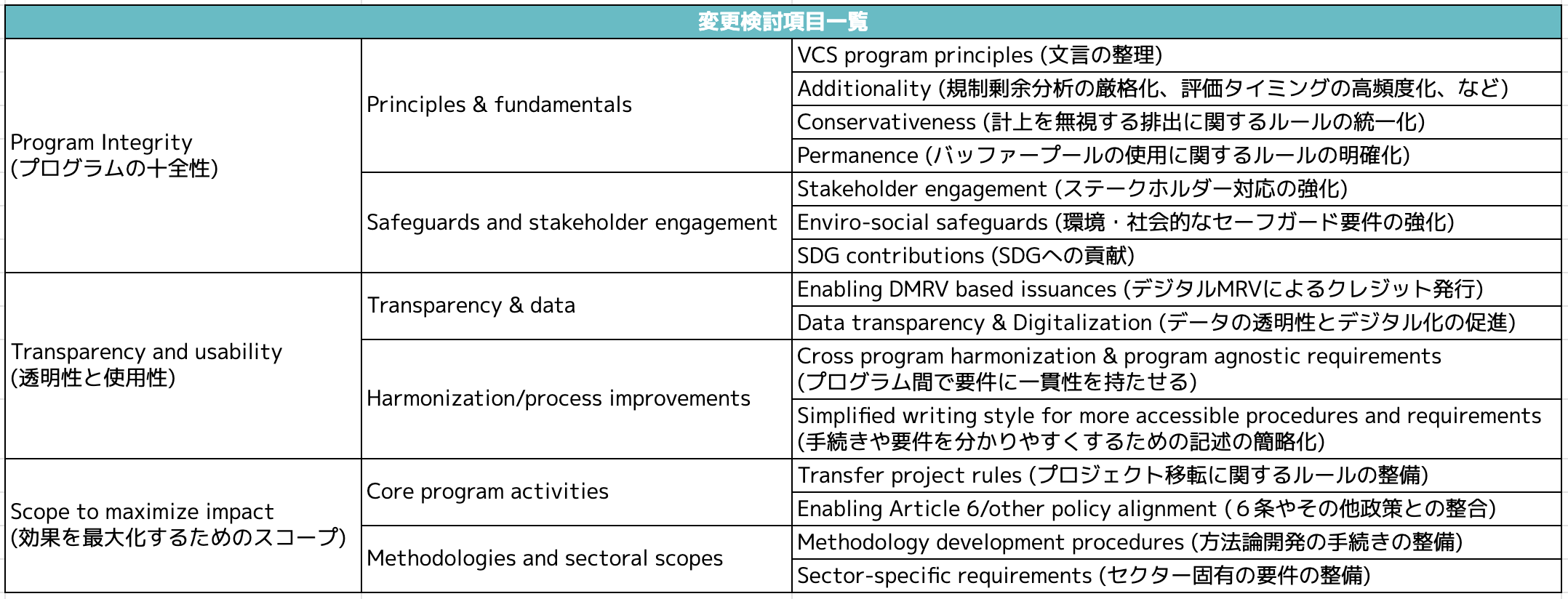

As mentioned at the outset, this newsletter will primarily focus on the proposed content within the "Safeguards and stakeholder engagement" and "Transparency & Data" sections.
Introduction to Proposed Content Regarding "Safeguards and Stakeholder Engagement"
The following four items are being considered in the Safeguards and Stakeholder Engagement section:
- 2.1 Strengthening Stakeholder Engagement
- 2.2 Strengthening Social and Environmental Safeguards
- 2.3 Clarifying Contribution to SDG Goals
- 2.4 Promoting Participation of Small-scale Projects
Below, we will introduce details on (2.2) Strengthening Social and Environmental Safeguards and (2.4) Promoting Participation of Small-scale Projects, which involve relatively significant changes.
(2.2) Strengthening Social and Environmental Safeguards
From 2023 to 2024, Verra has strengthened its safeguard standards, primarily with a focus on addressing the CCP and CORSIA. However, recognizing that there is still room for improvement, this update will introduce several additional requirements related to safeguards. Broadly, these are divided into social safeguards and environmental safeguards.
Social Safeguards
Below is a summary of the revised items concerning social safeguards. Benefit Sharing, respect for human rights and equity, and property rights are already described in the existing VCS Standard Version 4.7, but the requirements are being further clarified. Meanwhile, language, just transition, and armed personnel are newly introduced items.
Language
Require submission of a summary of project documents in commonly spoken local languages.
Also specify sections of the project description and Monitoring Report that must be included in the summary.
Benefit Sharing
Define Benefit Sharing as the distribution of monetary or in-kind benefits from Credit sales revenue.
Require a Benefit Sharing mechanism that includes all stakeholders whose property rights or customary rights are affected by the project.
Respect for Human Rights and Equity
Specify the types of information sources and evidence to be specifically used in conducting risk assessments.
Property Rights
Specify the types of evidence required to demonstrate that no transfer of property or loss of other rights has occurred.
Just Transition
Require prevention of job losses and assurance of fair alternative employment (e.g., employee transition plans, compensation for external dependents, mandatory skill enhancement).
Armed Personnel
Establish provisions regarding the operation of armed personnel (e.g., armed rangers in protected areas).
Specifically, establish policies concerning rules of engagement, appropriate training, legitimate use of force and de-escalation responses, reporting provisions for misuse of force, background checks, standards for physical and psychological stability, and restrictions on the use and deployment of weapons.