
November 2024 Methodology Updates (1/n)
This article is an automatically translated version of the original Japanese article. Please refer to the Japanese version for the most accurate information.
This is a newsletter from Sustainacraft Inc.
Methodology Updates is a series focusing on carbon and biodiversity Credit Methodologies. This article introduces research on a new leakage assessment method for IFM projects.
Earlier this month, a webinar hosted by Renoster was held, focusing on a new leakage assessment framework being developed by researchers from the University of Maine and The Nature Conservancy in North America ([1]). This newsletter will primarily explain the research ([2]) that formed the basis of that webinar, and the background of existing methodologies' leakage assessment.
In the context of Credit quality assessment, leakage assessment has continuously received relatively less attention compared to Baseline and Additionality. There are two types of leakage: Activity Shifting, where production activities shift to spatially adjacent surrounding areas, and Market Leakage, which occurs elsewhere through the market. Most methodologies have assessed only the former, Activity Shifting, using simplified methods.
However, with the introduction of an approach that also considers Market Leakage (albeit with rather broad assumptions) in Verra's ARR Methodology VM0047, published in September 2023, discussions have begun to advance towards improving leakage assessment methods in IFM as well. The research introduced here presents initial results, and it seems it will take some time for it to be actually incorporated into methodologies. However, for IFM, where economic activities fundamentally exist in the Baseline, leakage assessment is, in a sense, an item with even greater impact than ARR. We hope this article will serve as an opportunity to draw attention to leakage.
For inquiries, please contact us here.
Research Towards Improving IFM Leakage Modules
*The sources of information referenced this time are as follows.
- [1] Daigneault et al. "Understanding Leakage in Forest Carbon Projects: Insights from the Global Timber Model", Webinar, hosted by Renoster, November 7, 2024. https://www.youtube.com/watch?v=DWkIEhYyzN0
- [2] Daigneault et al. "A Global Assessment of Regional Forest Carbon Leakage." Research Square, 2023, https://doi.org/10.21203/rs.3.rs-3596881/v1 (preprint).
- [3] Verra. "VM0045 Methodology for Improved Forest Management Using Dynamic Matched Baselines from National Forest Inventories, v1.1." Last modified March 12, 2024. https://verra.org/methodologies/methodology-for-improved-forest-management/.
- [4] Verra. "VMD0054 Module for Estimating Leakage from ARR Activities, v1.0." Last modified September 28, 2023. https://verra.org/methodologies/vmd0054-module-for-estimating-leakage-from-arr-activities-v1-0/.
What is Leakage?
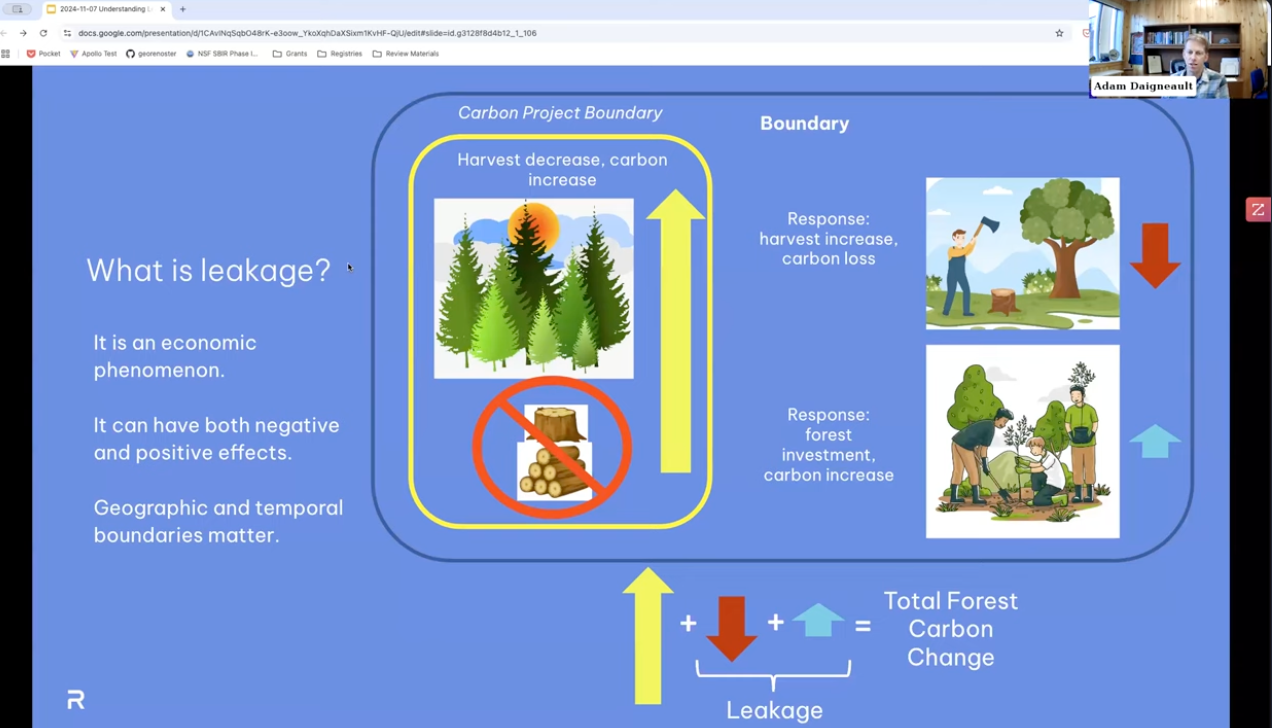
First, let's briefly review what leakage is. Leakage refers to unintended changes in carbon stock outside the project area caused by project activities1. In the context of IFM, an example would be extending the rotation period, which reduces timber supply. To compensate, additional alternative production occurs elsewhere, leading to a decrease in forest carbon stock in that location. This is an example of a negative impact. Conversely, there can also be positive impacts, such as when project activities raise awareness of forest protection, mitigating the speed of forest degradation in areas surrounding the project. To accurately assess the project's effectiveness, it is necessary to consider not only changes in carbon stock within the project area but also the impact of leakage.
How is leakage considered in current methodologies? As an example, we will introduce the approach in Verra's latest IFM Methodology VM0045 ([3]) below (the basic approach is similar in methodologies from other registries like American Carbon Registry and Climate Action Reserve). Additionally, for reference, we will explain the ARR Methodology VMD0054 ([4]; a leakage module associated with VM0047).