
November 2024 VCM Updates: Section B (1/n)
This article is an automatically translated version of the original Japanese article. Please refer to the Japanese version for the most accurate information.
This is the newsletter from sustainacraft Inc. This article is Section B (Trends in major overseas regulations) of VCM Updates (Voluntary Carbon Market Updates).
This article introduces the following paper:
- Paper Introduction: Systematic assessment of the achieved emission reductions of carbon crediting projects
Paper Introduction: Systematic assessment of the achieved emission reductions of carbon crediting projects
(link)
We introduce a review paper on the over-Issuance of Carbon Credits by researchers affiliated with institutions such as the Max Planck Institute.
A paper systematically reviewing various types of Carbon Credit projects, including REDD+, Cookstoves, and renewable energy, has been published and is gaining some attention in the industry. While it systematically organizes various issues previously pointed out in carbon projects, we believe that some parts require careful interpretation, given the small number of references for a review paper. Therefore, we would like to explain its contents.
(Unless otherwise specified, images below are cited from this paper.)
<Paper Summary>
The summary of this paper is as follows:
- Analyzed 14 studies across multiple project types (forest management, wind power, Cookstoves, etc.) and 51 similar intervention cases without Credit Issuance.
- Estimated that less than approximately 16% of issued Credits contributed to actual Emission Reductions.
- Listed causes such as convenient data selection by Project Developers, unrealistic assumptions, and inappropriate Methodologies.
- Pointed out the necessity for fundamental reform of the Carbon Credit system.
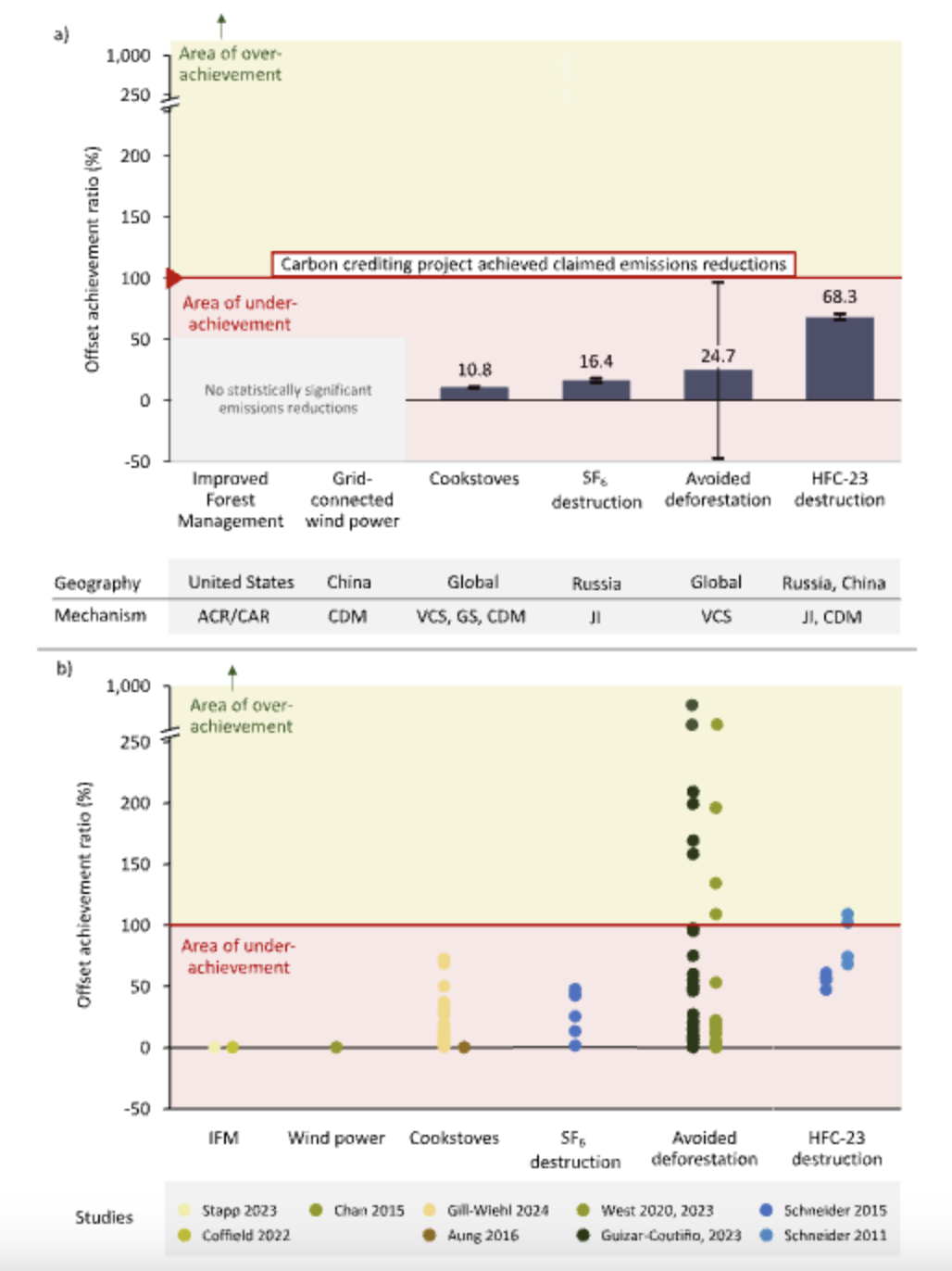
The paper evaluates the effectiveness of the Carbon Credit system, focusing on whether issued Credits actually lead to Emission Reductions. The paper introduces a metric called **Offset Achievement Ratio (OAR)**, comparing Emission Reductions calculated based on academic evaluations with those calculated by Project Developers for Credit generation. In this paper, an OAR of 50% means that only half of the Emission Reductions claimed by Project Developers and issued as Carbon Credits are estimated to have been actually achieved.
The paper analyzes approximately 1 billion tons of Credits, representing about one-fifth of the Credits issued by major international and independent Carbon Credit schemes. As a result, it is estimated that less than 16% of the Carbon Credits issued for the projects studied correspond to actual Emission Reductions. By project type, OAR is 11% for Cookstoves, 16% for SF6 destruction (capture and destruction of SF6 waste gas in sulfur hexafluoride production), 25% for Avoided Deforestation, and 68% for HFC-23 destruction (recovery and destruction of HFC-23 generated as waste gas during chlorodifluoromethane production). It points out that no statistically significant Emission Reductions are observed for wind power and IFM projects, meaning their OAR is 01.
<Interpretation>
Before moving to a detailed explanation, we will provide our interpretation of this review paper. In this newsletter, we have previously explained criticisms and issues related to Carbon Credits for each activity type, such as REDD+ and IFM. However, there are few other academic papers that systematically analyze multiple projects in this manner, and in that sense, we found it to be a very valuable document.
On the other hand, as explained below, for REDD+ for example, only two references are cited, and these two references show significant differences in OAR for the same project, making it difficult to draw conclusions from them. The difference in OAR stemming from REDD+ Baseline setting can also be said to inherently illustrate the difficulty of counterfactual Baseline setting.
In reality, the climate change effect is the same for Avoidance and Removal/Sequestration, but we believe the tendency to emphasize Removal/Sequestration is due to this point. Regarding this discussion, we explained it in a recent article, so please refer to it as well.

The conclusion states, "The results of this study corroborate doubts about the environmental quality of Carbon Credits from the project types investigated." However, similar to the discussion paper released by SBTi around July (for details, please refer to this seminar archive and others), there is no mention of subsequent discussions and major revisions to Methodologies. While it serves as a good review of past literature, we point out that it overlooks various improvements that have already been implemented. However, this does not seem to be the fault of the researchers who authored this paper.
This review paper was published in July 2023, but actually appeared in print in November 2024. The time lag between the peer-review process in academia and the real-world discussions and subsequent revisions may be problematic. In the rapidly evolving field of computer science, unreviewed preprints and conference proceedings are also highly valued. We feel that academia should also consider releasing findings in climate science not only through peer-reviewed journals but also in a more timely manner, such as through preprints.
<Reasons for Low OAR in Each Category>
An analysis of the factors causing over-Issuance is presented for each activity type. Here, we focus on Improved Forest Management (IFM) and Avoided Deforestation (which is sometimes referred to as "REDD+" hereinafter) from the activity types, and for reference, we describe "what is claimed in the paper" versus "what is already being done in the carbon market to address it."