
June 2024 VCM Updates: Section A
This article is an automatically translated version of the original Japanese article. Please refer to the Japanese version for the most accurate information.
For inquiries, please contact us here.
«VCM Updates Structure»
A. Voluntary Carbon Market Trends ← Focus of this article
- Credit Issuance and Retirement Analysis
- Project Pipeline Analysis
B. Major International Regulatory Trends
A. Voluntary Carbon Market Trends (Verra)
A-1: Credit Issuance and Retirement Trends
- Registries covered: Verra, GS (Gold Standard), CAR (Climate Action Reserve), ACR (American Carbon Registry)
- Period covered: May 2024
- Disclaimer: Please note that companies that retired credits are not obligated to register their real names with the registries, so accuracy cannot be guaranteed. Also, starting this month, what was previously referred to as AFOLU (Agriculture Forestry and Other Land Use) is now expressed as "Nature-based."
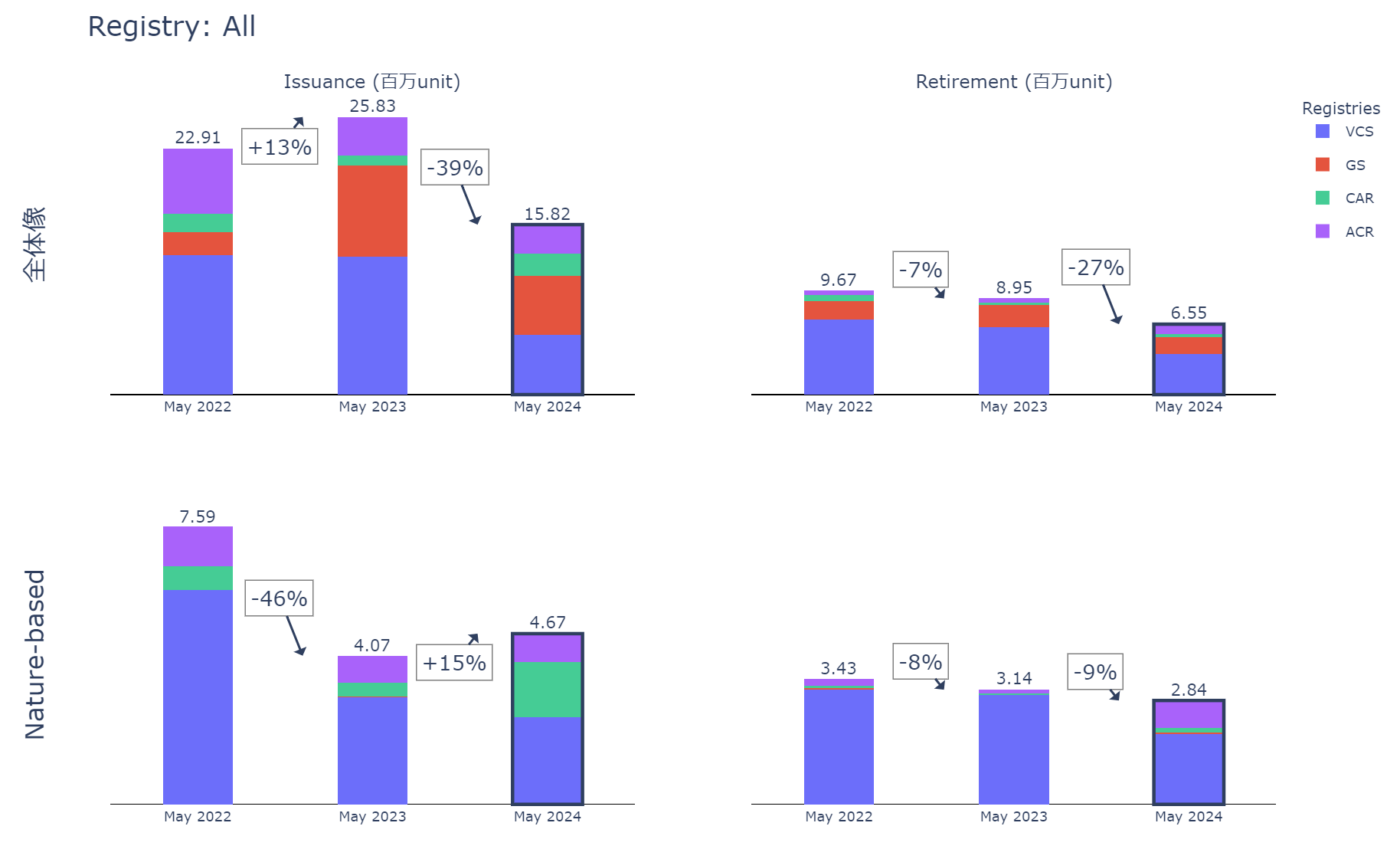
Issuance and Retirement performance for the period covered are as follows (figures in parentheses indicate year-on-year change).
- Issuance: 15.82 million (-39%), of which Nature-based 4.67 million (+15%)
- Retirement: 6.55 million (-27%), of which Nature-based 2.84 million (-9%)
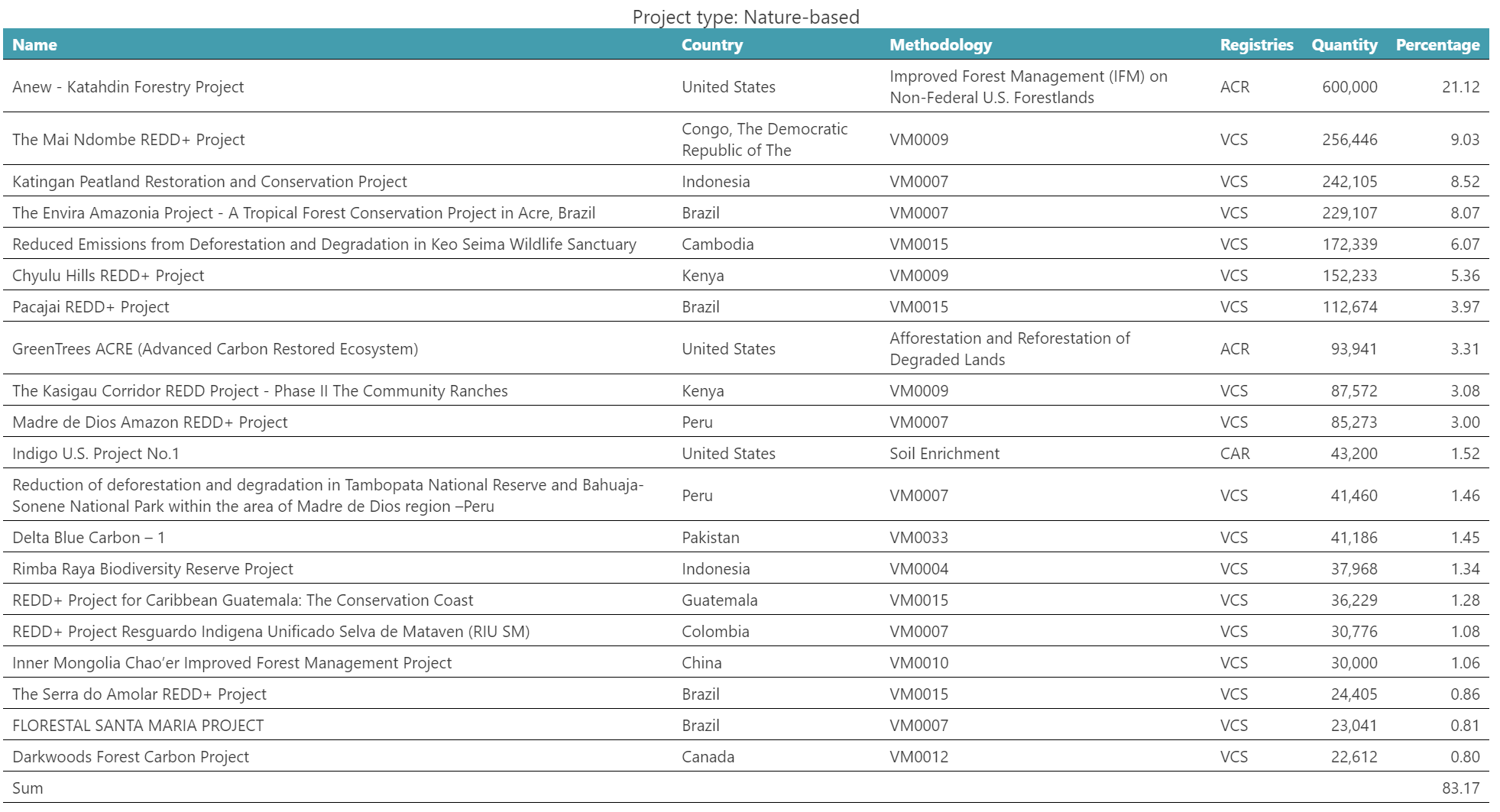
The list of Nature-based projects retired during the period covered is as follows. The top 20 projects account for approximately 83% of total Retirement.
The first project, Katahdin Forestry Project (accounting for 21% of Retirement volume), is a U.S. IFM project by Anew Climate. IFM projects generally have both Removal and Avoidance Reduction effects. An operation has begun in each registry to clearly assign a "Removal" label to the overall credit volume, and specifically, over 5 million credits from ACR projects have already been assigned a Removal label.
The top 20 companies that retired Nature-based project credits during the period covered are as follows. Microsoft is the company that retired the most credits, followed by Netflix and Petrobras. In this newsletter, we will focus on Microsoft, the newly established Symbiosis Coalition, and Netflix.

Corporate Case Study
Microsoft's Recent Efforts in Credit Procurement (Including the Newly Established Symbiosis Coalition)
Microsoft has been carbon neutral since 2012. In 2020, the company declared a commitment to become carbon negative by 2030 and to remove all its carbon emissions since its founding in 1975 by 2050 (Source). This means that from 2030 onwards, the company will remove more carbon than it emits. These are ambitious and uncommon targets.
In its first sustainability report in 2020, the company announced that it had received certification from the Science Based Targets initiative (SBTi) in 2019. However, in March 2024, SBTi changed the status of 239 companies, including P&G and Unilever, to "Commitment Removal," with Microsoft being one of them. This issue was recently covered in this article. In response, the company issued a press release stating that its ambitious goals would not be affected (Source).
Below, we will introduce the company's past Retirement activities and future procurement contracts.