July 2024 VCM Updates: Section B
This article is an automatically translated version of the original Japanese article. Please refer to the Japanese version for the most accurate information.
Sustainacraft Inc. newsletter. This article is Section B (Trends in Major Regulations) of VCM Updates (Voluntary Carbon Market Updates).
This month, as there are no prominent developments from the perspective of major regulations, we would like to introduce a paper published a while ago titled "Expert review of the science underlying nature-based climate solutions."
This paper systematically evaluates the potential and Uncertainty of several NbCS (Nature-based Climate Solutions). We aim to convey that in addition to projects like Reducing Emissions from Deforestation and Forest Degradation (REDD+), Afforestation, Reforestation and Revegetation (ARR), Improved Forest Management (IFM), and Agricultural Land Management (ALM), which are frequently registered and applied for as existing carbon projects, there are still many other activity types. It is noteworthy that there are still dormant activities with the potential for annual Greenhouse Gas (GHG) Emission Reductions and Sequestration of 1 billion tCO2e (roughly equivalent to Japan's total annual GHG emissions) beyond those for which Methodologies are currently established and widely implemented in carbon projects.
For high-level studies on NbCS, please refer to the article on the Economics of Forest Projects and the introductory articles (#1, #2) for an editorial on forest Carbon Credits published in August 2023, if you are interested.
Furthermore, regarding the discussion introduced in our May 2024 article on whether SBTi will allow Offsetting Scope 3 emissions with Carbon Credits (including other environmental certificates), a discussion paper was initially expected in July. However, the current status indicates Q3 2024, so it remains to be seen if it will be released by the end of September. In related news, VCMI announced a public consultation on its Scope 3 Claim (beta version) this month (July 2024). The publication of responses is scheduled for late 2024, with the final decision on overall Scope 3 claims expected in Q1 2025.
For inquiries, please contact us here.
«VCM Updates Structure (July 2024)»
A. Voluntary Carbon Credit Market Trends
- Credit Issuance and Retirement Analysis
- Project Pipeline Analysis
B. Trends in Major International Regulations ← Focus of this article
B. Trends in Major International Regulations
(1) Expert review of the science underlying nature-based climate solutions
(link)
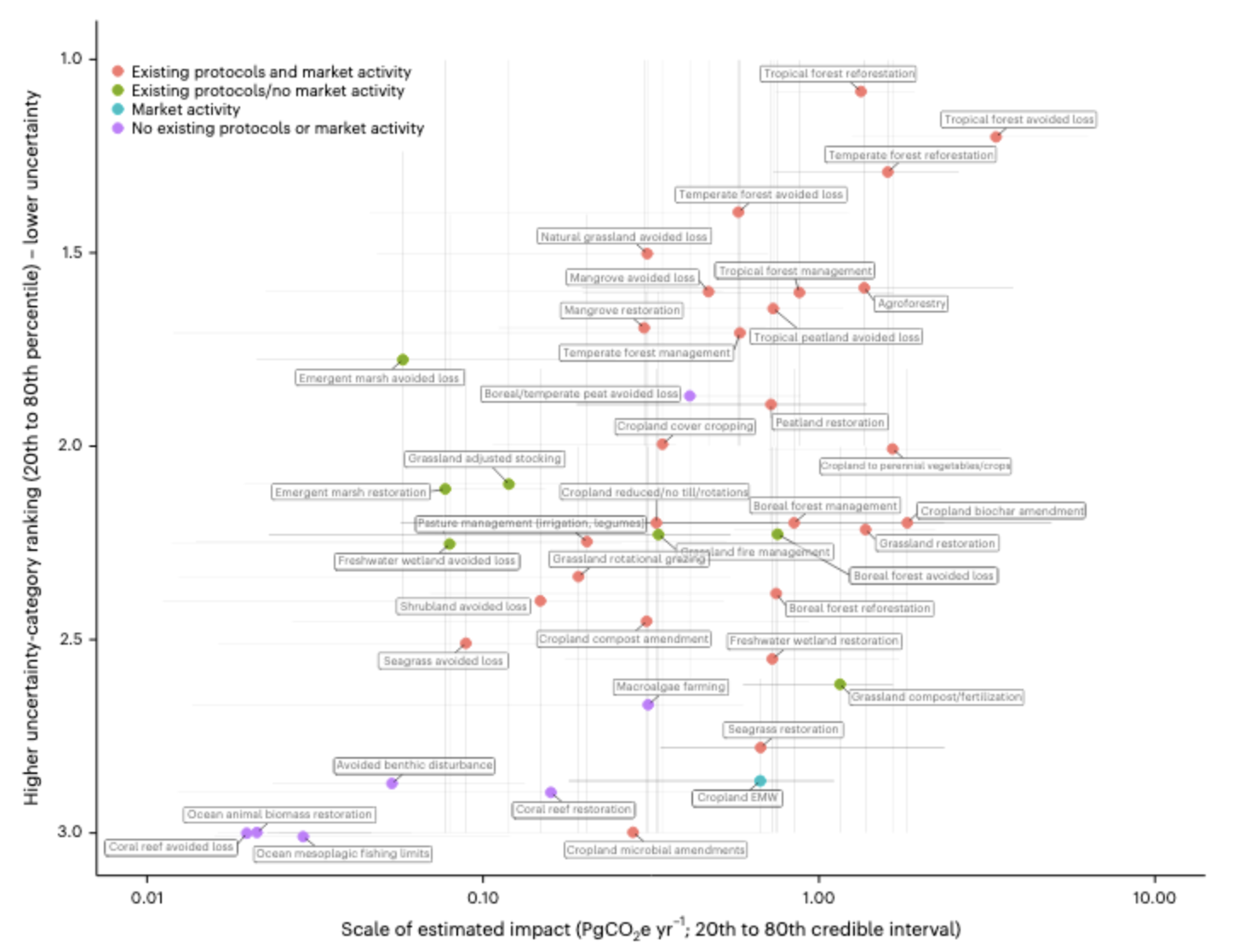
This paper, published in "Nature Climate Change" in March 2024, evaluates the "potential" (Greenhouse Gas Sequestration/Emission Reduction volume) and "Uncertainty" of 43 NbCS (Nature-based Climate Solutions) pathways (referred to as "pathways" in the original paper) in addressing climate change.
What is NbCS?
First, this paper clearly distinguishes between Nature-based Solutions (NbS), which have become increasingly discussed in Japan recently, NbCS, and Natural Climate Solutions. In this paper, NbCS is defined as narrower than NbS but broader than Natural Climate Solutions.
While NbS includes activities that generate Co-benefits from perspectives other than climate change, such as Biodiversity, food supply, and water resources, NbCS is specifically focused on climate change mitigation. On the other hand, Natural Climate Solutions generally emphasize mitigating climate through conservation, restoration, and improved land management, with the premise that ecosystems are not moved beyond their natural functions. However, NbCS includes activities that involve shifting ecosystems, for example, cultivating macroalgae in deeper waters than their usual habitat.
NbCS Pathways
Regarding specific pathways, they are broadly categorized into nine biomes (boreal forests, coastal areas, freshwater wetlands, grasslands, open ocean, Peatland, shrublands, temperate forests, and tropical forests) and three cultivation types (agroforestry, crop cultivation, and macroalgae aquaculture). From these, 43 pathways with potential for Greenhouse Gas Emission Reduction and Sequestration are identified. Of the 43, Methodologies for Carbon Credits have already emerged for 79%, and 65% already have implemented projects.
Conversely, what makes this paper interesting is that about 20% of the activities currently lack Carbon Credit Methodologies and, consequently, have no transaction history.
Results (Summary)
Before explaining the specific Methodologies, I would like to first present the results as a summary.