
August 2024 VCM Updates: Section B
This article is an automatically translated version of the original Japanese article. Please refer to the Japanese version for the most accurate information.
sustainacraft Inc. newsletter. This article is Section B (Trends in Major International Regulations) of VCM Updates (Voluntary Carbon Market Updates).
In this newsletter, we introduce the following two financing schemes related to carbon and biodiversity, recently announced by the World Bank Group:
- An Outcome Bond issued by the International Bank for Reconstruction and Development (IBRD) linked to Carbon Removal Units.
- A structured loan from IFC to TIG, a forest investment management organization operated by BTG Pactual, Brazil's largest investment bank.
Other noteworthy topics this month include the Scope 3 discussion paper and the results of a study on the effectiveness of environmental attribute certificates (EACs), including Carbon Credits, both announced by SBTi on July 30 (link).
We recently held a webinar on these topics, so we will defer the detailed explanation to that resource. We are also accepting registrations for the archived webinar here, so please register if you are interested.
The two World Bank Group projects introduced this time are both large-scale financing initiatives for reforestation projects. These projects generated significant buzz in the Carbon Credit industry when Microsoft announced long-term Offtake Agreements for the Carbon Credits to be created from them.
Microsoft's long-term Offtake Agreements and financing from institutions like the World Bank Group play crucial roles in establishing this market. Generally, while Offtake Agreements secure long-term revenue for Project Developers, payments are often made only upon Credit Issuance (with various exceptions). For afforestation/reforestation projects, which require significant upfront capital for land preparation and planting, earlier-stage financing is essential.
The financing from the World Bank Group addresses these early-stage financing needs. It can also be said that the presence of Microsoft's long-term Offtake Agreements, which secure future revenue with a high degree of certainty, enabled the decision for such financing. The World Bank Group's announcement presents an option for investors to contribute to the financial circulation into Natural Capital while mitigating some of the inherent risks of the carbon market.
Although Microsoft's Offtake Agreement announcement preceded the World Bank Group's announcement, considering the review process typically required by institutions like the World Bank Group, it is reasonable to assume that this framework had already been broadly agreed upon.
Another point of discussion is the balance between commercial reforestation and native species reforestation. In the case of TIG, introduced as the second project, the overall reforestation strategy emphasizes a 50% allocation to commercial reforestation and 50% to native species reforestation. However, to date, "TIG has invested in 37,000 hectares, already planted over 7 million seedlings, and commenced restoration of approximately 2,600 hectares of natural forest," suggesting that activities on the commercial reforestation side are more advanced. When solely considering economic returns, commercial reforestation tends to be prioritized. We plan to engage with stakeholders in this project to understand how they will balance "commitments to fund investors" with "biodiversity and ecosystem restoration," and how the outcome-linked condition based on ecosystem indicators in this IFC loan will function within that balance.
Please contact us here for inquiries.
«VCM Updates Structure»
A. Voluntary Carbon Credit Market Trends
- Credit Issuance and Retirement Analysis
- Project Pipeline Analysis
B. Trends in Major International Regulations ← Subject of this article
B. Trends in Major International Regulations
This article introduces two recent financing schemes from the World Bank Group in the carbon and biodiversity markets. The two financing schemes discussed here are:
- An Outcome Bond issued by the International Bank for Reconstruction and Development (IBRD) linked to Carbon Removal Units.
- A structured loan from IFC to TIG, a forest investment management organization operated by BTG Pactual, Brazil's largest investment bank.
The World Bank once again demonstrates its commitment to the carbon market and its willingness to promote alternative financing mechanisms for other ecosystem services such as biodiversity. Such mechanisms are expected to increase capital inflow into the carbon market, particularly stimulating activity among financial investors.
(1) Outcome Bond Issued by the International Bank for Reconstruction and Development (IBRD) Linked to Carbon Removal Units
(link)
On August 13, IBRD, the lending arm of the World Bank Group, announced the successful offering of a new large-scale bond linked to CRUs (Carbon Removal Units). Unlike previous bonds that targeted carbon Emission Avoidance, this new mechanism allows private bond investors to link economic returns to development outcomes in the Amazon region without being exposed to specific carbon market risks. This new mechanism is expected to serve as a template for future innovations in the bond market.
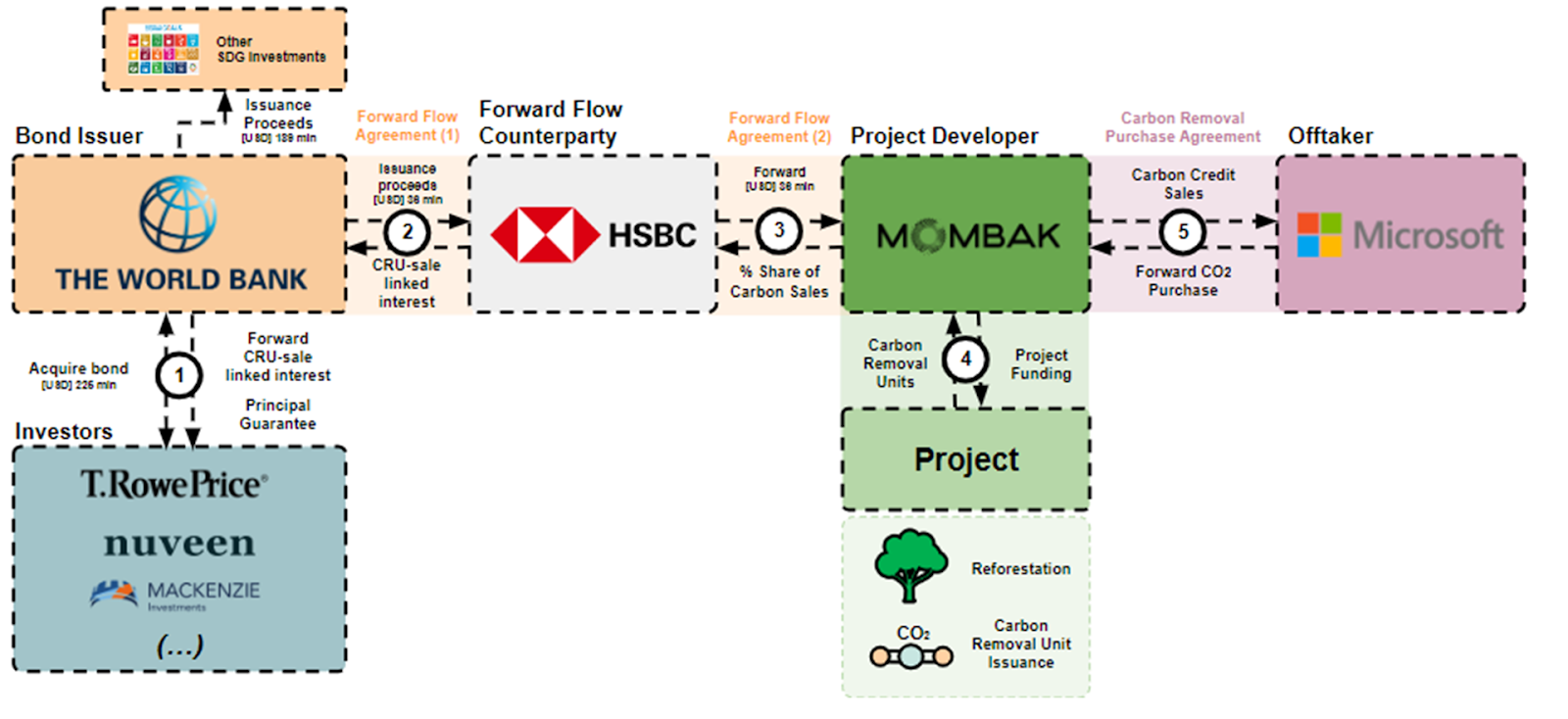
The diagram above organizes the scheme of this project based on various announcements made by our company. We will now explain each component by following the numbers 1 to 5 in the diagram.