
February 2025 Methodology Updates (1/n)
This article is an automatically translated version of the original Japanese article. Please refer to the Japanese version for the most accurate information.
Sustainacraft Inc. Newsletter
Methodology Updates is a series that covers carbon and biodiversity credit methodologies. This article introduces the results of the public consultation on the draft Version 5, a major update to Verra's VCS Standard.
For inquiries, please contact us here.
Announcement: Webinar (March 25, 2025)
We will be holding a webinar on the topic of "Japan's Latest NDC and the Supply Potential of Carbon Credits for GX/ETS and SBTi" as follows (register here).
On February 18, the Japanese government submitted its 2035 and 2040 NDCs to the UNFCCC, in addition to the 2030 NDC it had previously submitted (original available here). The content outlines ambitious targets on a linear path towards achieving Net Zero by 2050, aiming to **reduce Greenhouse Gases by 60% and 73% respectively by fiscal years 2035 and 2040 compared to fiscal year 2013**. Additionally, for the Joint Crediting Mechanism (JCM), a new target of **a cumulative 200 million units by 2040** was announced, in addition to the existing target of a cumulative 100 million units by 2030.
The SBTi (Science Based Targets initiative) is discussing the setting of **interim targets** for "neutralization" of Residual Emissions through Removal Credits, in preparation for the next revision of its Corporate Net Zero Standard (Version 2).
Considering the NDC figures, how might the supply and demand for Carbon Credits usable within GX/ETS evolve in the future? Furthermore, in the context of achieving Net Zero under SBTi, what are the recent investment trends in procuring Removal Credits for the "neutralization" of Residual Emissions, and how are project Pipelines progressing?
The webinar will cover the above topics, as well as recent developments regarding the Article 6.4 mechanism, which is expected to impact JCM Credits (recent developments concerning Article 6.4 and SBTi were also introduced recently in this article).
- Title: Explanation of Japan's Latest NDC and the Supply Potential of Carbon Credits for GX/ETS and SBTi
- Date & Time: March 25 (Tuesday) 13:30-15:00 JST
- Registration: Please register here
- Participation Fee: Free
- Capacity: 500 participants (Zoom Webinar)
※ Individuals, competitors or similar companies, and those in the consulting industry may be declined. Please register using your company email address.
※ After registration, a detailed email with the URL will be sent within a few days. For any questions or inquiries regarding seminar participation, please contact press@sustainacraft.com.
Results of the First Public Consultation on the Draft VCS Standard Version 5 (Verra)
(Source: VCS Program Version 5: Responses to First Public Consultation, accessed February 19, 2025. Unless otherwise specified, image sources are from the linked document. The original Japanese quoted sections are from our past newsletters linked below)
The VCS Standard is guidance commonly used across various types of projects implemented under Verra's VCS Program. It is a document that defines fundamental principles applicable regardless of project type, such as the principles of VCS projects, the process leading to Registration, the concept of Permanence, and safeguard considerations.
Verra is currently developing Version 5, a major update to the VCS Standard. An initial draft was released last September, and public comments (hereinafter, "public consultation") were solicited. The details of this draft were thoroughly introduced in the following newsletters from last October.


As mentioned in these newsletters, this is a draft of a major update, so changes from various perspectives have been proposed.
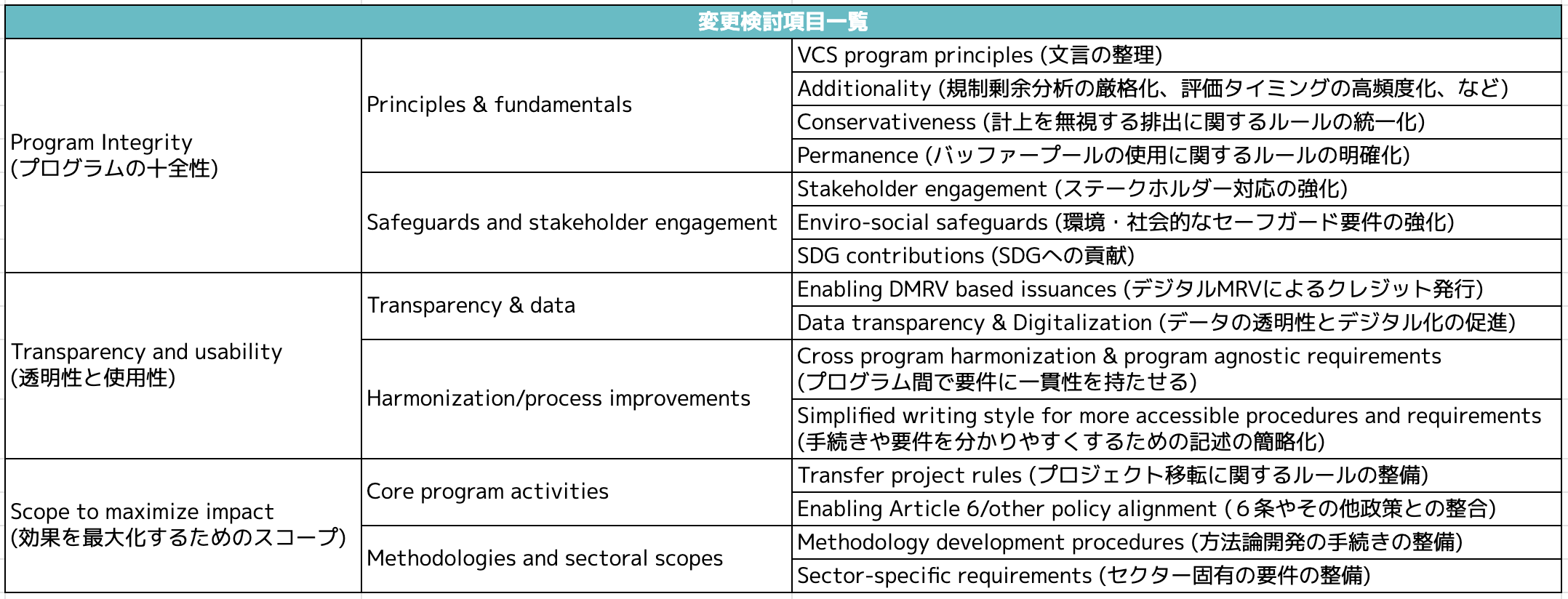
Last month, a document summarizing the comments received on the first public consultation was released. Industry attention to this draft appears to be high, with a total of 1,943 comments received from 61 stakeholders in this public consultation. The breakdown of respondents is as follows:
- 62%: Project Developer / Proponent
- 10%: Corporations / End Users
- 8%: Non-profit Organizations
- 7%: Consultants
- 2%: Validation/Verification Body (VVB)
- 11%: Others (e.g., Banks/Investment Institutions, UN agencies, Educational Institutions)
Over 60% of respondents were Project Developers / Proponents. Therefore, the general trend shows many negative responses to proposed changes that would increase the burden on Credit suppliers, while proposals that would reduce the burden or increase profitability received many positive responses. It is important to note the composition of respondents behind these trends.
In this announcement, Verra's comments do not extensively detail how feedback will be specifically addressed by the next public consultation. Thus, it is difficult to determine how the proposed content will change in the future. Looking at past public consultations and their responses, it appears that Verra does not always adopt the majority opinion directly, and a certain degree of tension seems to be maintained between Verra and Project Developers / Proponents. However, recently, with the tightening of methodologies, we hear that a situation described as "Verra departure" is occurring, where some are migrating to other registries. Keeping this background in mind, attention is focused on how Verra will incorporate this feedback into the draft going forward.
Below, as an initial organization of information, we will review the background of topics touched upon in previous newsletters and present a summary of the public consultation responses.
Please note that the numbers at the beginning of the following sections correspond to the draft's section numbers.
1.4 Requirement for Proof of Prior Consideration (Additionality)
Background and Proposed Changes
First, let's review the background of the proposal.
Additionality means that the GHG Emission Reductions / Removals from a project activity are greater than they would be without it, and that the activity would not have occurred without the Carbon Credit mechanism. Proving this Additionality is a crucial element for ensuring Credit quality, and the IC-VCM is currently considering revising its standards. Correspondingly, this major update is considering adding proof of prior consideration.
Prior consideration means that there was an intention to register a project as a carbon project prior to the start of the project activity. In other words, it means not allowing activities that were conducted as normal economic endeavors to be retroactively registered as carbon projects when the possibility of Issuance of Credits emerged later.
Under Verra's current standards, there are provisions for the maximum period from the project start date to Validation and Registration, but proof of prior consideration is not required. Specifically, for AFOLU projects, it is stipulated that a request for Pipeline listing must be made within three years of project commencement, and Validation must be completed within a maximum of eight years.
In the AFOLU sector, including REDD+ and ARR, there are advanced activities such as voluntary forest protection measures and afforestation that predated the establishment of carbon registries as they exist today. Under current standards, some such activities could potentially be monetized retroactively through Credits, but this will no longer be possible in the future, which is likely to be a highly impactful change for some Project Developers / Proponents.
The following three changes were proposed in response to the above (source partially modified below).
Proposed Change 3: Establish an instance-level Pipeline listing process for group projects.
It is noted that depending on the results of the public consultation, not all three points, but only some, might be required.