
January 2025 Methodology Updates (2024 Review)
This article is an automatically translated version of the original Japanese article. Please refer to the Japanese version for the most accurate information.
sustainacraft Inc. newsletter. Methodology Updates is a series that covers methodologies for Carbon Credit and Biodiversity Credit.
This month, as the first issue of the new year, we will review the developments of 2024, focusing on methodology revisions. This year, we will continue to regularly disseminate various information, focusing on Nature-based Carbon Credit methodologies. Thank you for your continued support.
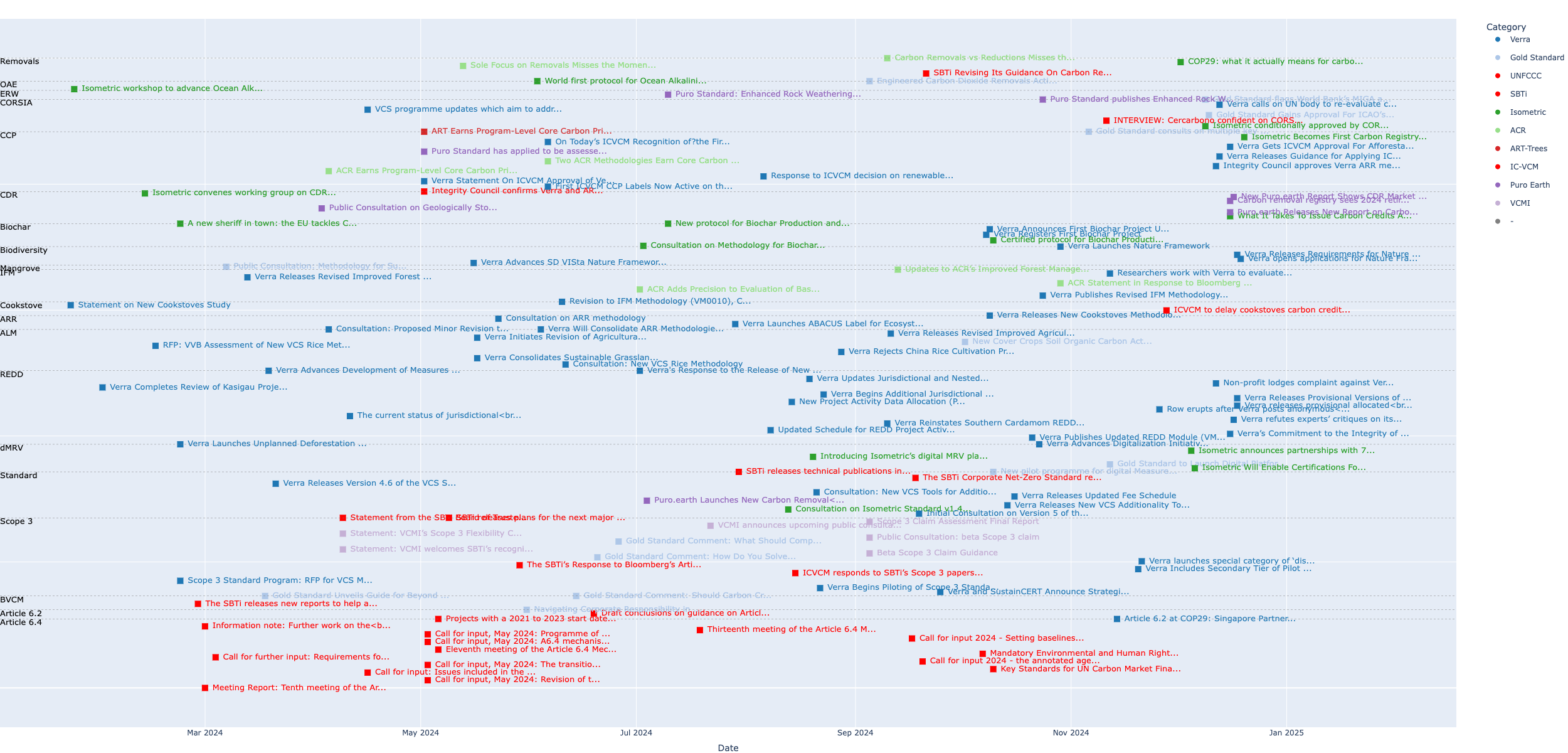
Below are the announcements from UNFCCC, Voluntary Carbon Standards (such as Verra, Gold Standard, ACR, CAR), IC-VCM, SBTi, VCMI, and others. The horizontal axis represents dates, and the vertical axis represents topics, showing the key announcements made in 2024.
While this article primarily focuses on methodologies, it is also necessary to organize the movements of initiatives that influence methodology revisions, such as IC-VCM's CCP and CORSIA. Therefore, the accompanying figure visualizes these as well.
From here, we will introduce topics from a vertical (topic-based) perspective. We will also refer to past articles that explain each topic as appropriate.
Note: This article assumes a certain level of prior knowledge for each topic and aims to provide a broad review of the year. For more detailed information on each topic, please refer to the past articles referenced in their respective sections.
Below are the topics covered. The organizations primarily issuing announcements are indicated in parentheses.
- Paris Agreement Article 6.2 / 6.4 (mainly UNFCCC)
- BVCM and Scope 3 (SBTi and various Carbon Standards)
- Standard / dMRV (mainly various Carbon Standards)
- Various Methodologies; REDD+, IFM, ARR, biodiversity… (mainly various Carbon Standards)
- CCP, CORSIA (IC-VCM, ICAO, and various Carbon Standards)
For each topic, we will summarize its overview and past articles that explained the topic.
Article 6.4 / 6.2 (Paris Agreement Article 6.2 / 6.4)
Regarding Paris Agreement Article 6.2 and 6.4, announcements primarily from UNFCCC are listed.
As explained in last month's article, the Article 6.4 Methodology Standard and Removal Activities Standard were agreed upon just before COP29. Moving forward, methodologies for each activity type will be developed based on these standards.
While many public comment announcements, such as Calls for Input, were also issued in May of this year, the current criteria have been agreed upon after multiple revisions through several years of deliberation.
As also stated in the article above, the criteria for the Article 6.4 mechanism announced this time incorporate criticisms and feedback from the Carbon Credit market to date. It is likely that bilateral transactions under Article 6.2 and Voluntary Carbon Standards will be critically viewed if their requirements deviate from this Article 6.4 Standard.
Particularly stringent requirements have been established for the conservatism of 'Baseline' setting for Avoidance/Reduction activities, and for monitoring requirements, including 'Reversal', for Removal/Sequestration activities.
BVCM / Scope 3
While BVCM (Beyond Value Chain Mitigation) is gaining traction as a term, the procurement of Carbon Credits as BVCM does not appear to be widespread.
Scope 3 was one of the topics that saw significant movement when looking back at 2024.
Scope 3 emissions are included in a company's GHG Inventory, so it is not mandatory to convert them into Carbon Credits. However, with more companies expressing a shift from 'Offset' to 'Inset', proving the absence of Double Counting and ensuring stringency and conservatism in calculations have emerged as challenges. The momentum to use existing Carbon Standards to address these issues is accelerating.
Amidst this, veteran registries such as Verra and Gold Standard have developed their own programs for Scope 3, and several companies are starting to advance pilot projects.
For Inset, the most critical point is the definition of 'what constitutes the internal operations of a company's Value Chain', and for this, we must await the revised version of the GHG Protocol, which is scheduled to be announced this year.
Furthermore, SBTi and VCMI have issued various announcements regarding the use of Carbon Credits for Scope 3 emissions.
These topics are explained in detail in the articles below and this seminar. Additionally, environmental claims using Carbon Credits, focusing on use cases related to the Paris Olympics and European regulations and guidelines, were introduced in this seminar.
Standard
Here, 'Standard' primarily refers to revisions at a higher Carbon Standard level, rather than per activity type like REDD+ or ARR.
For Verra, announcements regarding major updates to '5.0' were made in the latter half of 2024, in addition to minor updates such as VCS Standard '4.6'. These updates are strongly conscious of responding to the requirements of CCP and CORSIA.
While separate from the VCS Standard document, there was also an announcement about Verra's unique Additionality tool, which is also used across activity types. Renewable energy methodologies did not pass the category-level review of IC-VCM CCP, and a major reason for this is said to be issues with the CDM Additionality tool that Verra has historically used. A draft of a new Additionality assessment tool, developed with CCP compliance in mind, was announced in September.
Registries other than Verra have also announced standard-level revisions.
dMRV (Digital MRV; Measurement, Reporting, and Verification)