Various Discussions on Permanence (Part 2)
This article is an automatically translated version of the original Japanese article. Please refer to the Japanese version for the most accurate information.
Sustainacraft Inc.'s Newsletter (Special Edition). This time, it's a continuation of the discussion concerning the **permanence** of carbon storage.
Recently (February 27), I had the opportunity to speak at GX Studio, an event held by the GX League, which is managed by the Ministry of Economy, Trade and Industry (METI). While "rule-making" was the topic, "rule-making in GX" essentially involves deciding what incentives to establish for which types of Emission Reduction / Removal, a process that inevitably creates conflicts among industries.
In addressing such a theme, it is necessary to understand the contribution of each solution to climate change measures from an academic perspective, and this is where **permanence** becomes a crucial point of discussion.
Furthermore, by following the discussions around the EU's CRCF (Carbon Removal Certification Framework) introduced below, I hope this will provide an opportunity to reflect on questions such as how decisions should be made at the policy level, and what kind of discussions might arise depending on the design of the process.
It has been a while since the last update, but in the article below, we introduced several discussions related to permanence.
Regarding the valuation of temporary carbon storage, we discussed topics such as GWP (Global Warming Potential), physical and economic equivalence, Tonne-year Accounting, and the impact of albedo.

Building on the prior knowledge from the above, this time, I would like to introduce a paper published in Nature Climate Change by researchers from the University of Cambridge. The question it seeks to answer is how to justify the Greenhouse Gas Emission Reduction / Sequestration effects of different projects and their associated costs.
Before that, as related topics, I would like to briefly touch upon the following, both announced in February 2024:
- (1) EU's CRCF (Carbon Removal Certification Framework)
- (2) Oxford Offsetting Principles (Revised Edition)
Recent Topics Regarding Carbon Removal Categories
(1) EU's CRCF (Carbon Removal Certification Framework)
(link)
In November 2022, the European Commission submitted a proposal for a regulation on the Carbon Removal Certification Framework (CRCF). Based on various feedback received, it was announced on February 20, 2024, that an agreement had been reached on the revised CRCF.
The most important and significant change from the 2022 version is the clear distinction between units generated from permanent carbon removal (at the multi-century level), carbon products (such as wood-based construction materials, lasting at least 35 years), and Carbon Farming (e.g., forest restoration and wetland management). Specifically, carbon removals are divided into the following 3 (+1) categories:
permanent carbon removal (storing atmospheric or biogenic carbon for several centuries)temporary carbon storage in long-lasting products (such as wood-based construction products) of a duration of at least 35 years and that can be monitored on-site during the entire monitoring periodtemporary carbon storage from carbon farming (e.g. restoring forests and soil, wetland management, seagrass meadows)soil emission reduction (from carbon farming) which includes carbon and nitrous oxide reductions from soil management, and activities that must overall reduce the carbon emissions of soils or increase carbon removals from biological matter(examples of activities are wetland management, no tilling and cover crop practices, reduced use of fertilizer combined with soil management practices, etc.)
Many positive opinions are observed regarding the above changes, but concerns have been raised regarding the last (+1) part mentioned above.
For example, this article points out that regarding (+1), as a result of strong agricultural lobbying in Europe (approximately 38% of the EU budget is used for agriculture), soil carbon Emission Reduction was included, but it should not have been part of this framework.
Furthermore, Carbon Market Watch published an article titled "CRCF: The EU’s carbon removal certification failure," and in a very strong tone, highlighted issues beyond the aforementioned Emission Reduction.
Nevertheless, even in 2022, the public comments were fully disclosed in an easy-to-view format, making it possible to see supportive and opposing views, and which organizations submitted which opinions. This transparency alone could offer valuable insights, for instance, into how discussions on requirements for GX/ETS-eligible Credits should proceed.
So, what kind of impact will this CRCF have? Although its specific applications are not yet clear, it is anticipated that CDR will be integrated into the EU-ETS, the world's largest Emission Trading System. It is also expected that Buyers in the Voluntary Carbon Market will consider CRCF in their procurement strategies.
(2) Oxford Offsetting Principles
(link)
The Oxford Principles were created to design and implement rigorous voluntary Net Zero commitments by governments, cities, and corporations.
The initial version released in 2020 drew criticism for overemphasizing highly permanent carbon removals, which still require significant time for technological development. However, the current revision appears to have introduced adjustments that acknowledge the value of more immediate solutions.
The revision from the previous version initially emphasizes the following six points:
Reinforcing the urgency of reducing emissionsRe-emphasising the need to close the carbon removal gapHighlighting further recent evidence showing that nature-based solutions are critical for addressing the drivers and impacts of climate changeClarifying the durability risks and co-benefits of different types of removal and storageDefining terms to reflect new international guidance on net zero and nature commitments and claimsRecognising the value of mitigation efforts outside of organisational net zero targets.
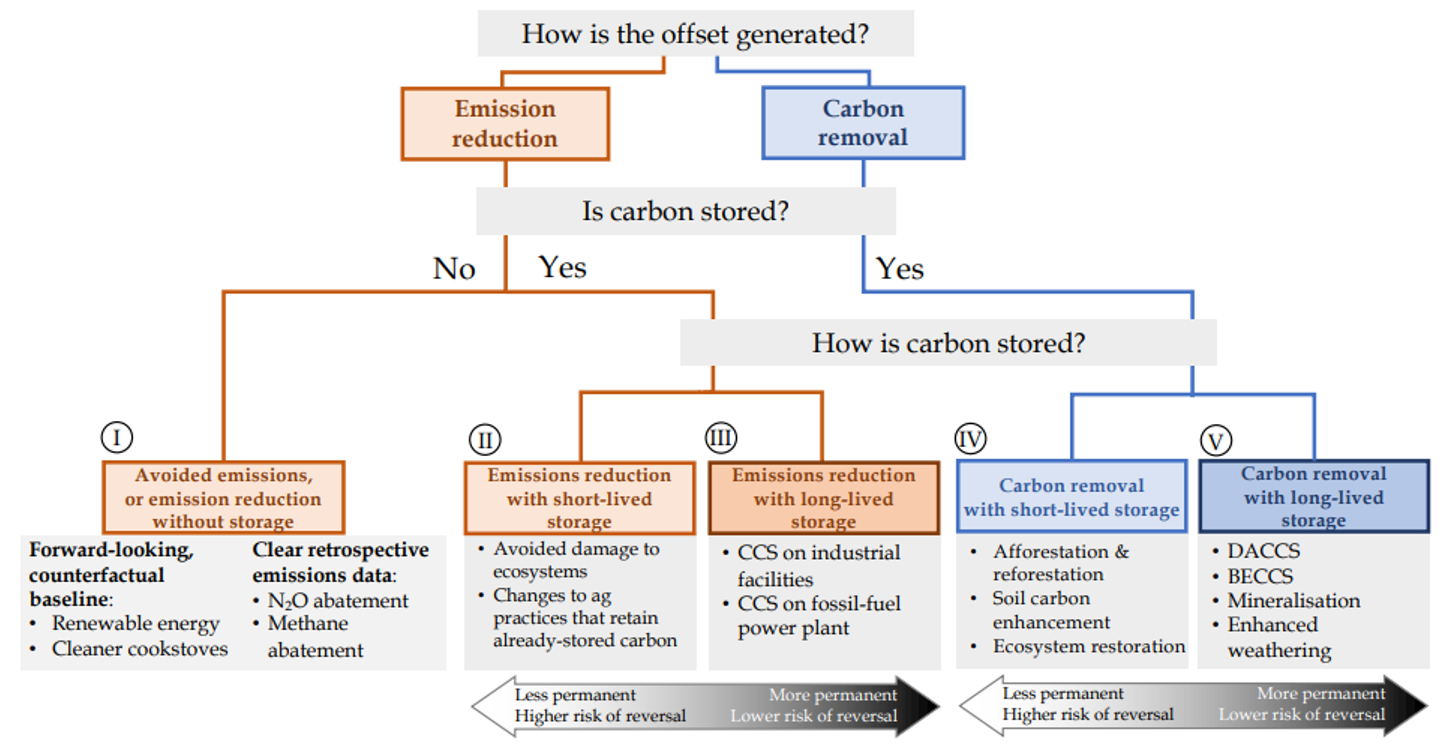
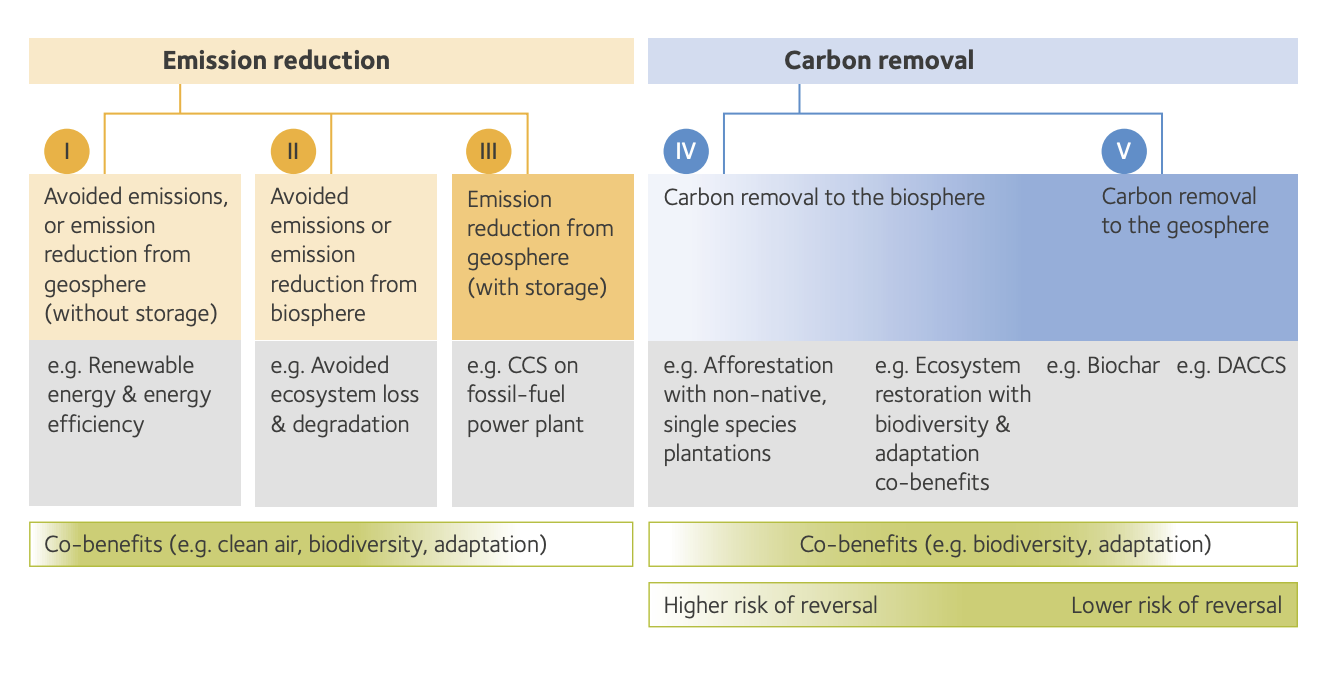
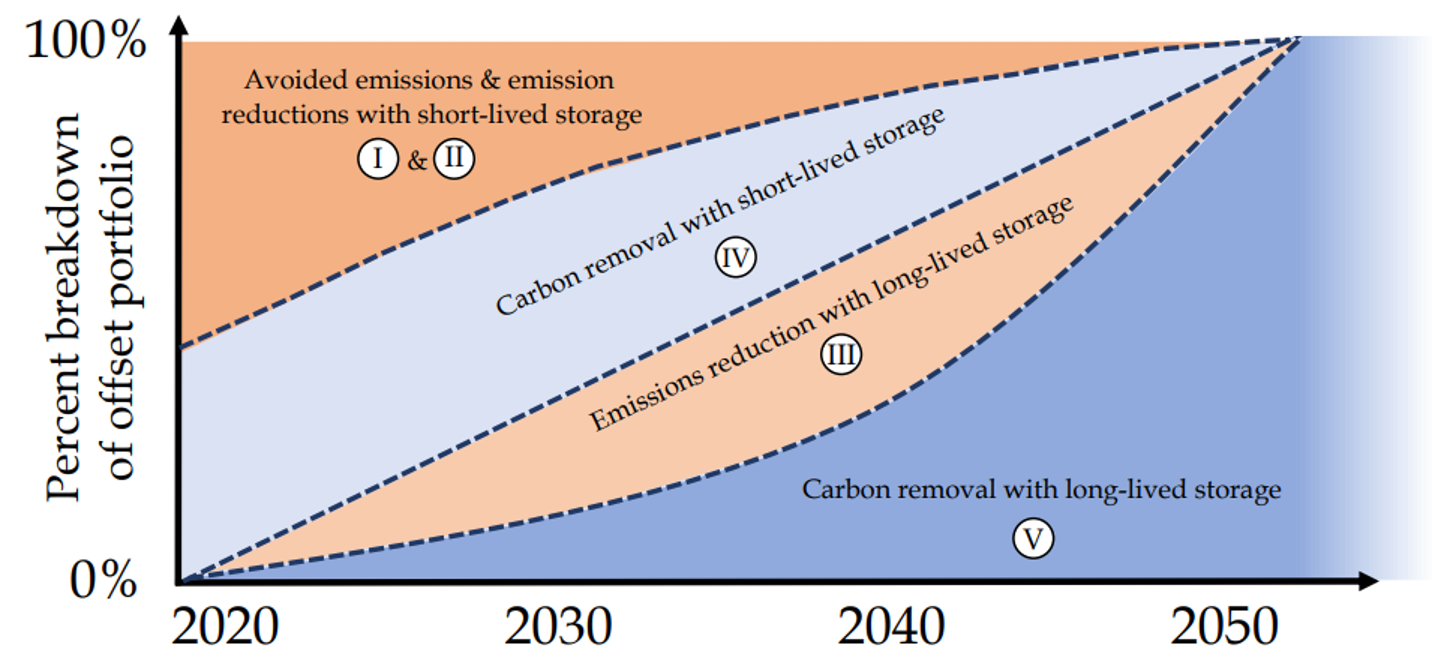
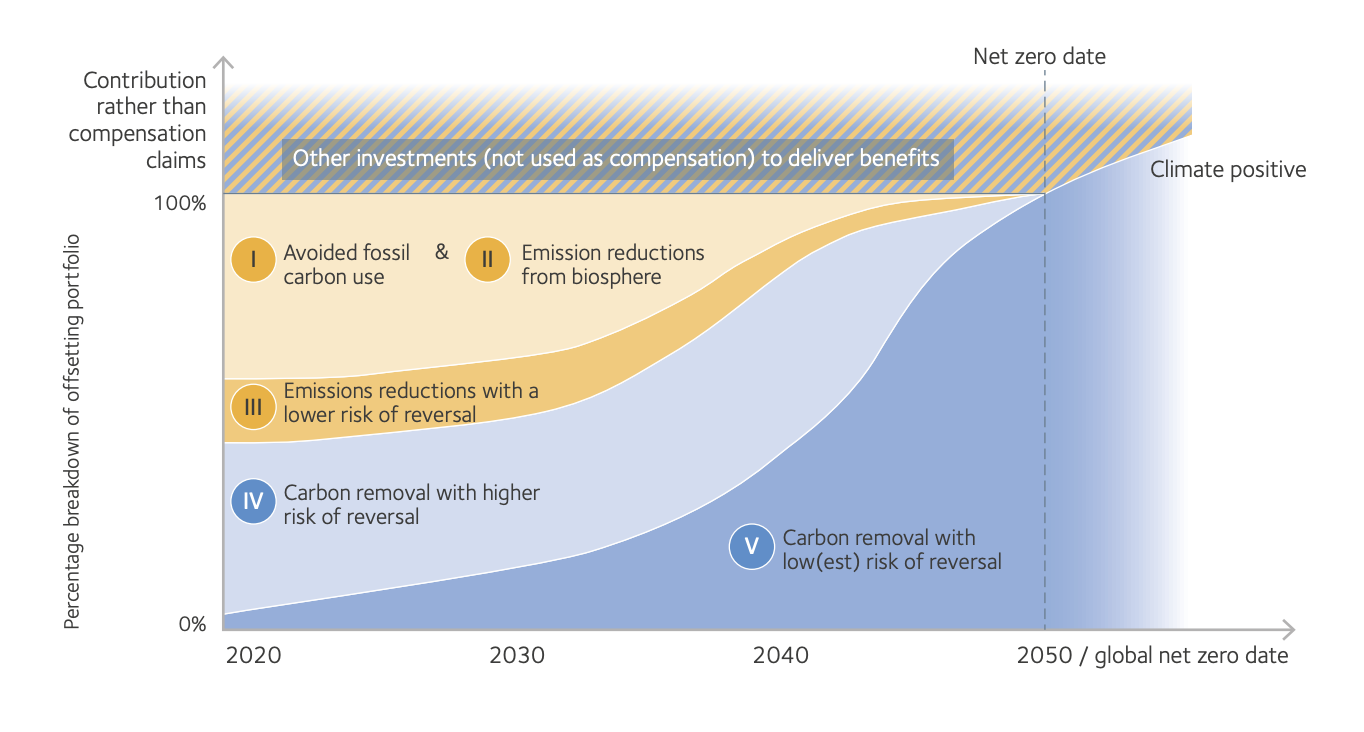
So, what specific revisions have been made? We will compare the key figures from the 2020 and 2024 versions, displayed one above the other.
First, there's a change in the classification concept itself. In the 2020 version, terms like "short-lived/long-lived" have been replaced with "higher/lower risk of reversal." Additionally, there's a clear inclusion of Co-benefits. Both of these correspond to the fourth point mentioned above.
Next, regarding the "Percentage breakdown of offsetting portfolio." Although it states that this is not intended to be read precisely, there are several differences in the shape of the curves.
First, for categories corresponding to i and ii, the shape is quite different from the previous version, having been modified to maintain levels largely unchanged from the present until around 2035.
Also, the proportion of iii (CCS) has decreased, while the proportion of iv (primarily Nature-based Solutions Removal categories) appears to have increased. In addition to the explicit mention of Co-benefits above, these changes are believed to correspond to point 3 above (Highlighting further recent evidence showing that nature-based solutions are critical for addressing the drivers and impacts of climate change).
Furthermore, in the shaded area exceeding 100%, "Other Investments," which are considered equivalent to BVCM (Beyond Value Chain Mitigation), have also been added.
Realizing the social value of impermanent carbon credits
(link)
From here, I will introduce a paper that proposes a framework for evaluating the value of temporary carbon storage, which is the main topic. In the previous article, we introduced the idea that temporary carbon removals, which are re-released before the peak warming timing, have no value from the perspective of "contribution to peak warming."
The framework introduced below, however, takes the stance that even temporary carbon storage re-released before peak warming should have social benefits.
Overview
This paper proposes a framework called PACT (Permanent Additional Carbon Tonne) Framework to evaluate the value of temporary carbon storage, and presents evaluation results for several hypothetical project scenarios.
Results
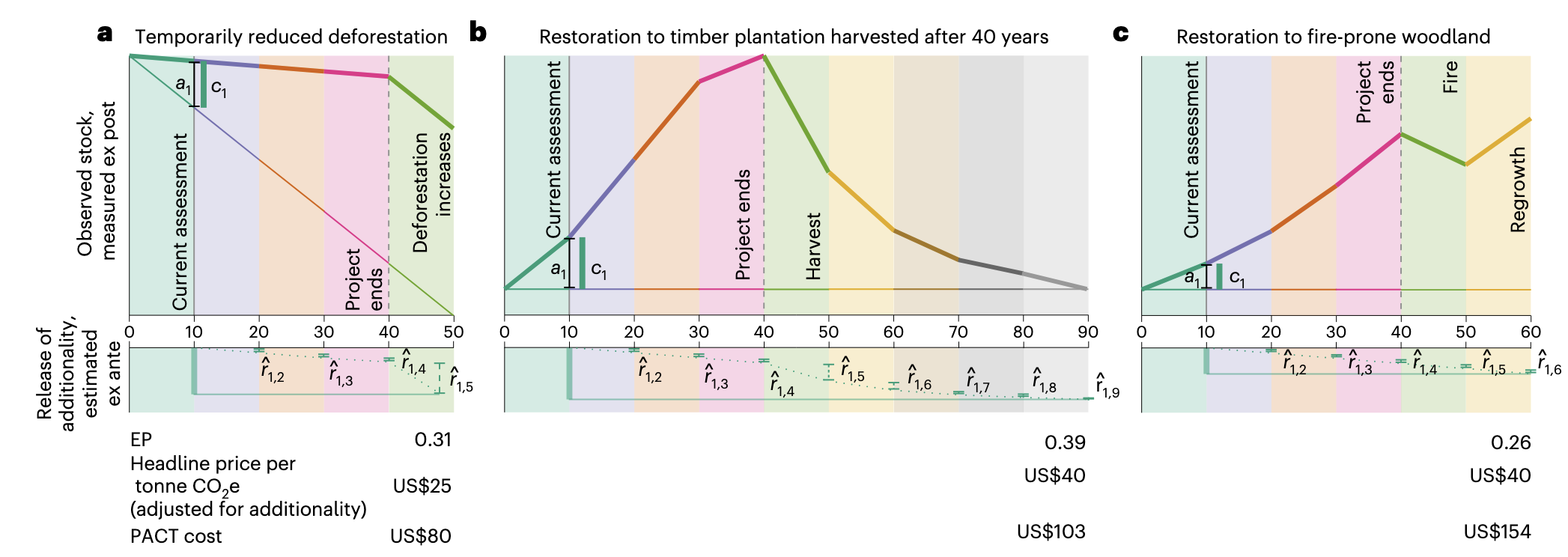
First, before delving into the details of the framework, let's explain what kind of evaluations it yields. The figure below shows the results evaluated by the PACT Framework, based on three hypothetical scenarios.
Nature-based Solutions projects such as REDD (Reducing Emissions from Deforestation and Forest Degradation) and ARR (Afforestation, Reforestation and Revegetation) are often criticized for their permanence. For instance, in REDD, cases where Deforestation continues after the Crediting Period are cited, and for ARR, cases where forests are harvested or damaged by forest fires after the Crediting Period are mentioned. The following three scenarios, evaluated here, correspond to these criticisms. Each project period is assumed to be 40 years.
- a: Temporality reduced deforestation: Cases where Deforestation was successfully suppressed during the project period but progresses after the period ends.
- b: Restoration to timber plantation harvested after 40 years: Cases where the timber plantation is harvested after the project period.
- c: Restoration to fire-prone woodland: Cases where the woodland suffers damage from forest fires after the project period ends.
In the figure below, the horizontal axis represents time, and the vertical axis represents ex-post observed carbon stock. The thick line shows values for the project site, and the thin line shows values for the counterfactual site (how the counterfactual site is set up will be explained later).
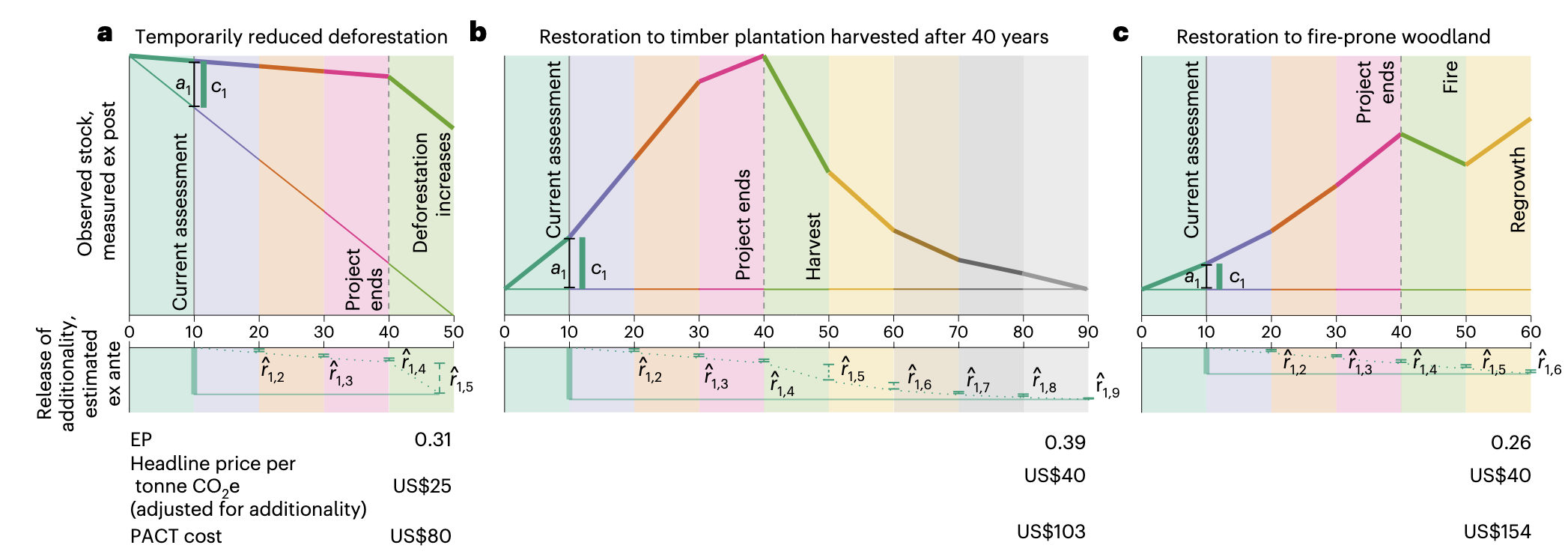
Please pay attention to the three values listed at the bottom. EP (equivalent permanence) is a crucial component of the PACT Framework, and its details will be explained later. The inverse of EP (i.e., 1/EP) indicates how many impermanent Credits need to be purchased currently to be equivalent to durable storage in terms of social benefits.
What is the PACT Framework?
The PACT framework is summarized in the following excerpt. From here, we will examine each component of the PACT framework.
Here we attempt to address these substantial limitations by presenting a new dynamic accounting method for quantifying the long-run social benefits of impermanent NBS-derived carbon credits. Our Permanent Additional Carbon Tonne (PACT) framework allows credits to be issued and sold at the end of each time period, based on ex post determination of additionality and ex ante forecasting of reversals, and comprises three interlinked advances:
(1) Understanding the permanence of a project’s impacts as its additionality—relative to a statistically derived counterfactual— through time.
(2) Risk-averse forecasting of the expected social cost of the impermanence of carbon gains, so that purchasers can make like-for-like comparisons across diverse offset products while having confidence that NBS credits have been fully adjusted for impermanence.
(3) Using long-term monitoring for the ongoing correction of errors in deliberately pessimistic forecasts of post-credit releases, so that project providers can be compensated if forecasts are overly conservative.
(1) Permanence as additionality through time
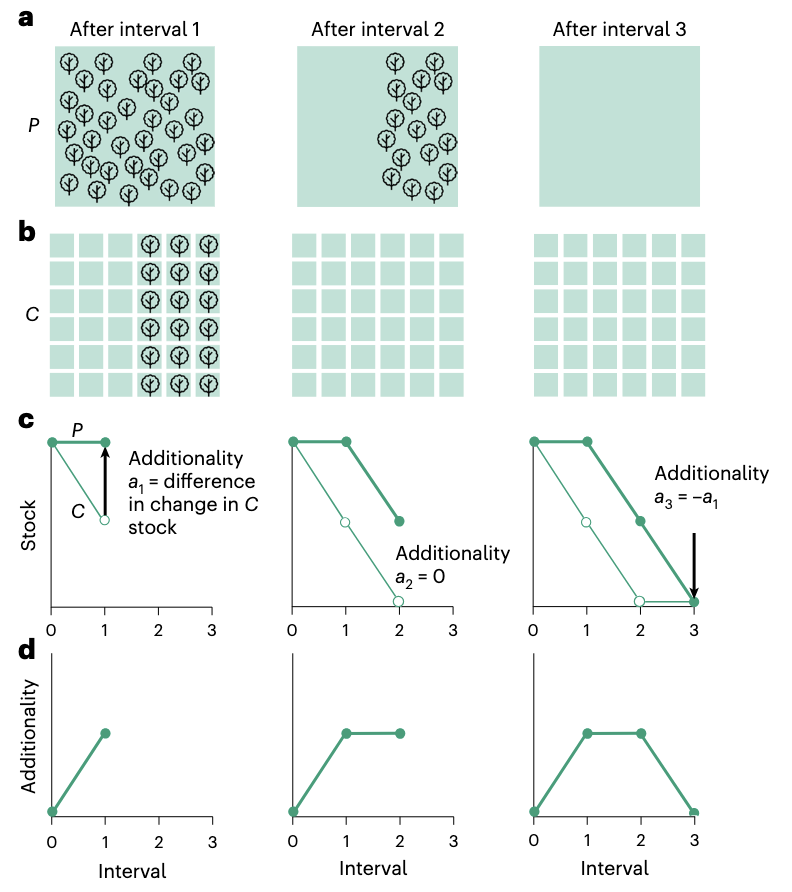
First, an introduction to the foundational concept. Perhaps it can be described as "Permanence as additionality through time." Similar to the general theory of Carbon Credit, here, the contribution of a project is thought to be the difference between the project scenario and the counterfactual scenario over a given unit of time.
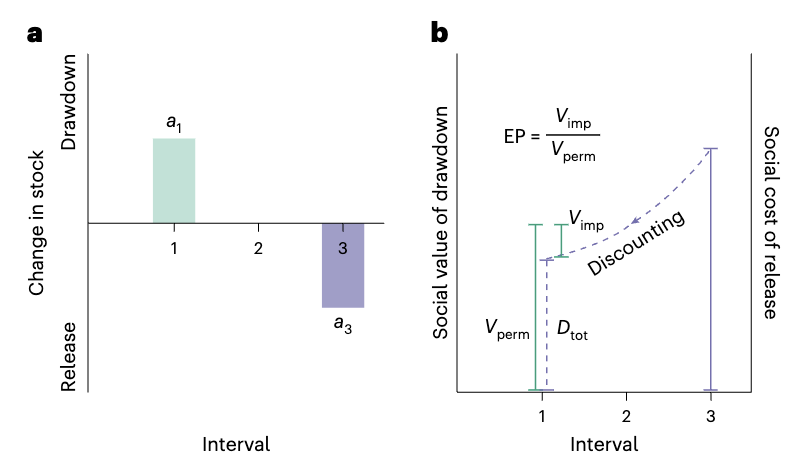
The figure below assumes a REDD project, where a scenario is envisioned in which zero Deforestation is achieved until t=1, but half is lost at t=2, and it is completely lost at t=3. By calculating the difference from the counterfactual scenario in each period, the Additionality over a certain period is calculated.
(2) Social value and equivalent permanence
This section quantifies the benefits of short-term carbon storage based on the concept introduced in (1). In the first part of this series, we explained the idea that temporary carbon storage re-released before the peak warming does not contribute from a "peak warming" perspective, as follows:
In a context where "temperature rise depends on cumulative CO2 emissions," temporary carbon storage re-released before the peak warming makes no contribution from a "peak warming" perspective.
The PACT framework, however, while acknowledging the above perspective, takes the position that even temporary carbon storage re-released before peak warming should have social benefits. For example, it provides the following explanation:
"Imagine a health policy with the specific goal of extending the average lifespan of people born after 2050 to 100 years. Interventions that extend the lives of people currently alive would not directly help achieve that goal. However, most of us currently alive would benefit from even one additional year of life, so such interventions have social value."
(Translated by DeepL)
Here, SCC (Social Cost of Carbon) is used to quantify social value. SCC represents the economic cost (long-term cumulative costs discounted to present value) caused by the Emission of one tonne of Carbon Dioxide (equivalent). This paper refers to the DICE (Dynamic Integrated Climate-Economy) model by Professor Nordhaus (who received the Nobel Memorial Prize in Economic Sciences in 2018 for "The Economics of Climate Change") as the approach for estimating SCC.
Here, an Offset from permanent Carbon Dioxide Removal (CDR) of 1 tonne CO2(e) is considered to have a value equal to the SCC at that time (with the opposite sign), which is represented as V_perm in the figure below. On the other hand, for impermanent Offsets, it is the permanent SCC minus the present cost of damages caused by subsequent carbon release, estimated from the SCC at the time of release, and denoted as V_imp. The aforementioned EP (equivalent permanence) is defined as the ratio of V_perm to V_imp.
This is illustrated in the figure below. Here, a hypothetical case of activities to halt Deforestation is assumed, with a complete Reversal occurring at t=3.
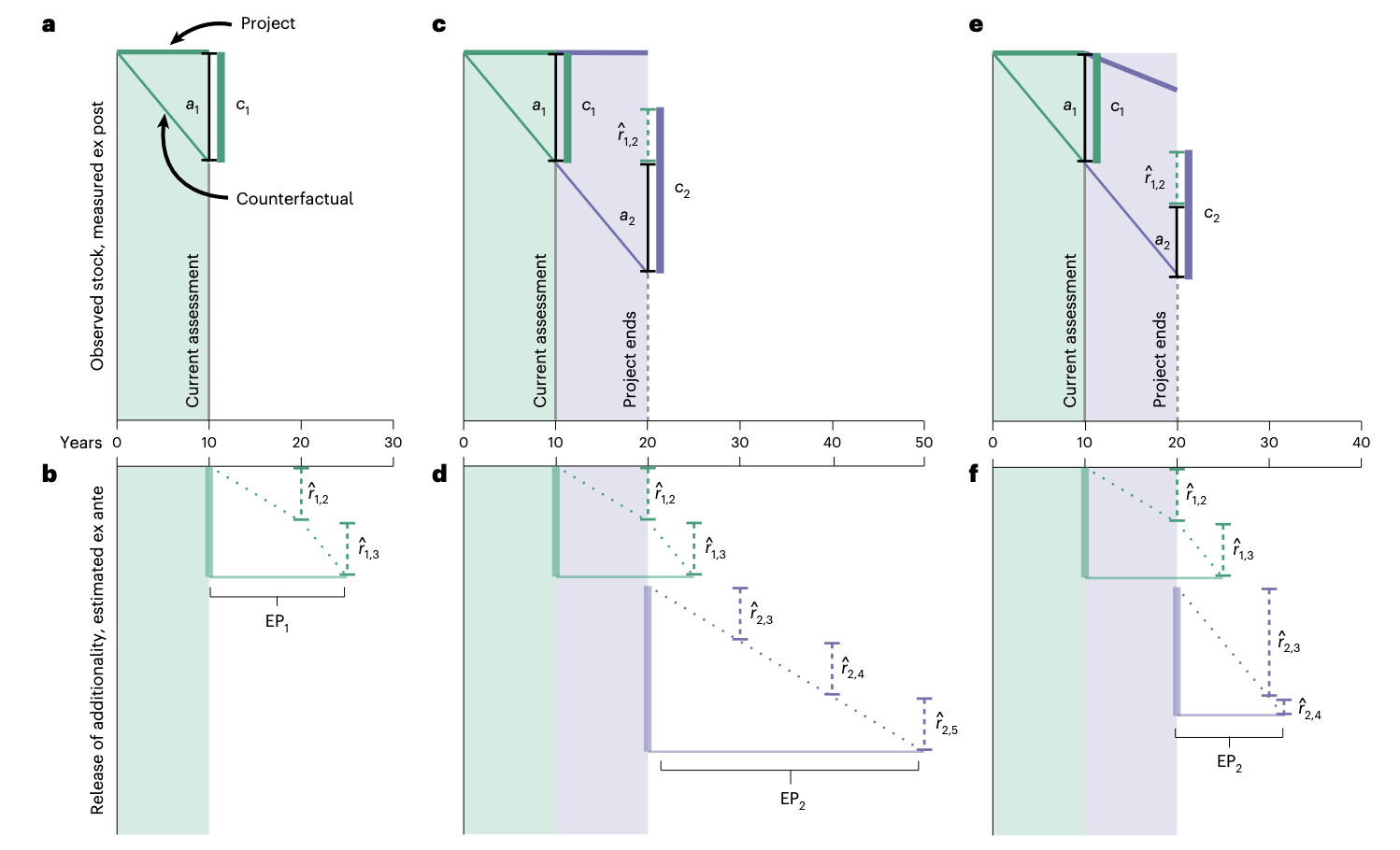
The figure below explains this concept with a more realistic setting. Here, a hypothetical REDD project is assumed. Ten years after project inception, by ex-post comparing the carbon stock trends of the project and a statistically derived counterfactual site, it is confirmed that the project has generated an additional value a_1 (Figure a below). Here, EP_1 is calculated based on future predictions (Figure b below). A critical point in the operation of the PACT framework is that EP_1 is calculated under a pessimistic scenario (here, a pessimistic scenario assuming that the achieved a_1 will be completely reversed in the next 20 years) (Figure c and beyond will be explained in the next paragraph).
(3) Correction for forecasting errors
The third element is the correction of ex-ante conservatively set EP values, ex-post, according to actual performance.
In Figure c above, a scenario is depicted where Deforestation was kept at zero for 20 years after the project's start. In Figure b above, EP_1 was calculated using a quite pessimistic scenario. To correct this ex-post, c_2 is calculated by adding `\hat{r_1,2}` to a_2. Here, for `\hat{r_i,j}`, 'r' represents a Reversal (or release of additionality), and `\hat{r_i,j}` denotes the predicted 'r' at time j, made at time i (the hat symbol "^" typically indicates a prediction). In other words, this addition is a process of ex-post adding back what was not reversed as initially predicted.
Furthermore, Figure d illustrates that the Reversal schedule for calculating the subsequent EP (EP_2) is based on an updated, slightly more optimistic version than the previous one, given the developments so far. While I will omit the explanation for e and f, as mentioned previously, the approach proposed by PACT is to calculate EP based on pessimistic forecasts and then adjust it according to actual performance.
Summary
Now, let's return to the calculation results introduced at the beginning. PACT cost is calculated by multiplying the headline price per tonne by the inverse of EP. This signifies the cost at which an Offset, equivalent in value to permanent Carbon Dioxide Removal (CDR) in terms of SCC, can be justified, assuming current costs. The figure below shows that for REDD, it is 80 USD; for Afforestation projects to be harvested after 40 years, it is 100 USD; and for forest restoration projects with Reversal risk due to fire, it is 154 USD.
Naturally, these costs are considerably higher compared to recent transaction prices, but they can be considered quite inexpensive when compared to what is starting to circulate as permanent Carbon Credit on platforms like Puro.earth.
Since the permanence varies depending on the Carbon Dioxide Removal (CDR) / Emission Reduction solution, approaches like the CRCF mentioned at the beginning, which clearly categorize, or the Oxford Principles, which provide certain guidelines for portfolios over time, considering anticipated technological development speeds, have been put forth. The PACT framework, on the other hand, can be seen as an approach that attempts to propose a single metric to ensure equivalence from an SCC perspective.
Various limitations have been pointed out regarding the DICE model itself, which is used for SCC estimation. Therefore, operating solely with such a monolithic approach might not be realistic. However, the concept of making different permanence levels comparable through a clear indicator like EP (equivalent permanence) could be valuable when companies formulate portfolios and strategies for decarbonization.
This was the second installment of our discussion on permanence. While the discussion on permanence is quite complex, as mentioned at the outset, we believe it is an indispensable topic for companies considering decarbonization or interpreting various external guidelines.
That concludes Sustainacraft's Newsletter (Special Edition).
Our company profile materials are available here for your reference.
Disclaimers:
This newsletter is not financial advice. So please do your own research and due diligence.