
Clarification of Offset Issues

This article is an automatically translated version of the original Japanese article. Please refer to the Japanese version for the most accurate information.
This is a newsletter (special edition) from Sustainacraft Inc.
In this article, we will primarily introduce the paper "All Excess Emissions must be Removed" and discuss the following topics:
- Clear Global Net Zero vs. Unclear Sub-Global Net Zero
- Emission Reduction Credits and Removal Credits have the same impact on the atmosphere
- "Fair" Carbon Budgets and "Residual Emissions" for each country
The main references for this article are the following:
- [1] All Excess Emissions must be Removed (link)
- [2] How Much Could Article 6 Enhance Nationally Determined Contribution Ambition Toward Paris Agreement Goals Through Economic Efficiency? (link)
- [3] Demystifying carbon removals in the context of offsetting for sub-global net-zero targets (link)
- [4] Indicators of Global Climate Change 2023: annual update of key indicators of the state of the climate system and human influence (link)
- [5] Fair National Carbon Accountability for past and future emissions (link)
Announcement: Seminar for Financial Institutions on Wednesday, November 20th
Before we dive into the main topic, here's an announcement. Next month, on Wednesday, November 20th, we will be holding an in-person seminar (no online streaming) exclusively for financial institutions.
Details can be found here. If you work at a financial institution and are implementing or considering businesses such as trading or financing of overseas Emission Reduction / Removal Credits, please register using the form.
Introduction
SBTi has a significant direct and indirect influence on corporate Greenhouse Gas Emission Reduction efforts. As many of you know, SBTi does not allow the inclusion of Offsets from Carbon Credits within Emission Reduction targets (short-term and long-term SBTs). Instead, it requires Residual Emissions at the time long-term targets are achieved to be neutralized by Removal Credits.
This time, we will introduce the following arguments, referencing several papers:
Applying the concept of Global Net Zero directly to Sub-Global Net Zero (at the country or company level)1 is not scientifically based but a policy decision.
"Emission Reduction Credits" and "Removal Credits" have the same impact on the net transfer of Greenhouse Gases to the atmosphere.
Rather than neutralizing "Residual Emissions" with Removal Credits at the time long-term targets are achieved, "Excess Emissions" must be Removed from the present (or even much earlier).
Of the above, it is important to note that the second point, in particular, comes with several conditions.
One condition is that the Credit project must be reliable (i.e., it has Additionality, the quantity is estimated sufficiently conservatively, and Permanence is ensured2). The other is that the implementation of the project does not lead to other Emission increases.
We believe that the former point is actually a perspective that can, to some extent, justify the argument that "Removals should be used instead of Emission Reductions." Criticisms over the past few years regarding the over-Issuance of Credits for REDD+ projects and the lack of Additionality in renewable energy/energy efficiency projects are generally related to this point. However, we believe that most of these issues are being resolved through extensive Methodology revisions over the last one to two years.
Regarding the latter, first, we are not arguing that companies purchasing Credits should reduce their Emission Reduction efforts within their corporate Value Chain. While it is certainly desirable that Emission Reduction efforts do not decrease, we believe there is no problem if Corresponding Adjustments are made in the country originating the Credit. When viewed from a broader system, this can be positioned as a priority allocation of funds to activities with lower marginal costs, and the effect of such efficient fund allocation has been confirmed in research [2]. From this perspective, we believe that Corresponding Adjustments are extremely important, even in voluntary Credit use.
Clear Global Net Zero and Unclear Sub-Global Net Zero
Nowadays, various "companies" are setting "Net Zero" targets. Japan, as a "country," has also declared its intention to achieve "Net Zero" by 2050.
However, "Net Zero" is originally a term used at the global level, and there is no clear definition when used at the level of countries or companies. "Net Zero" at the global level is a term derived from climate science, indicating a state where the amount of Greenhouse Gases emitted into the atmosphere is "Removed" in equal measure from the atmosphere.
It was SBTi (Science Based Targets initiative) that brought this concept into rules at the sub-global level. SBTi does not allow the inclusion of Offsets from Carbon Credits within Emission Reduction targets (short-term and long-term), and it requires that "Residual Emissions" at the time long-term targets are achieved be neutralized by "Removal Credits."
As a result, many companies are not currently considering using Credits, or if they are procuring Credits for future preparedness, they are seeking "Removal Credits" that comply with SBTi requirements.
Not allowing the use of Offsets as part of Emission Reductions, and requiring the use of only Removal Credits for neutralizing Residual Emissions, is not scientifically derived but rather a "policy decision" by SBTi.
This seems to be based on two major implicit assumptions:
One is the assumption that "Emission Reduction Credits" and "Removal Credits" have a different impact on the net transfer of Greenhouse Gases to the atmosphere. The other is the assumption that companies or countries still have a Carbon Budget remaining, and there is a reasonably high probability of achieving it through a scientific Emission Reduction pathway.
In this article, we will introduce the following arguments for each of the two points above:
- For the former: Fundamentally (theoretically), both Emission Reduction Credits and Removal Credits have the same impact on the atmosphere.
- For the latter: Depending on the perspective, many developed countries have actually already exhausted their Carbon Budget and must undertake Removals immediately (ideally including past liabilities).
Emission Reduction Credits and Removal Credits have the Same Impact on the Atmosphere
The impact on the net transfer of Greenhouse Gases to the atmosphere is theoretically no different whether it's a Removal Credit or an Emission Reduction Credit. This is explained in [3].
The content is simple. In the figures below, the top figure shows the logic that Emission Reduction Credits have no net effect, while Removal Credits result in a net zero. Such logic is often presented as the basis for the common argument that Removals, rather than Emission Reductions, should be used.
On the other hand, looking at the bottom figure, it can be seen that while Business As Usual (BAU) emissions are a net 2, the net emissions are identical at 1 whether Offsetting with an Emission Reduction Credit or a Removal Credit.
What causes this difference? It's the difference in what is considered a single system. The principle of boundary setting in carbon accounting is to include "all and only" the emission sources and sinks affected by the choice of mitigation action. The author of the paper states that the result in the top figure is a "misleading conclusion about intervention effects arising from an inconsistent use of assessment boundaries."
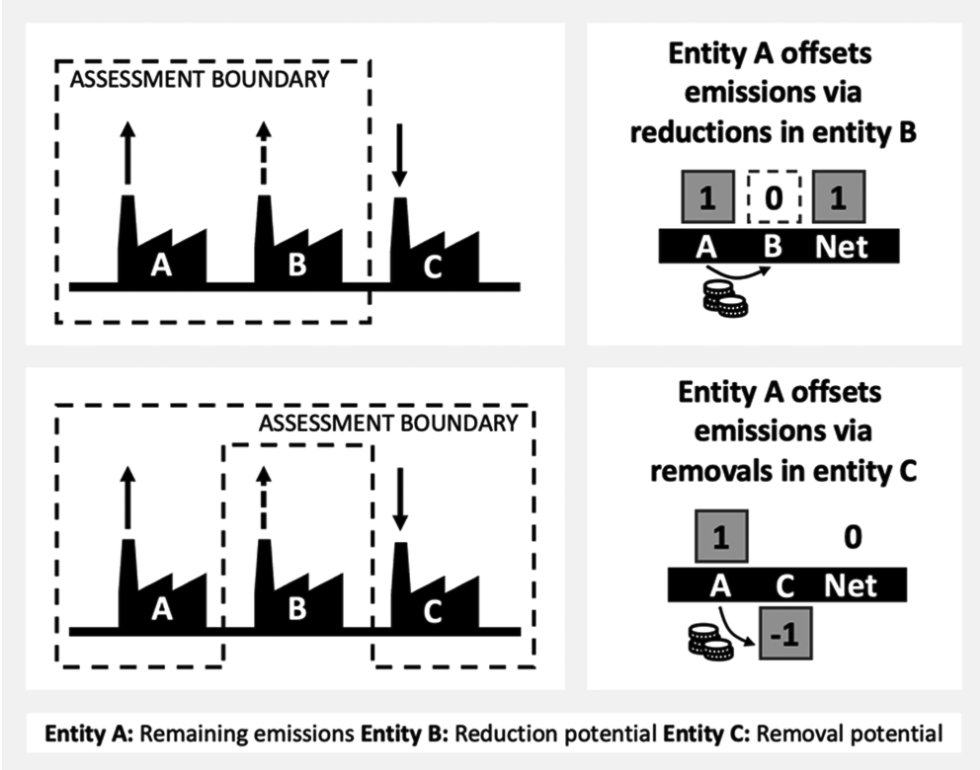

As mentioned at the beginning, this can also be explained from the perspective of boundary setting. Even if a company that purchases Credits neglects Emission Reductions as a result, if Corresponding Adjustments are made for the procured Credits, Double Counting will not occur in the country that sold the Credits. Therefore, a net Reduction effect is recognized for the system as a whole.
Regarding the latter, first, we are not arguing that companies purchasing Credits should reduce their Emission Reduction efforts within their corporate Value Chain. While it is certainly desirable that Emission Reduction efforts do not decrease, we believe there is no problem if Corresponding Adjustments are made in the country originating the Credit.
Conversely, this implies that if a company Retires Credits without Corresponding Adjustments, and subsequently does not advance Emission Reductions within its Value Chain (compared to if it had not Retired the Credits), there may be no net Reduction effect. This is a typical situation where Carbon Credits are criticized as a "right to pollute."
Currently, Corresponding Adjustments are not mandatory for voluntary Credit use, but from the perspective mentioned above, we believe companies should adopt a clearer stance on Corresponding Adjustments.
Prerequisites for the above logic to hold
However, the above argument (i.e., the net transfer of Greenhouse Gases to the atmosphere has the same impact whether it's a Removal Credit or an Emission Reduction Credit) comes with several prerequisites. These include the key Carbon Credit principles: Additionality, conservative Baselines, and Durability. While these principles are stipulated as requirements, many projects registered to date have not adequately met them in practice.
In particular, over the past few years, REDD+ (Reducing Emissions from Deforestation and Forest Degradation) activities have been criticized for having inappropriate Baseline settings and issuing an excessive number of Credits compared to actual reductions3.
On the other hand, for projects generating Removal Credits, the Baseline can often be assumed to be zero4. Furthermore, many such projects have no revenue streams other than Carbon Credits, making it possible to clearly claim Additionality.
Thus, from the perspective of Carbon Credit credibility, the argument that Removal Credits are less "problematic" than Emission Reduction Credits may be reasonable. However, Removal Credits, particularly activities referred to as Engineered CDR, have also been pointed out to have negative impacts other than carbon, such as adverse effects on ecosystems.
For Emission Reduction Credits as well, various Methodology revisions over the past few years have led to more conservative calculations of Credit quantities. In particular, the Core Carbon Principles (CCP) by IC-VCM have become the foundational idea driving many Carbon Standards like Verra, Gold Standard, ACR, and CAR to revise their Methodologies in a stricter direction.
In this way, we believe that the aforementioned conditions are coming into effect5.
Fair Carbon Budgets and Residual Emissions for Each Country
Now, we will finally delve into the content of reference [1], introduced at the beginning. The arguments in this paper can be summarized as follows:
- Currently, there is a perception that there is not much time left regarding the Carbon Budget, but that each country "has not yet exhausted it." However, depending on the perspective, most developed countries have already exhausted their Carbon Budget and are carrying significant carbon debt.
- Based on this perspective, carbon debt would peak in the year Net Zero is achieved, and even after Net Zero, a large amount of carbon Removal will be necessary to repay that debt.
Concept of Carbon Budget Allocation
First, let's look at the concept of Carbon Budget allocation. According to reference [4], as of the beginning of 2024, the amount of carbon that can be emitted with a 50% probability of limiting warming to 1.5°C is approximately 200 GtCO2. Considering recent global annual emissions of 41 GtCO2, it is projected to be used up within 6 years.
Normally, Carbon Budgets are determined by the concept of "grandfathering." This idea allocates more budget to those who have historically emitted more. Under this concept, it is true that all countries still have at least a few years' worth of remaining Carbon Budget.
On the other hand, the "equal per capita model" [5] allocates Carbon Budget proportionally to population, and under this approach, most developed countries have already exhausted their Carbon Budget. Another method of Carbon Budget allocation, based on "ability to pay," which considers a country's economic capacity for Emission Reduction and Removal, is also mentioned, and it is pointed out that this yields similar allocation results to the "equal per capita model."
Concept of Carbon Debt and Required Removals
Now we move on to the second point. This paper discusses the required Removals using Europe as an example. Following reference [5], in a scenario where the EU's fair share of the Carbon Budget is assumed to have been exhausted in 2009, net zero CO2 emissions (i.e., emissions equal to removals) are achieved in 2045, and the carbon debt that began accumulating in 2009 peaks in 2045 and is repaid by 2100.
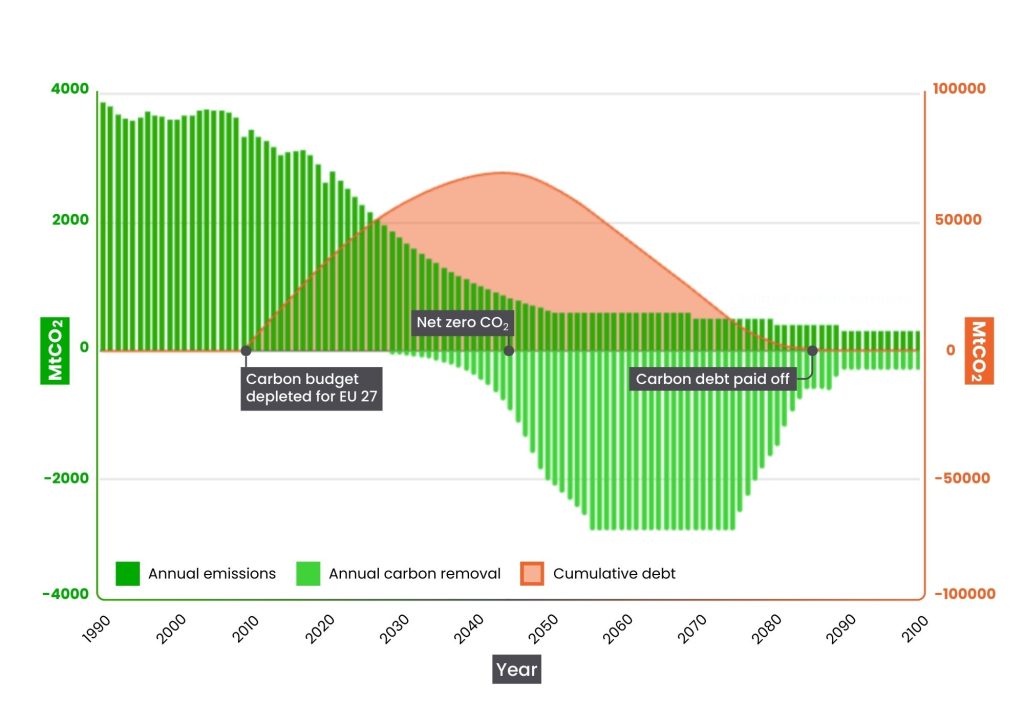
What is notable here is that (rather than grandfathering) according to the "equal per capita model" in reference [5], the Carbon Budget for the EU was already exhausted in 2009, and as of 2024, the carbon debt exceeds 40 GtCO2. To repay this massive debt, an annual Removal of 2 GtCO2 will be required, in addition to "Removals necessary to neutralize ongoing emissions to maintain Net Zero."
Here, let's re-organize "residual emissions" and "excess emissions" (some other terms are shown in the figure below, but we will omit their explanation here).
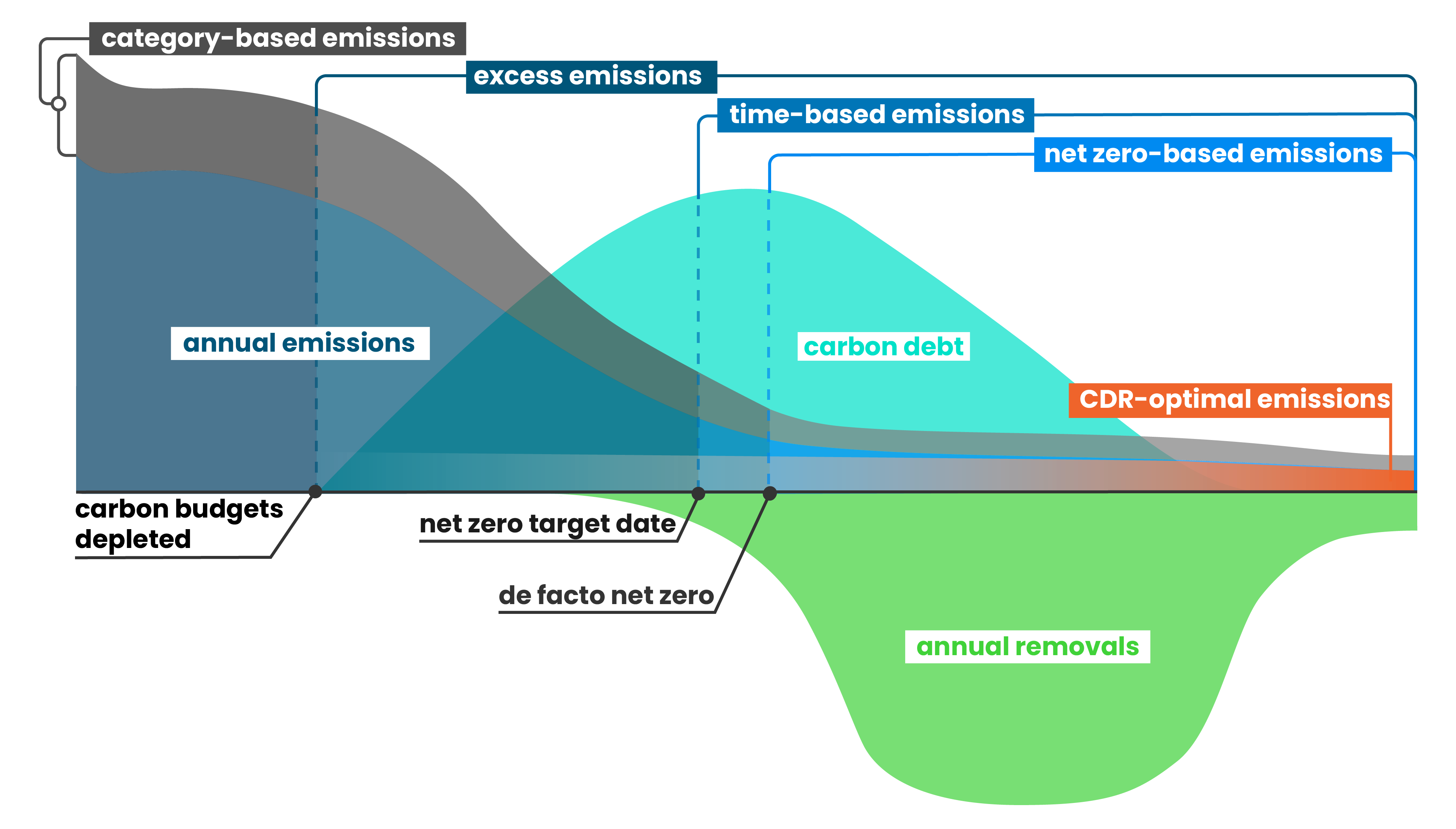
Residual emissions refer to the part corresponding to "Removals necessary to neutralize ongoing emissions to maintain Net Zero," as mentioned above. Generally, it refers to the emissions that remain even after reductions have been made in line with a scientific Emission Reduction pathway. This is the portion that SBTs require to be "neutralized by Removal Credits," and in the figure above, it corresponds to the part labeled "net zero-based emissions"6.
In contrast, excess emissions refer to emissions that exceed the Carbon Budget, and as shown in the figure above, they represent total emissions from the point at which the Carbon Budget was exhausted.
Reference [1] argues that not just "residual emissions," but *all* "excess emissions" must be Removed to achieve Net Zero. This is the meaning of the title of reference [1], "All Excess Emissions must be Removed."
This section has shown that what constitutes the responsibility of each country/company to achieve Sub-Global Net Zero largely depends on how the Carbon Budget is allocated and what constitutes a fair Carbon Budget allocation.
Conclusion
Recently, investment in Credits has been revitalized by a limited number of players, primarily Microsoft, which has set a goal to Remove all CO2 emitted since its founding by 2050. As a result, Credit prices are generally on an upward trend.
Until now, REDD+ had been caught in a negative cycle. Recently, REDD+ Credits, which used to be traded generally for around 3-5 dollars, are now frequently traded for 15-20 dollars. Higher prices enable Project Development in areas where Additionality is clearer and the risk of Deforestation is higher (i.e., areas with high opportunity costs). We expect that rising prices will make it possible to form projects with higher environmental contributions, moving into a positive cycle.
For this to happen, it is crucial for the market to broaden beyond its current state, where it is driven by a limited number of players, and for demand to grow. If demand follows, prices will rise accordingly, making it economically feasible to form reliable projects.
While Removals are important, we imagine that some sectors and companies find it difficult to procure Removal Credits due to carbon intensity or industrial structure. For the Carbon Credit market to truly gain demand, it is important that the effectiveness of Emission Reduction Credits is also recognized and they are traded.
This concludes Sustainacraft's newsletter (special edition).
Our company profile can be viewed here.
Disclaimers:
This newsletter is not financial advice. Please do your own research and due diligence.

Academic institutions and NGO/NPO interested in subscribing to the paid version should contact us individually.
This refers to the approach to Credit handling in SBTs. ↩
Project-level Permanence cannot be guaranteed; it is assumed to be secured by some method, such as a Buffer at the overall system level, like a registry. ↩
For criticisms regarding REDD+, please refer to this article, among others. ↩
Depending on project settings, a non-zero Baseline may be appropriate in some cases. ↩
Regarding Methodology revisions, this newsletter covers various topics monthly, so please refer to it if interested. ↩
Strictly speaking, some supplementary explanations are needed, but they are omitted here. ↩