
Calculation of Baseline and Leakage under Paris Agreement Article 6.4
This article is an automatically translated version of the original Japanese article. Please refer to the Japanese version for the most accurate information.
Sustainacraft Inc. Newsletter.
Methodology Updates is a series that covers carbon and biodiversity credit Methodologies. This article introduces the guidance on baseline setting and leakage treatment under Paris Agreement Article 6.4, which was held this month.
Introduction
In mid-May 2025, the 16th Supervisory Body Meeting (SBM 016) of Paris Agreement Article 6.4 was held. An overview of this meeting was briefly covered in the VCM section of our company's newsletter this month.

A significant decision at SBM 016 was the adoption of standards defining baseline setting and leakage treatment under Article 6.4. The positioning of these standards is not as individual Methodologies (e.g., VM0048 or VM0042) that Project Developers reference to create a PDD, as we typically introduce in this newsletter. Instead, they serve as guidance that defines the requirements for Methodologies to be tradable under Article 6.4. In other words, they are used by individual Methodology developers as a reference, and by SBM to determine whether to authorize their use under Article 6.4. It should be noted that, currently, these standards apply to individual project-level Methodologies (e.g., VM0048), but there is a possibility that they may be revised in the future to apply to larger scales (e.g., JNR).
This article will first briefly introduce an overview of SBM and past discussions, then detail the content of the newly adopted baseline setting standards and leakage standards, respectively.
Paris Agreement Article 6.4, SBM, and MEP
Paris Agreement Article 6 defines mechanisms for Parties to cooperate internationally to achieve their Greenhouse Gas (GHG) emission reduction targets (NDCs). This includes market mechanisms for the international transfer of Emission Reductions between bilateral and multilateral parties, and non-market-based cooperative approaches. Within this, Paris Agreement Article 6.4 stipulates a specific mechanism for the international transfer of credits (A6.4ERs) generated from specific Emission Reduction projects operated under UN supervision. In terms of its position, it is the successor to the Clean Development Mechanism (CDM) under the Kyoto Protocol, but its specific rules are designed from scratch, leveraging lessons learned from the CDM. Notably, its requirements for environmental integrity are strengthened, and a distinguishing feature is the requirement for consent among participating countries and Corresponding Adjustments (CA).
The SBM (Supervisory Body Meeting) is tasked with developing and overseeing the requirements and processes necessary to operate the Article 6.4 mechanism. This includes the development and approval of Methodologies, Registration of activities, the accreditation of third-party Verification Bodies (designated operational entities, DOE), and the management of registries. SBM emphasizes transparency, and SBM meetings, unless kept private for confidentiality reasons, are open to the public, including through electronic means, and recordings are also made public. All proceedings of the SBM016 meeting introduced here are available on this YouTube channel.
To ensure efficient operation and secure expert knowledge for SBM, supporting bodies, namely the Methodological Expert Panel (MEP) and the Accreditation Expert Panel, have been established under SBM. In particular, the MEP plays a crucial role in conducting technical reviews on methodological issues such as baseline setting and leakage treatment, and making recommendations to SBM. Based on the general guidance from the CMA (Conference of the Parties serving as the meeting of the Parties to the Paris Agreement) and specific instructions from SBM, the MEP typically drafts proposals, which SBM then deliberates and adopts.
Past Discussions at SBM
(*This section's explanation is limited to baseline setting and leakage treatment.)
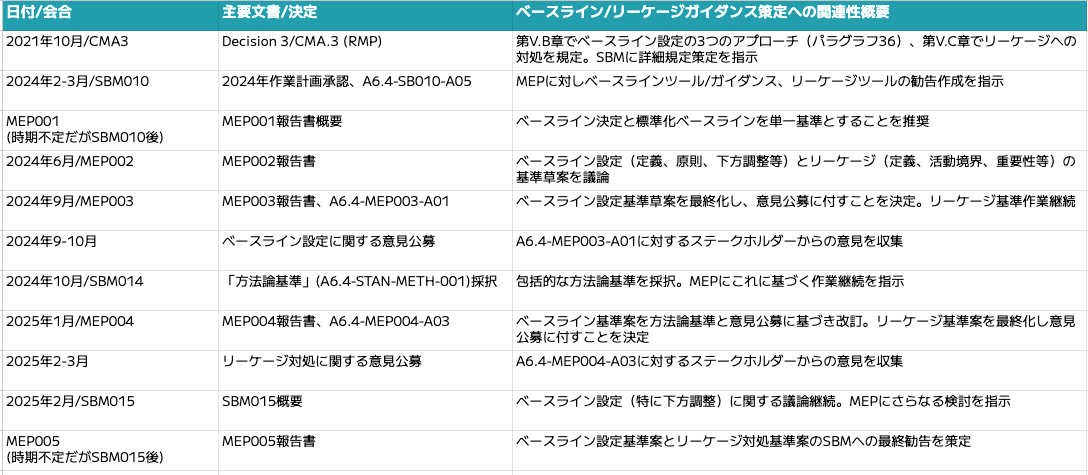
In the Article 6.4 mechanism, Methodologies for baseline setting and leakage have been progressively concretized since the adoption of the Paris Agreement.
The most fundamental framework for Article 6.4 Methodologies was provided by Annex to Decision 3/CMA.3, adopted at CMA3 (Glasgow) in 2021, titled "Rules, modalities and procedures for the mechanism established by Article 6, paragraph 4, of the Paris Agreement" (hereinafter RMP). The RMP serves as the legal basis for the entire Article 6.4 mechanism and sets high-level rules that SBM and MEP must adhere to when developing detailed standards.
The comprehensive development of guidance on baseline setting and leakage formally began at SBM010, held in February 2024. At this meeting, SBM approved its 2024 work plan and requested the MEP to develop recommendations for guidance on baseline tools and standardized baselines. In response, the MEP subsequently developed drafts through multiple meetings. At MEP003 (September 2024), a draft standard for baseline setting was finalized, and it was agreed to conduct a public input process for it. Work on the leakage standard continued at this time.
However, agreement on baseline setting was not reached at SBM015 (February 2025). In particular, the complexity of balancing environmental integrity with project feasibility became a point of contention regarding downward adjustments and ensuring below Business as Usual (BAU). This point will be elaborated on in the section below.
Finally, at MEP005 (likely held just before SBM016), the final recommendations to SBM concerning both baseline setting standards and leakage standards were compiled. This formed the basis for their adoption at SBM016.
From here, we will specifically introduce the content of the standards adopted at SBM016.