
Research Highlight: Editorial: Forest carbon credits as a nature-based solution to climate change? (1/n)
This article is an automatically translated version of the original Japanese article. Please refer to the Japanese version for the most accurate information.
This is sustainacraft Inc.'s Newsletter (Special Edition).
This is the first in a series introducing 2-3 articles from the editorial (Editorial: Forest carbon credits as a nature-based solution to climate change?), published in August 2023, concerning forest Carbon Credits. Approximately nine papers are featured, covering a wide range of topics such as Additionality, Permanence, and Leakage.
Recently, West's paper (pre-peer-review at the time), which was covered in the article below, was published in Science magazine. While opinions from Verra, Everland, and rating agencies have emerged in response, the content and approach of the paper, including the reactions, haven't sparked significant new discussions, so we will omit further introduction. For those interested, please refer to the links above. Please note that our newsletter concerning the Guardian article below has been our most viewed publication to date.

In this article, we will introduce the contents of the following three articles related to Improved Forest Management (IFM).
(1) California’s forest carbon offsets buffer pool is severely undercapitalized
(2) Comprehensive review of carbon quantification by improved forest management offset protocols (repost of previous introduction)
(1) California’s forest carbon offsets buffer pool is severely undercapitalized
(link)
This year alone, numerous forest fires have occurred, particularly in the Northern Hemisphere, including North America and Europe. This paper analyzes the Carbon Credit standard used in California's cap-and-trade program from the perspective of the Buffer Pool.
The conclusion is that the current Buffer Pool is not adequately sized to compensate for the risks posed by forest fires.
1) Background: The Concept of a Buffer Pool
First, let's explain how a Buffer Pool works. The purpose of a Buffer Pool is to function as a safeguard to ensure the Permanence of previously issued Credits. It can be thought of as an insurance mechanism to ensure that each Carbon Credit represents one ton of CO2 Emission Reduction or Avoidance, even if some carbon stock is unexpectedly lost due to events like forest fires. In each project, not all verified quantities are available for sale; instead, the quantity is the net Emission Reduction or Removal, minus a Buffer calculated according to a specific methodology.
Regarding the duration for guaranteeing Permanence, the Integrity Council for the Voluntary Carbon Market (IC-VCM) recently announced requirements at the category level under the Core Carbon Principles (CCP), which set a 40-year monitoring and compensation period for Nature-based Carbon Credits such as REDD+, Agricultural Land Management (ALM), Afforestation, Reforestation and Revegetation (ARR), and Blue Carbon. (Meanwhile, a 100-year monitoring and compensation period is being considered for the next update).
With Verra, the amount of Buffer deducted is calculated using a Permanence assessment tool called the Non-Permanence Risk Tool (NPRT), which includes aspects such as:
- Internal Risks: project management activities, financial viability, opportunity costs of not continuing carbon storage, project residual duration, etc.
- External Risks: land tenure and ownership, prior informed consent, local governance, etc.
- Natural Risks: fires, pests and diseases, extreme weather events, etc.
Recently, Verra updated its Permanence assessment tool. We plan to cover this in our September Methodology Update, but it includes numerous updates such as requirements specific to Agricultural Land Management (ALM) projects, risks related to Sea Level Rise (SLR), future climate change risks, and political risk assessments.
Recently, the World Resources Institute (WRI) also released a report on forest fires, based on research from the University of Maryland. In 2021 and 2022, 9.3 million and 6.6 million hectares of forest were lost respectively, with an increase in forest fires particularly in boreal forests in Canada, Russia, and other northern regions.
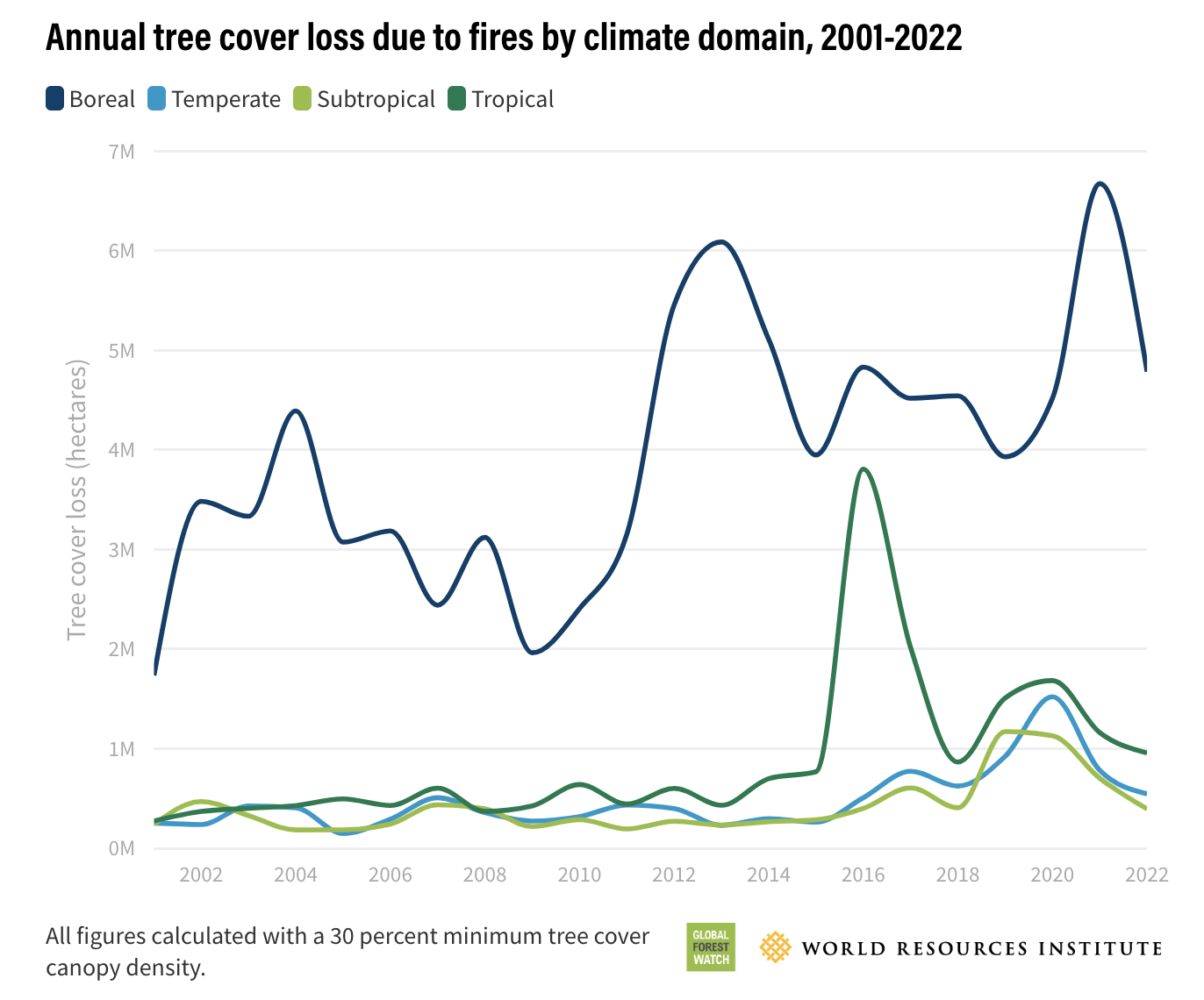
A feedback loop is pointed out, where climate change increases the risk of forest fires, which in turn accelerates climate change.
The paper introduced below analyzes whether the current Buffer Pool adequately guarantees Permanence given the recent trends in forest fires, particularly against the backdrop of increasing forest fires in North America.