
Monthly: Methodology Updates (July)
This article is an automatically translated version of the original Japanese article. Please refer to the Japanese version for the most accurate information.
This is the Sustainacraft Inc. newsletter. This Monthly Methodology Update will primarily focus on topics related to VCS Methodology revisions announced in June 2023.
While there isn't major news regarding methodologies this month, revisions for many activity types have been announced, including REDD+, Methane (CH4) from rice cultivation, Improved Forest Management (IFM), Blue Carbon, Cookstoves, and Biochar.
As mentioned primarily in the section on Methane (CH4) from rice cultivation, a gap can be observed with the J-Credit Scheme in terms of rigor. Over the past few years, as the Voluntary Carbon Market for Credits expanded, there were many discussions regarding quality. As a result, many revisions leaning towards a more conservative approach have been announced.
On the other hand, the J-Credit Scheme is currently at a crucial phase for expansion, so its Methodologies are likely designed to prioritize project creation through simpler means. However, if the aim is to look at international trends and qualify as a Credit under international standards like CORSIA, it may be necessary to anticipate significant Methodology revisions at an early stage.
Furthermore, observing the criticism regarding Australia's ACCU and the reactions to it, it seems that being a "state-led scheme" does not necessarily mean quality does not need to be considered1.
Monthly Methodology Update
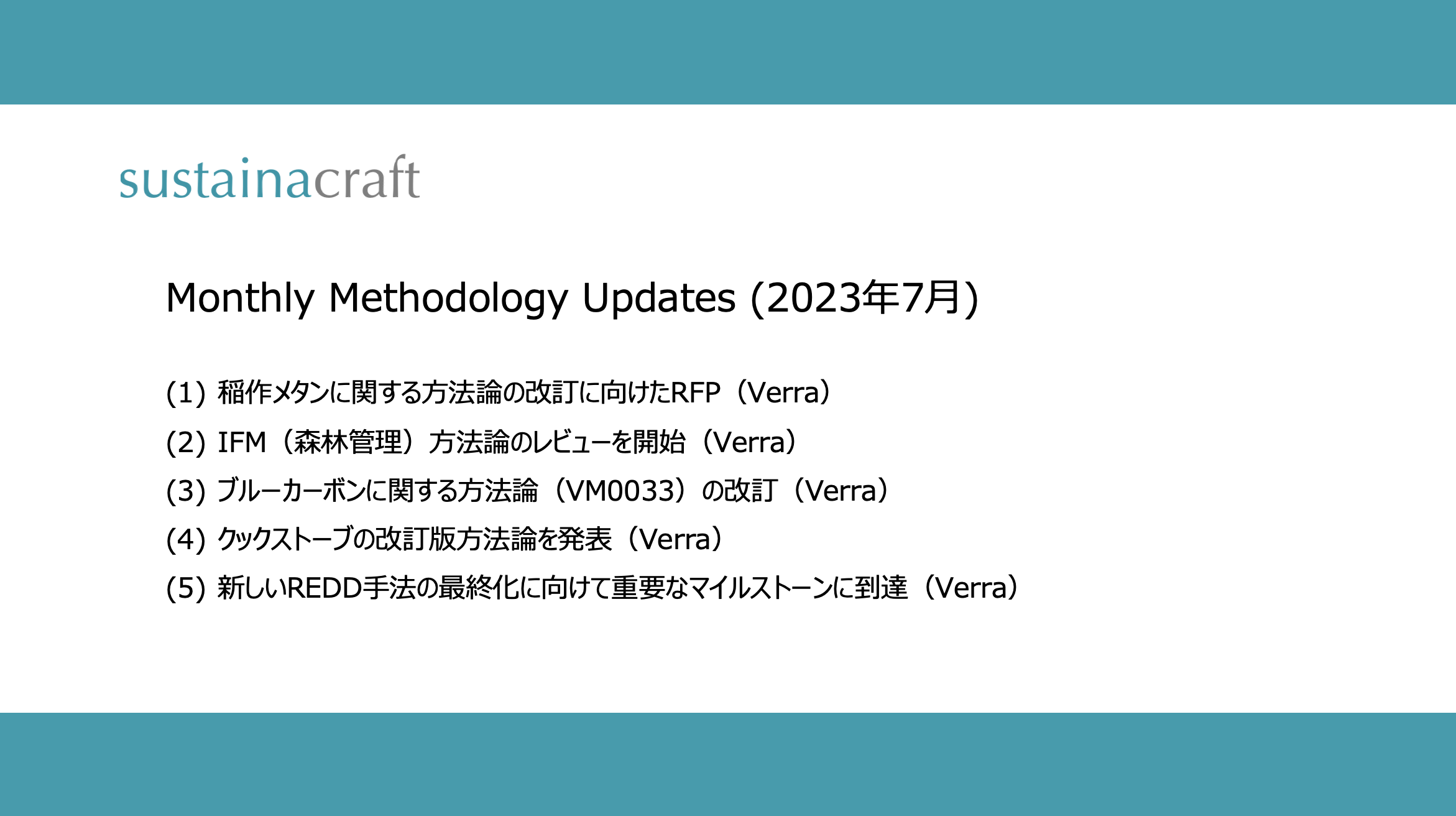
This month's updates cover the following:
- RFP for a Methodology revision concerning Methane (CH4) from rice cultivation (Verra)
- Review of Improved Forest Management (IFM) Methodology initiated (Verra)
- Revision of Blue Carbon Methodology (VM0033) (Verra)
- Revised Cookstoves Methodology published (Verra)
- Significant milestone reached towards finalizing new REDD+ approaches (Verra)
(1) RFP for a Methodology revision concerning Methane (CH4) from rice cultivation (Verra)
(link)
Previously, we introduced the Cancellation of CDM's AMS-III.AU (Methane emission reduction by adjusted water management practice in rice cultivation), which Verra had used, in this article. The existing Methodology was primarily based on the premise that extending the mid-season drainage period would suppress methane emissions. However, evidence suggesting that such project activities contribute to increased nitrogen emissions and Soil Organic Carbon (SOC) loss was among the reasons for its Cancellation.
The RFP issued this time anticipates a revision to be incorporated into the existing Agricultural Land Management (ALM) Methodology, VM0042. As introduced here, VM0042 notably features statistical descriptions and references VMD0053 as a module. This RFP also requires that models for changes in Methane (CH4), Nitrous Oxide (N2O), and Soil Organic Carbon (SOC) stock be described in alignment with VMD0053, as stated below, indicating an expectation of a more rigorous revision.
Guidelines for using models and testing their performance to estimate CH4 and N2O emissions and SOC stock changes aligned with existing guidance in the VMD0053, v2.0
Furthermore, VM0042 anticipates a process where the Validation/Verification Body (VVB) can request experts in this field to verify the modeling components, thus advancing the establishment of processes aligned with the latest science.
"Extension of mid-season drainage periods in paddy rice cultivation" was approved as a new Methodology in the J-Credit Scheme in March of this year, drawing significant attention in Japan. As the J-Credit Scheme itself is advancing applications for CORSIA-eligible Credits, it is necessary to closely monitor such overseas Methodology revisions concerning Methane (CH4) from rice cultivation.
In particular, since this revision is fundamentally oriented towards a more conservative calculation of project effects, understanding whether the J-Credit Scheme will adopt a similar approach and how it will be perceived internationally is important for companies using Credits generated from paddy methane projects.