
Monthly: VCM Updates (September)
This article is an automatically translated version of the original Japanese article. Please refer to the Japanese version for the most accurate information.
This is Sustainacraft Inc.'s newsletter. This edition is a Monthly VCM Update, focusing on topics related to the Voluntary Carbon Market and international regulations, primarily those announced in August 2023.
Monthly VCM Update
This month, we introduce the following topics:
A. Voluntary Carbon Credit Market Trends
B. Trends in Key International Regulations
- Benefit Sharing with Indigenous Peoples and Local Communities (IPLCs)
- Developments in African Nations
- Launch of the Asia Carbon Institute
A. Voluntary Carbon Credit Market Trends (Verra)
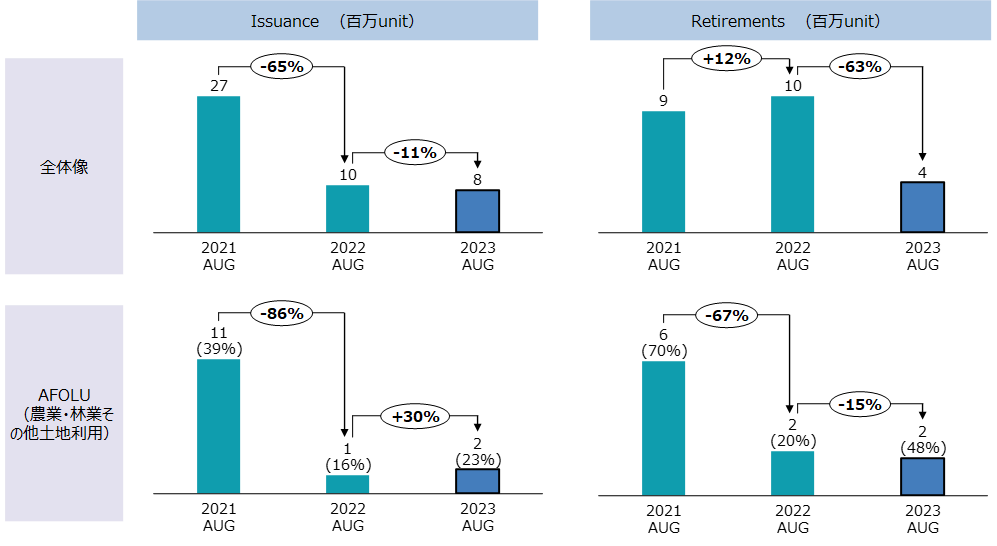
In August 2023, 8,445,814 units of Verra Voluntary Carbon Credit were newly issued, and 3,615,167 units were retired. These figures represent decreases of 11% and 63% respectively compared to the same month last year.
Focusing on the AFOLU (Agriculture, Forestry and Other Land Use) sector, 1,921,109 units were issued and 1,722,332 units were retired. These represent a +30% increase and a -19% decrease respectively compared to the same month last year.
This is a list of projects retired in August 2023 (AFOLU sector only). The top 20 projects accounted for over 80% of total retirements. By country of retirement, Brazil was the largest (32%), followed by Indonesia (23%), China (13%), Cambodia (10%), and Peru (9%).

The top 20 companies that retired Carbon Credits from the Verra AFOLU sector are as follows. Companies from the Energy, Mining, Financial Institution, Consulting, and E-commerce industries accounted for these retirements. Route, ranked eighth, is an e-commerce platform that offers Carbon Neutral Shipping. It states that by choosing Green Package Protection when using e-commerce, delivery will be conducted through carbon-neutral means.

B. Trends in Key International Regulations
This section reports on updates regarding key regulations and related information concerning the use and quality of Voluntary Carbon Credits, as well as the protection of forests and natural resources.
B-1. Benefit Sharing with Indigenous Peoples and Local Communities (IPLCs)
(Source: The Nature Conservancy)
Nature-based Carbon Credit projects are implemented using land. These lands may be owned by corporations or by multiple Indigenous Peoples and Local Communities (IPLCs). When owned by corporations, their ownership is recognized by the local governing authorities. However, even in such cases, it is possible that the customary land rights of IPLCs related to that land may be overlooked. Therefore, in nature-based Carbon Credit projects, regardless of the form of documented land ownership, careful evaluation is required to ensure that IPLCs are appropriately involved and that the method of Benefit Sharing for IPLCs' contributions is adequate.
Criticism regarding insufficient Benefit Sharing for Indigenous Peoples and Local Communities has recently garnered attention, notably in reports such as Carbon Market Watch's "Secretive intermediaries: Are Carbon Markets Really Financing Climate Action?" As also discussed in this month's newsletter, proposed legislation in various African nations seeking a certain percentage of distribution to governments and local communities for Carbon Credit projects conducted within their borders can also be seen as an effort to counter insufficient Benefit Sharing for IPLCs.
In response to this issue, The Nature Conservancy (TNC), which promotes many nature-based Carbon Credit projects, published a report titled "Beyond Beneficiaries" on August 18, comprehensively outlining the challenges and proposed solutions related to this problem. This month, we will introduce excerpts from this report. While it does not offer specific solutions or detailed evaluation criteria, I believe it provides a clear framework for assessing the IPLC issues within nature-based Carbon Credit projects.
The report divides its discussion into four sections: 1) Current Framework, 2) Gap, 3) Standards, and 4) Solutions, explaining the current state of Benefit Sharing for IPLCs, the problems, the response of existing standards, and the direction for solving these issues. In this newsletter, we will introduce the content described in section 2) Gap and the related section 4) Solution.
Currently, inequities are arising in the distribution of revenues generated by Carbon Credit projects for various reasons. This can lead to disparities between project proponents, developers, and funders on one hand, and landholders (often IPLCs) on the other, as well as inequalities among different groups within IPLCs who may or may not be beneficiaries.
The reasons for this inequity include issues stemming from individual projects (PROJECT LEVEL GAPS) and broader issues beyond individual projects (BEYOND PROJECT GAPS).