
SBT FLAG Guidance / Ceres' Carbon Credit Use Assessment
This article is an automatically translated version of the original Japanese article. Please refer to the Japanese version for the most accurate information.
This is the inaugural newsletter from sustainacraft Inc. In this newsletter, we plan to provide information in Japanese on Nature-based Solutions (NbS) bi-weekly to once a month.
Since the start of 2022, numerous important guidelines related to NbS have been released. In this first newsletter, we will highlight a few of them.
PickUp Section
Science Based Targets (SBT) Guidance for FLAG Sectors
(Source, January 2022)
- The number of private companies participating in Science Based Targets (SBT), an initiative for setting targets aligned with the levels required by the Paris Agreement, is increasing year by year.
- FLAG refers to the forest, land, and agriculture sectors. A draft of the SBT guidance for FLAG sectors was released in January 2022.
- The FLAG sector, also academically known as AFOLU (Agriculture, Forestry and Other Land Use), accounts for approximately one-quarter of the world's annual anthropogenic Greenhouse Gas (GHG) emissions of 50 billion tons (Carbon Dioxide equivalent).
- This guidance outlines which companies should set FLAG SBTs and what they should do by when.
- What is important here is the positioning of FLAG SBTs, with the following statement found in Chapter 1, Introduction, "1.3 How do FLAG SBTs differ from non-FLAG SBTs?"
”It is important to note that because FLAG SBTs are separate from non-FLAG SBTs, FLAG abatement cannot be used to meet non-FLAG abatement targets (e.g., emission reductions from agricultural activities in a company’s supply chain cannot be used to meet facility or office emission reduction targets). That is, companies cannot account for biogenic removals in their value chains to meet non-FLAG targets. Biogenic removals may be accounted for to meet FLAG targets.”
- This draft states that, as a business activity, GHG emissions from the industrial sector cannot be Offset by Emission Reductions in the FLAG sector, and it does not explicitly mention how Carbon Credits will be treated.
- However, for example, carbon-neutral LNG is Offset with forest Credits, but following this guidance, there is a possibility that this would not be recognized in the context of SBTs.
- Regarding Offsetting with Credits, various companies have different approaches, but here we will conclude by quoting the case of Unilever.
(Quote from the following Ceres report)
Unilever notes that it will focus on reducing emissions this decade, not on offsetting. However, the company is also creating a €1 billion climate and nature fund to invest in NCS projects. While some of those NCS projects will generate credits for offsetting emissions in the future, the company does not know to what extent it will need to use carbon credits to neutralize residual emissions as it does not yet know to what extent it will reduce emissions by 2039.
Ceres' "Evaluating the Use of Carbon Credits"
(Source, March 2022)
- Ceres (Ceres) is a US-based non-profit organization.
- This report provides guidance to financial institutions and investors on how to assess companies that utilize Carbon Credits.
- As follows, financial institutions are encouraged to verify, when a company Offsets with Carbon Credits, what kind of projects they are, and whether these projects have obtained additional certification from a social and environmental standard (in addition to carbon sequestration, considering aspects such as Biodiversity and local job creation).
Recommendations for financial institutions to engage companies on high quality carbon credits
To ensure that carbon projects provide social and environmental benefits in addition to credible climate change mitigation, investors should ask companies to discloseThe GHG crediting programs, suppliers, and projects from which they source carbon creditsWhether their carbon credits have achieved additional certification from a social and environmental standard
- Over the past year alone, several initiatives have published guidance on how companies should utilize Carbon Credits, and this report organizes the main ones with links.
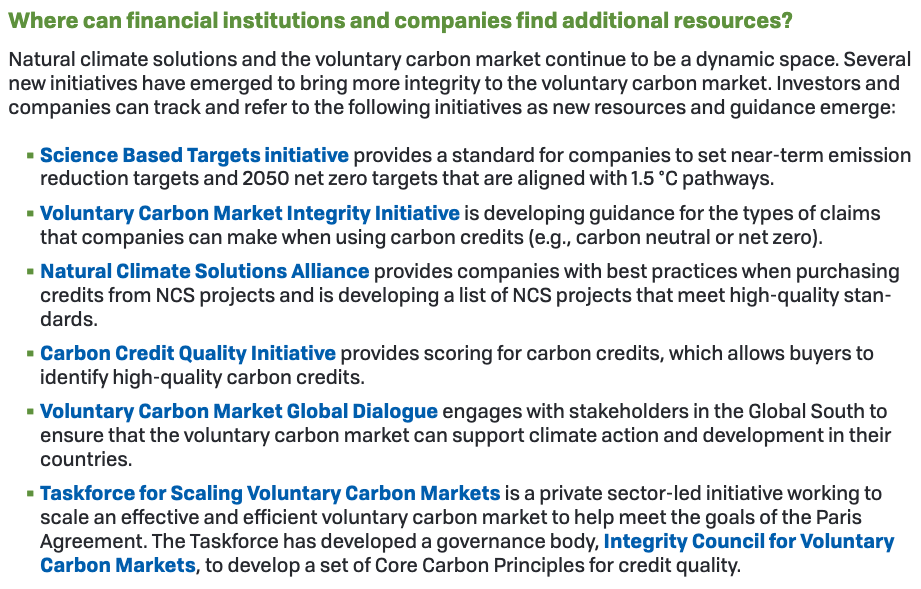
- For example, the Carbon Credit Quality Initiative (CCQI) provides comprehensive risk scores for nature-based and engineered Carbon Credits from multiple perspectives, including Permanence and transition to Net Zero.
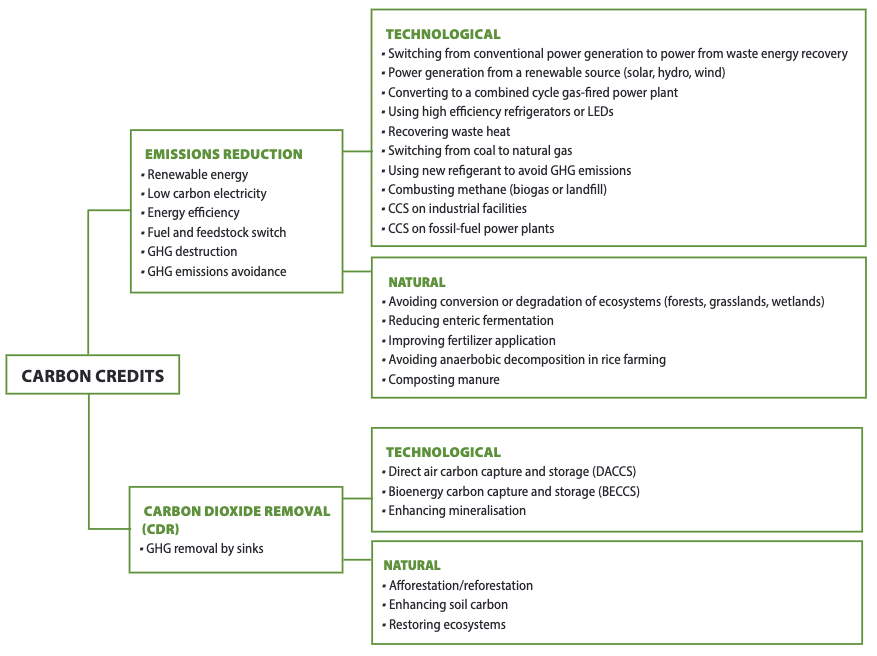
- The following is an excerpt from Figure 1 of the Ceres report. In the CCQI report, for instance, afforestation and reforestation are considered significant risks from the perspective of Permanence, while CCS at fossil fuel power plants receives a low rating of 2 out of 5 from the perspective of "transition to Net Zero."
Spatial Finance: Challenges and Opportunities in a Changing World
- Finally, we introduce a report from 2020.
- Quite recently (March 2022), the Taskforce on Nature-related Financial Disclosures (TNFD) prototype (beta version) was announced.
- Japanese summaries of this have been released by various sources, so here we introduce this report as it relates to TNFD.
- This report, authored by the World Bank and WWF, particularly emphasizes the importance of 'location-linked data' highlighted by TNFD and who will be responsible for providing that data, with TNFD mentioned multiple times.
- Under the recognition that the E (Environment) in ESG remains underdeveloped in the financial industry, the report discusses the importance of Spatial Finance, key data within it, and the key institutions that hold such data.
- Spatial Finance is described as follows:
Spatial finance is a geospatial-driven approach designed to provide ESG relevant insights into a specific commercial asset, a company, a parent company, a portfolio or national level scorings.
SPATIAL FINANCE -an emerging field, which works by defining the location of a company’s physical assets and their suppliers’ assets, and then comparing those assets against other datasets (observational data) to providing independent insights (often climate and environmental) into the performance of assets, companies, and even regions or states for use within the financial sector.
- Here, the classification of Asset Data and Observational Data is as follows:
Asset data is the ownership information (e.g. company name) and the geospatial information that defines the location of a commercial asset, i.e. real estate, a field, a mine, a factory, a powerline.
Observational data is classified as any data used to compare against asset data to provide insights.
- As an example of Asset Data, the World Resources Institute (WRI) publishes global power plant data.
- Observational Data includes information on Deforestation and climate change.
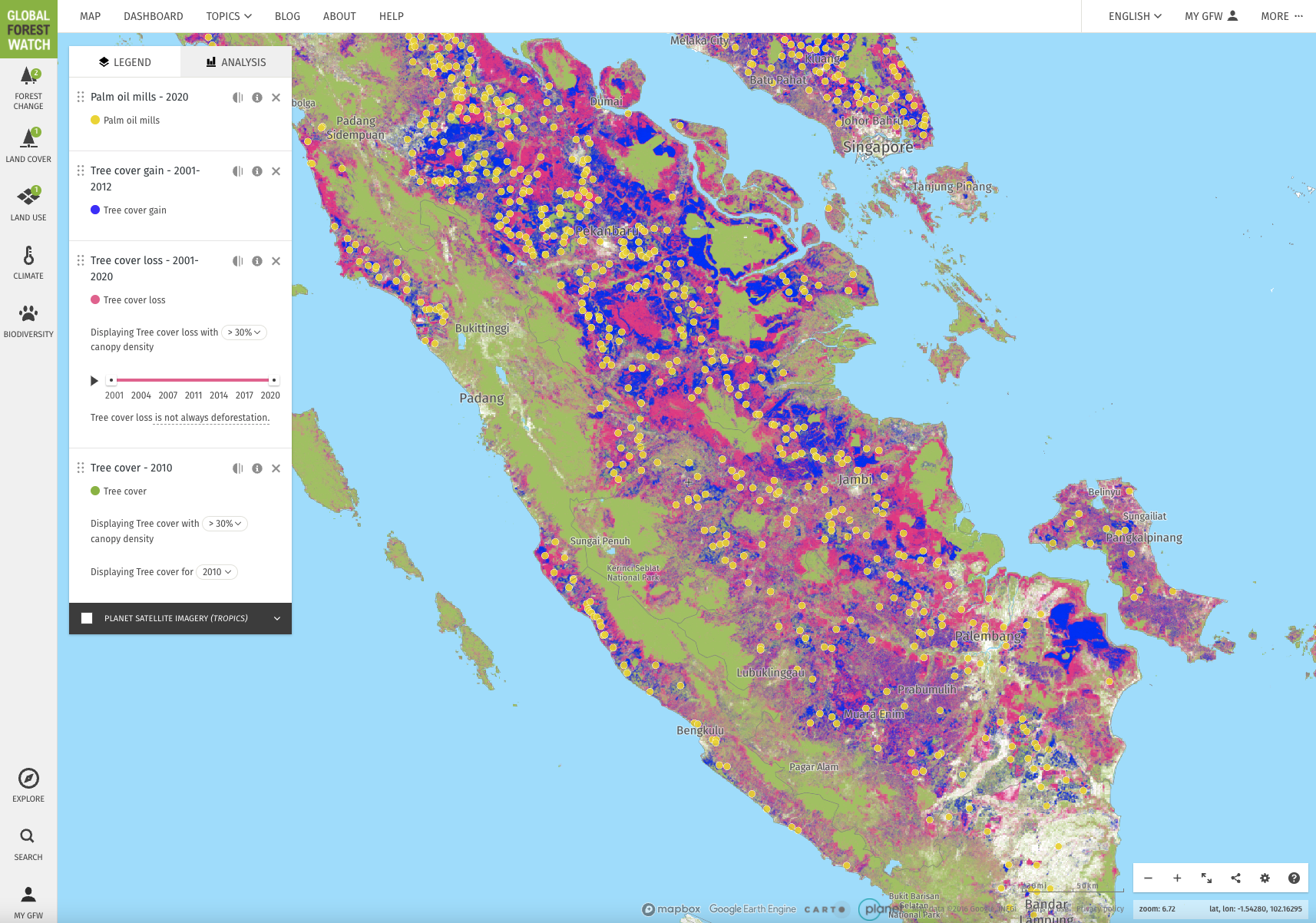
- Global Forest Watch allows for overlapping and analyzing Observational Data such as forest cover and Deforestation with Asset Data like palm oil mills.
- Spatial Finance is categorized into five layers, with an introduction to what data is obtained from what sources for each.
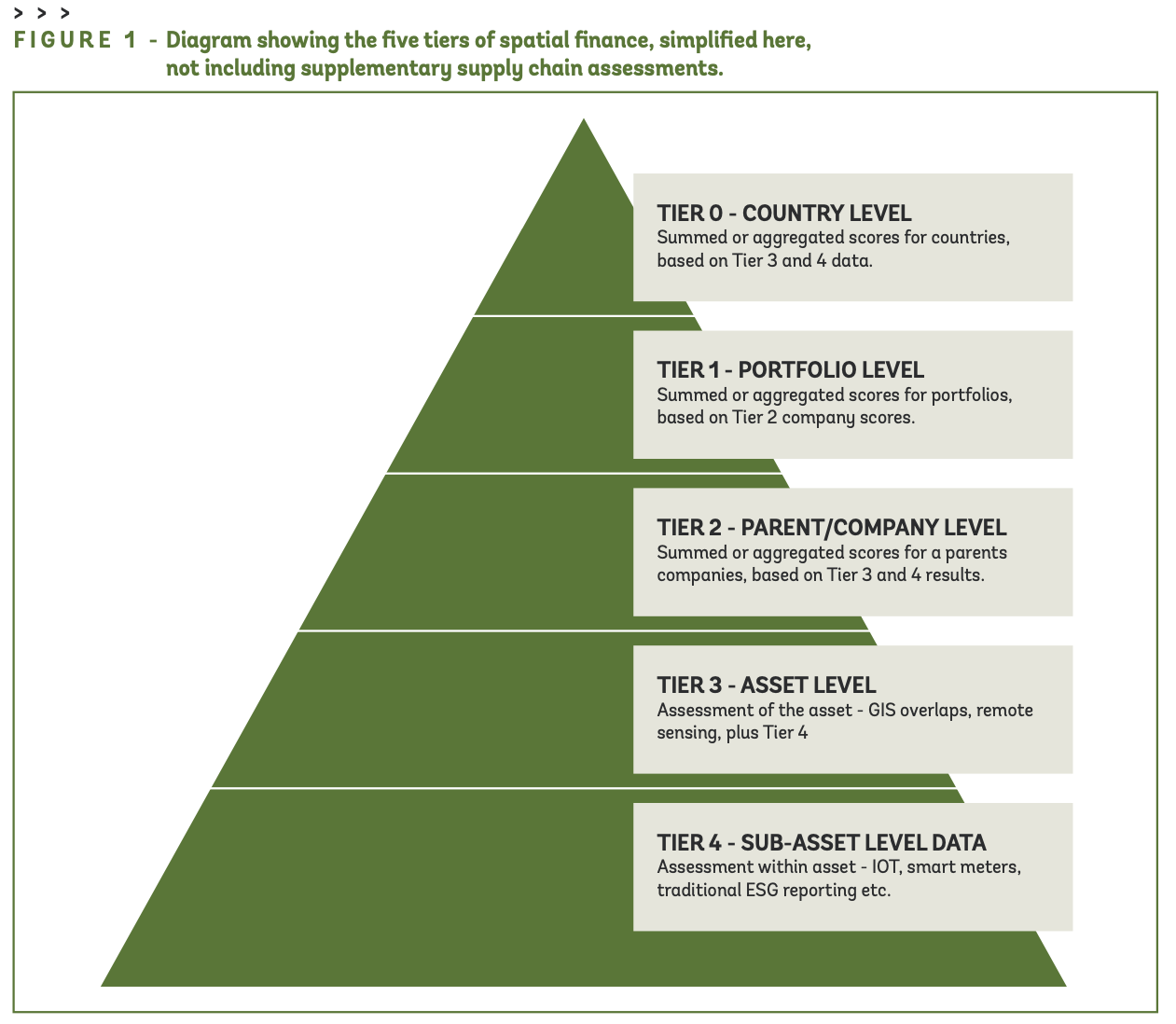
- Based on the above categorization, the following challenges are summarized:
Lack of Asset Data
Improving Tier 3 Climate and Environmental Observational Data
Tracking Parent Company and Company Trees
Benchmarking Scoring Methodologies
Supply Chain Asset Assessment
Complexities of Tier 4 Data
To address these, the following necessities are advocated:
Continuously develop data solutions by identifying needs through dialogue between climate and environment data experts and the financial sector.
Environmental NPOs, as key holders of climate and environmental data, have a responsibility to engage in this field and ensure that optimal data is available and correctly applied to provide reliable insights into spatial finance.
Such a portfolio of climate and environmental data should become a global public good.
News from sustainacraft
- We have joined the Science Based Targets Network Corporate Engagement Program.
- Currently, we are seeking verification partners (financial institutions and operating companies) for the SBT for Nature guidance and the aforementioned TNFD prototype.
- Operating companies will provide site and Supply Chain information, which we will use to perform layered analysis with data such as IBAT. We will then organize discussion points regarding the above guidance and prototype and provide feedback to the operating bodies.
- If interested, please feel free to contact us.
- Selected for Orange Fab Asia.

- Orange Fab Asia is an accelerator program operated by the French telecommunications carrier Orange, supporting Asia-based startups aiming for global expansion.
Closing remarks
When founding our company, we strongly felt that Supply Chain analysis and Remote Sensing2 from above are two crucial technological elements in sustainability. The importance of location-linked information emphasized by TNFD and the new concept of Spatial Finance align with this intuition.
Furthermore, the risk analysis tool for Deforestation related to Brazilian soybean procurement, released by the French government in November 2021, precisely embodies what is advocated in Spatial Finance.
It was striking to hear a sustainability manager from a large Brazilian soybean producer state recently that "in the future, soybeans that are not carbon-free will be unthinkable."
This concludes sustainacraft's inaugural newsletter. In this newsletter, we plan to provide information in Japanese on NbS bi-weekly to once a month.
Our company profile can be found here for your reference.
Disclaimers:
This newsletter is not financial advice. So do your own research and due diligence.

“World Bank; WWF. 2020. Spatial Finance : Challenges and Opportunities in a Changing World. Equitable Growth, Finance and Institutions Insight;. World Bank, Washington, DC. © World Bank. https://openknowledge.worldbank.org/handle/10986/34894 License: CC BY 3.0 IGO.” ↩
Recently, I've felt that there isn't a clear distinction between Remote Sensing and IoT. A study published at SIGGRAPH in 2014 reported that by filming a bag of potato chips in a room where sound is present, using a high-speed camera from outside the room, the sound inside could be reconstructed from the vibrations. This is an interesting approach that is both Remote Sensing-like and IoT-like. ↩