Measurement of Soil Organic Carbon
This article is an automatically translated version of the original Japanese article. Please refer to the Japanese version for the most accurate information.
PickUp Section
This is the 5th newsletter from sustainacraft Inc. This time, we will bring you topics related to Soil Organic Carbon Credits.
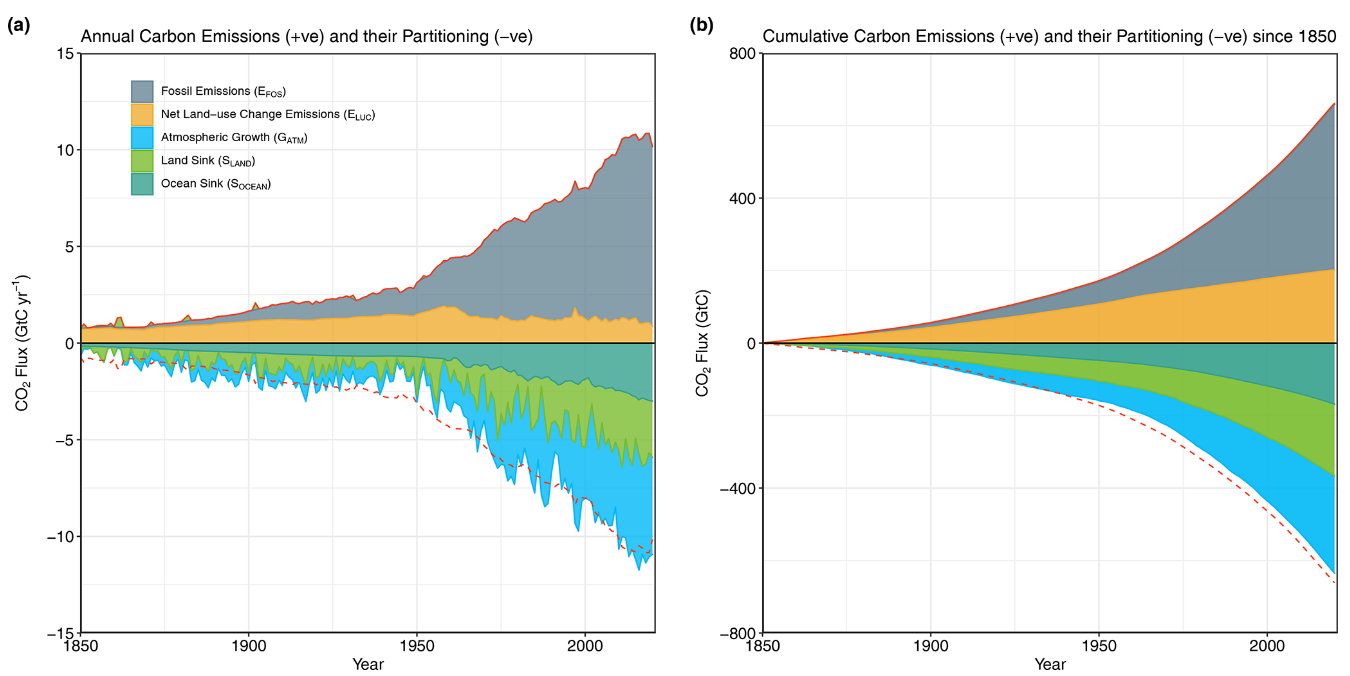
Since industrialization, GHG emissions have been continuously increasing. These increased GHG emissions have been absorbed by the atmosphere, oceans, forests, and soil on the Earth's surface. This absorption has grown in tandem with emissions (Global Carbon Budget 2021).
Which bears more carbon: forests or soil? According to Visualizing Carbon Storage in Earth’s Ecosystems, in most cases (all except tropical rainforests), soil stores more carbon than forests and vegetation.
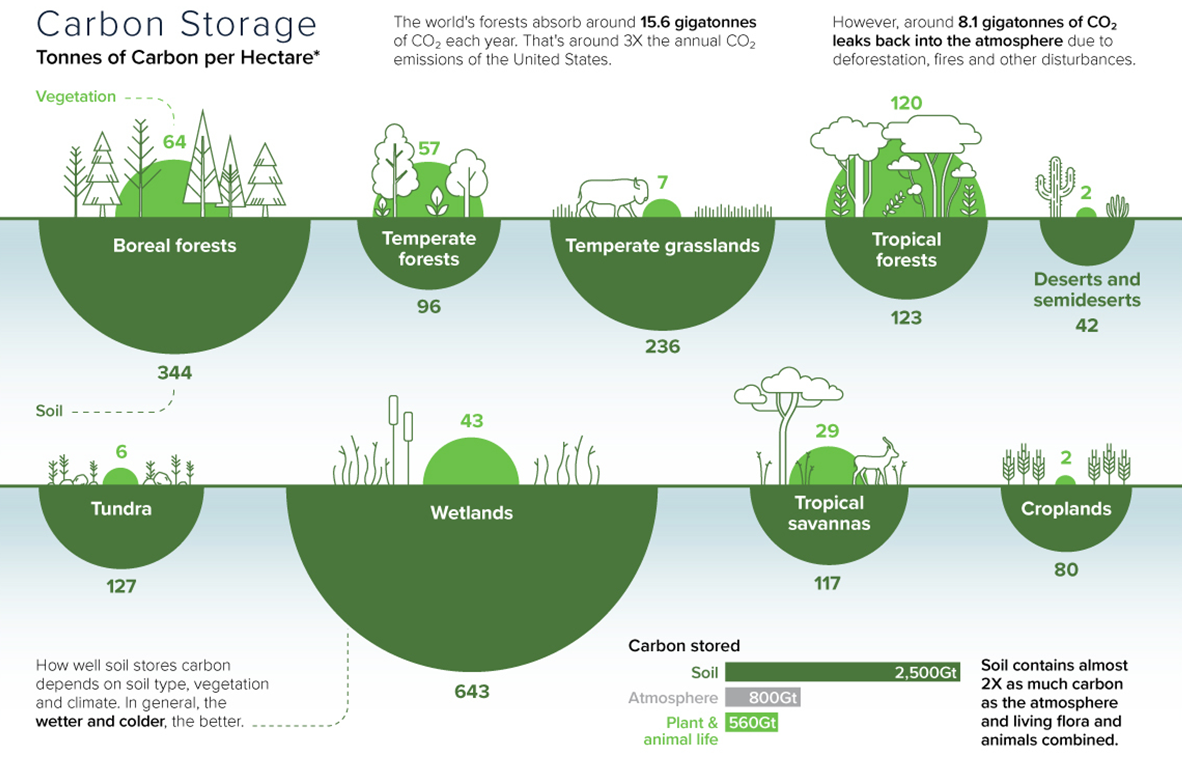
While previous newsletters have primarily focused on technologies and literature related to above-ground forests, this time we will explore the massive carbon storage potential of soil, efforts towards Carbon Credit Issuance, and the challenges of monitoring technology.
Methodologies for Carbon Credit Issuance Utilizing Soil Carbon Sequestration (Soil Organic Carbon)
Carbon sequestration in soil is achieved when dead plants and animals and their excretions on the surface form Soil Organic Carbon (SOC) underground, trapping carbon in the soil over the long term. SOC has been used to improve agricultural yields by 1) forming aggregates to enhance water retention and 2) increasing cation exchange capacity to improve nutrient retention.
While SOC has been studied for a long time from the perspective of yield improvement, it has not been widely utilized for climate change countermeasures or Carbon Credits. There are several reasons why carbon sequestration by SOC has not been widely implemented, one of which is the difficulty of Measurement, Reporting and Verification (MRV).
Carbon sequestration by forest vegetation can be measured based on tree species, wood density, and external appearance (DBH, tree height). (This is itself a challenging task and a development theme we are focusing on). Carbon sequestration by vegetation occurs through above-ground biomass (trunks, etc.) and below-ground biomass (roots). While below-ground biomass is difficult to assess from external appearance, in practice it is estimated by multiplying above-ground biomass by a coefficient, assuming proportionality.
In contrast, measuring soil carbon requires collecting soil samples to a certain depth, and then analyzing and quantifying these samples using combustion tests, visible light, near-infrared, etc. This measurement must be performed regularly at multiple locations throughout the Crediting Period, which places a significant burden on Project Developers. This is a bottleneck for promoting large-scale soil carbon sequestration projects, as pointed out by the CGIAR (Consultative Group on International Agricultural Research).
Farmer incentives, consumer education for informed choices, and transparent, accurate, consistent, and comparable methods for measurement, reporting, and verification (MRV) of changes in SOC stocks are lagging behind and preventing large-scale SOC protection and sequestration from fully taking off. Improvements in SOC MRV could be achieved notably through deploying new technologies and enabling standardized protocols at low transaction costs.
Various efforts have been made to reduce the burden of SOC measurement. One such effort is the Modeled Approach. This approach evaluates SOC increments using models based on agricultural practices, environmental information (temperature, rainfall, etc.), and mathematical formulas representing chemical reactions occurring in the soil. Using this method, the number of actual SOC measurements can be reduced without sacrificing measurement accuracy, thereby reducing the burden on Project Developers.
Methodologies for estimating Carbon Credits using this Modeled Approach are approved by Verra, Gold Standard, ACR, and others. As an example, let's delve into VM0032 (Methodology for the Adoption of Sustainable Grassland Management through Adjustment of Fire and Grazing), Verra's methodology for evaluating Soil Organic Carbon.
Challenges of the Modeled Approach
The Modeled Approach is said to be lower cost compared to direct measurement methods, but depending on the model, it may require inputting a large number of variables other than soil organic matter content, which still entails significant time and cost burdens. The CENTURY model, commonly used in this field, requires periodically evaluating and inputting over 20 numerical values.
To operate the Modeled Approach in a more cost-efficient manner, it is important to 1) use models that can measure soil organic matter with fewer variables, 2) reduce the number of samples by performing appropriate Stratification, and 3) use cost-efficient methods such as remote sensing to measure the necessary variables.
As a concrete example, let's introduce a case study of ALM (Agricultural Land Management) in a grassland in northern Kenya (Project 1468). This initiative aims to increase SOC, and thus carbon sequestration, by implementing new grazing methods (Rotational Grazing) in grasslands (savannas) where residents graze livestock in northern Kenya. Here, a Modeled Approach applying the SNAP model developed in Serengeti National Park in Tanzania, a neighboring country of Kenya, is utilized.
The SNAP model considers the following carbon substance reaction pathways to measure the total SOC and carbon sequestration:
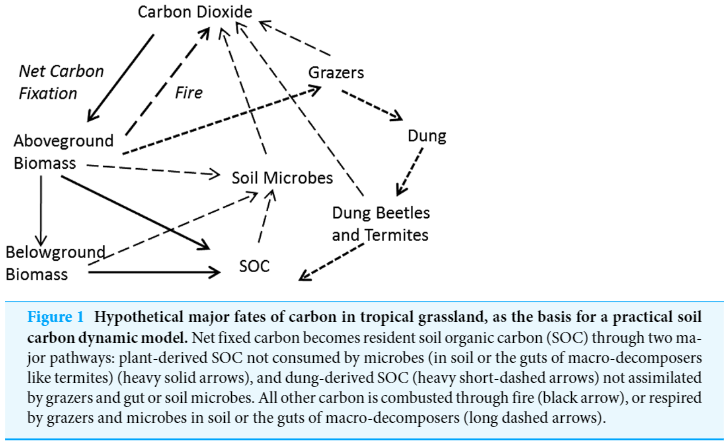
Factors that increase SOC are 1) plant residues (PDSOCt) and 2) animal dung (DDSOCt), while the factor that decreases it is 3) respiration of soil microbes (SOC decomposition). Therefore, it can be expressed by the following equation:

Of these, the input from plant residues is the sum of the above-ground net primary production (ANPP) not affected by grazing or fire, and the below-ground net primary production (BNPP). Furthermore, since only lignin and cellulose portions are actually converted to SOC, the ratio of lignin and cellulose (LIGCELL) is ultimately multiplied.

Animal dung is calculated as a portion of the above-ground vegetation consumed by animals through grazing.

Soil microbes are known to become active when soil moisture exceeds a certain level. Therefore, the respiration of soil microbes (SOC decomposition) is assumed to be proportional to WETDAYS (number of rainy days per year).

By using this model (SNAP), soil organic matter can be estimated with four parameters: 1) Grazing Intensity (GI), 2) fire frequency, 3) lignin and cellulose content in vegetation, and 4) SAND content in the soil (temperature may also be used, but the referenced literature considers its impact small and excludes it from the model). Compared to the CENTURY model (which requires over 20 variables), this model successfully implements a Modeled Approach with significantly fewer variables. Although the variables are few, the SNAP model claims to be able to evaluate SOC changes with sufficient accuracy for this Northern Kenya grazing project.
When performing this monitoring, periodically evaluating grazing intensity is quite labor-intensive. Grazing intensity is an indicator that represents vegetation damage due to grazing, expressed as the ratio of bare land in the target area. In this Northern Kenya project, Normalized difference vegetation index (NDVI) is measured by MODIS (Moderate Resolution Imaging Spectroradiometer) with a resolution of 250m x 250m, leveraging the characteristic that NDVI correlates with grazing intensity.
As demonstrated above, it is possible to measure SOC efficiently by using the Modeled Approach and remote sensing. However, the scope of simple models like the SNAP model is limited, and further research and development are needed. Furthermore, the development of remote sensing technology is also required as a means to easily acquire the indicators needed by the models.
In addition, while the above explanation focused on remote sensing, the development of more efficient technologies for direct SOC measurement methods is also needed. VM00032 states the following regarding measurement in appropriate laboratories:
Organic carbon concentrations must be measured in appropriate academic or industrial laboratories that use either chemical combustion or appropriately calibrated spectral analysis methods. IR methods must be calibrated by regression, with R2 > 0.90, of IR measurement with measurement by chemical or combustion methods.
Development of sensors capable of easily measuring SOC using visible and infrared light in laboratories or in the field is also progressing. In the Carbon Challenge held last year, Indigo Ag. was awarded in the Quantification category for its Laser Induced Breakdown Spectroscopy, which it claims can measure 15 parameters of soil organic matter in less than a minute. This is another area where future technological development is anticipated.
Future Trends: “Sustainable Carbon Cycling”
The European Commission announced its “Sustainable Carbon Cycles” communication last December. In it, it emphasized that the development of Carbon Removal technologies such as Carbon Farming is essential to achieve the "European Green Deal."
Third, we need to upscale carbon removal solutions that capture CO2 from the atmosphere and store it for the long term, either in ecosystems through nature protection and carbon farming solutions or in other storage forms through industrial solutions while ensuring no negative impact on biodiversity or ecosystem deterioration in line with the precautionary and Do No Significant Harm principles. The development and deployment at scale of carbon removal solutions is indispensable to climate neutrality and requires significant targeted support in the next decade.
At the same time, it points out that many challenges remain to expand Carbon Farming, such as the immaturity of business schemes and monitoring technologies.
financial burden resulting from the costs of carbon farming management practices and uncertainty about revenue possibilities;uncertainty or lack of public trust in the reliability of standards in voluntary carbon markets, in conjunction with concerns around environmental integrity, additionality or permanence;unavailability, complexity or high costs of robust monitoring, reporting and verification systems;insufficiently tailored training and advisory services.
To address these challenges, the European government has declared it will inject public funds. This move is expected to further accelerate efforts towards SOC measurement and Carbon Credit Issuance.
News from sustainacraft
Closing remarks
Soil Organic Carbon is garnering attention as an effective Nature-based Solution for carbon sequestration. While there are technical challenges, as discussed in the Northern Kenya example, combining it with remote sensing technology holds the potential to build more user-friendly and transparent SOC measurement models and Methodologies. As a company, we aim to explore our potential contributions to SOC measurement.
This concludes sustainacraft's Newsletter #5. In this newsletter, we plan to disseminate information in Japanese on NbS approximately bi-weekly to monthly.
Our company profile can be viewed here.
Disclaimers:
This newsletter is not financial advice. So do your own research and due diligence.