
Terrestrial Storage of Biomass (TSB) Overview and Methodology Comparison
This article is an automatically translated version of the original Japanese article. Please refer to the Japanese version for the most accurate information.
This is the newsletter from sustainacraft Inc.
Methodology Updates is a series focusing on carbon and biodiversity credit Methodologies. This article focuses on Terrestrial Storage of Biomass (TSB), one of the project types for Carbon Credit.
TSB refers to a method of storing biomass under conditions that inhibit microbial activity, thereby sequestering its carbon for hundreds to thousands of years. It is gaining attention in the Voluntary Carbon Market (VCM) as a new option due to its high Permanence and clear Additionality. Below, we will first introduce the logic of TSB's carbon Sequestration, its implementation methods and considerations, and the advantages and disadvantages of TSB as a carbon Sequestration method. Subsequently, we will introduce two existing TSB Methodologies and clarify their differences.
Seminar Announcement
Before delving into the main topic, here is a seminar announcement. This time, we will be holding a seminar on **within corporate value chains**.
In this seminar, we will explain specific strategies that Japanese companies should adopt, considering major regulations such as the **EU Deforestation Regulation (EUDR)**, **forced labor prevention laws (UFLPA・EU FLR)**, **Corporate Sustainability Due Diligence Directive (CSDDD)**, **European Battery Regulation**, and **Carbon Border Adjustment Mechanism (CBAM)**.
- Title: **Data-Driven Sustainable Supply Chain Strategy: Integrated Response to CBAM, EUDR, CSDDD, UFLPA, Trump Tariffs, and Scope 3 Reductions**
- Date: **Tuesday, July 8, 2025**
- Registration page: Please register here.
How should the "Supply Chain" and "Sustainability" divisions collaborate? We will present quantitative analysis examples using our platform to show how to identify high-risk suppliers and products in response to the aforementioned regulations and simulate the impact of future regulatory changes. We hope this will be a valuable reference for considering the construction of sustainable Supply Chains.
Overview of TSB
Principles of TSB Carbon Sequestration
Simply put, TSB sequesters carbon by burying plant biomass directly underground, preventing the re-release of carbon into the atmosphere through decomposition. Plants absorb atmospheric CO₂ through photosynthesis and store it as organic carbon within their tissues. In an unmanaged system, this biomass eventually decomposes primarily due to microbial activity, releasing much of its carbon content as CO₂ and Methane into the atmosphere. TSB intervenes in this process by harvesting fast-growing vegetative feedstock and placing it in dry, low-oxygen environments or specially designed storage systems that prevent microbial and oxidative decay.
Methods of TSB Implementation
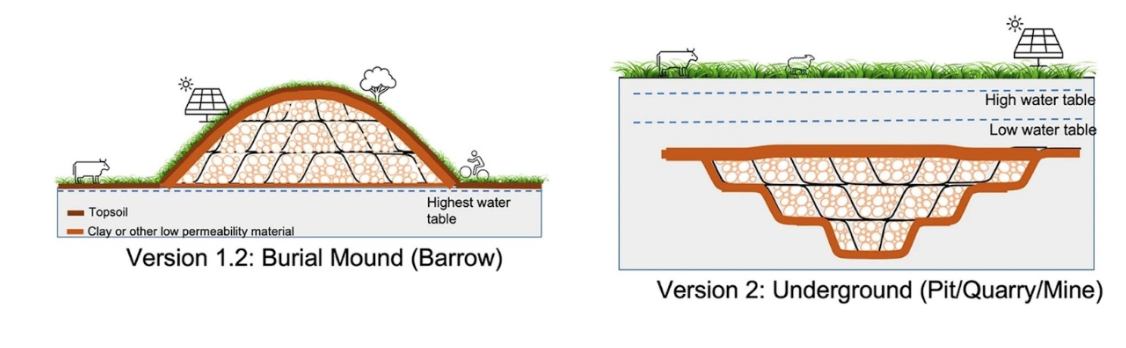
Microbial decomposition can be minimized through a combination of oxygen restriction, moisture limitation, increased pressure, and physical isolation of biomass from microorganisms. Therefore, multiple methods exist for TSB implementation. For instance, dry storage allows oxygen but minimizes moisture to restrict decomposition. Anoxic storage restricts decomposition by creating oxygen-deficient conditions, such as submerging the biomass in water. Injected storage allows moisture but restricts decomposition through anaerobic and high-pressure conditions. Figure 1 shows an example of a storage site proposed in the paper by Zeng and Hausmann (2022). Version 1.2 stores biomass feedstock in a low-moisture, low-oxygen environment, while Version 2 buries the feedstock in a low-oxygen environment below the water table.
When stored under controlled conditions (low oxygen, low moisture, physical isolation), the carbon in biomass can potentially remain sequestered for hundreds to thousands of years. For example, in peatland, dry tombs, and permafrost, natural carbon Sequestration has persisted for thousands of years. TSB systems can be thought of as replicating this natural phenomenon of Permanence by ensuring environmental stability and monitoring potential degradation.
The most commonly used feedstocks for TSB include fast-growing, carbon-rich plant materials such as woody debris, crop residues (e.g., corn stover, wheat straw), invasive alien species, and dedicated biomass crops like switchgrass and miscanthus. These materials are rich in lignocellulose, which has higher resistance to microbial decomposition than simple sugars and proteins. Harvested biomass is dried or pre-treated before storage to reduce moisture content, thereby inhibiting decay. Additionally, the feedstock is ideally locally available, has low opportunity costs, and minimizes transport Emission Reductions and Leakage.
Advantages and Disadvantages of TSB
Next, we will briefly summarize the advantages and disadvantages of TSB.