
How to Use the BGC Model in VCS ALM Projects
This article is an automatically translated version of the original Japanese article. Please refer to the Japanese version for the most accurate information.
Sustainacraft Inc. Newsletter.
Methodology Updates is a series that covers methodologies for carbon and biodiversity credits. This article explains Verra's module VMD0053, which provides guidance on calibration and validation methods for biogeochemical models in ALM projects.
For inquiries, please contact us here.
How to Utilize BGC Models in VCS ALM Projects
Introduction
Verra announced on March 26, 2025, the release of VMD0053 v2.1, a guidance document on the utilization of Biogeochemical (BGC) models in Agricultural Land Management (ALM).
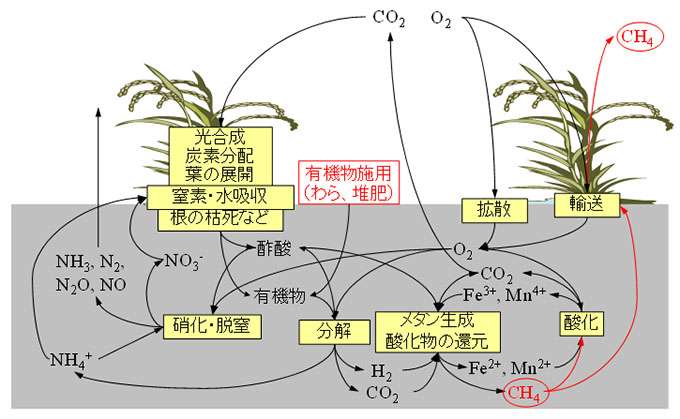
BGC models are mathematical representations of the cycling of substances such as carbon, nitrogen, and water within ecosystems. They can simulate the dynamics of these substances while considering the influences of climate, soil, vegetation, and human activities. Therefore, BGC models are used in ALM projects as a method for quantifying Greenhouse Gas (GHG) Emission Reductions and Removals resulting from changes in agricultural land management practices.
To make reliable estimations using BGC models, model calibration (the process of adjusting model parameters to match observed values) and validation (evaluating the accuracy of a calibrated model) are essential. However, this requires specialized knowledge, and care must be taken to prevent arbitrariness in data selection. Therefore, VMD0053 serves as a guideline to standardize these procedures.
This revision is a minor update from v2.0 to v2.1, with only slight changes. Specifically, the main change is the modification of wording to allow VMD0053, which was previously a module used only with VCS's ALM Methodology VM0042, to also be used with VM0051, a recently published Methodology for paddy fields1. ALM is a general category referring to various activities that reduce and sequester GHG emissions through improved agricultural land management practices, and VM0042 also covers activities in paddy fields. However, its focus is on changes in Soil Organic Carbon (SOC), whereas VM0051 is a Methodology focused on quantifying Methane (CH4) and Nitrous Oxide (N2O), which are more significant GHGs in paddy fields. While VM0051 primarily targets Alternate Wetting and Drying (AWD), it also covers other activities in paddy fields. For more details on VM0051, please refer to the following newsletter.

AWD projects in paddy fields are considered a promising source of Credit supply in the short term, including under the Joint Crediting Mechanism (JCM), but the high cost of direct measurement is cited as a challenge to their scalability. Specifically, direct measurements require analyzing samples obtained from closed chambers, but the labor costs for sample collection and the analysis costs increase with the project area's size and the heterogeneity of paddy field management. Therefore, quantifying GHGs through models is expected to play a crucial role in the widespread adoption of AWD projects across broader areas.
Currently, the use of models is not permitted under the JCM Methodology, but given the increasing adoption in the Voluntary Carbon Market, discussions about model utilization might progress within JCM in the future. In that sense, understanding the model requirements and limitations in VMD0053 is considered valuable.
With the above in mind, this newsletter will delve into the details of VMD0053.
Requirements of VMD0053 v2.1
First, the diagram below illustrates the overall steps for quantifying GHGs using models under VMD0053. The diagram indicates the corresponding sections in VMD0053. Sections 1-3 and 6 onwards contain summary and supplementary content, so the core part consists of Sections 4 and 5. As the diagram shows, the "Model validation" section is comprehensive. In fact, VMD0053 provides little specific guidance on model selection or calibration; its main content focuses on how to choose data sets for proper validation and the accuracy requirements that must be met during validation.
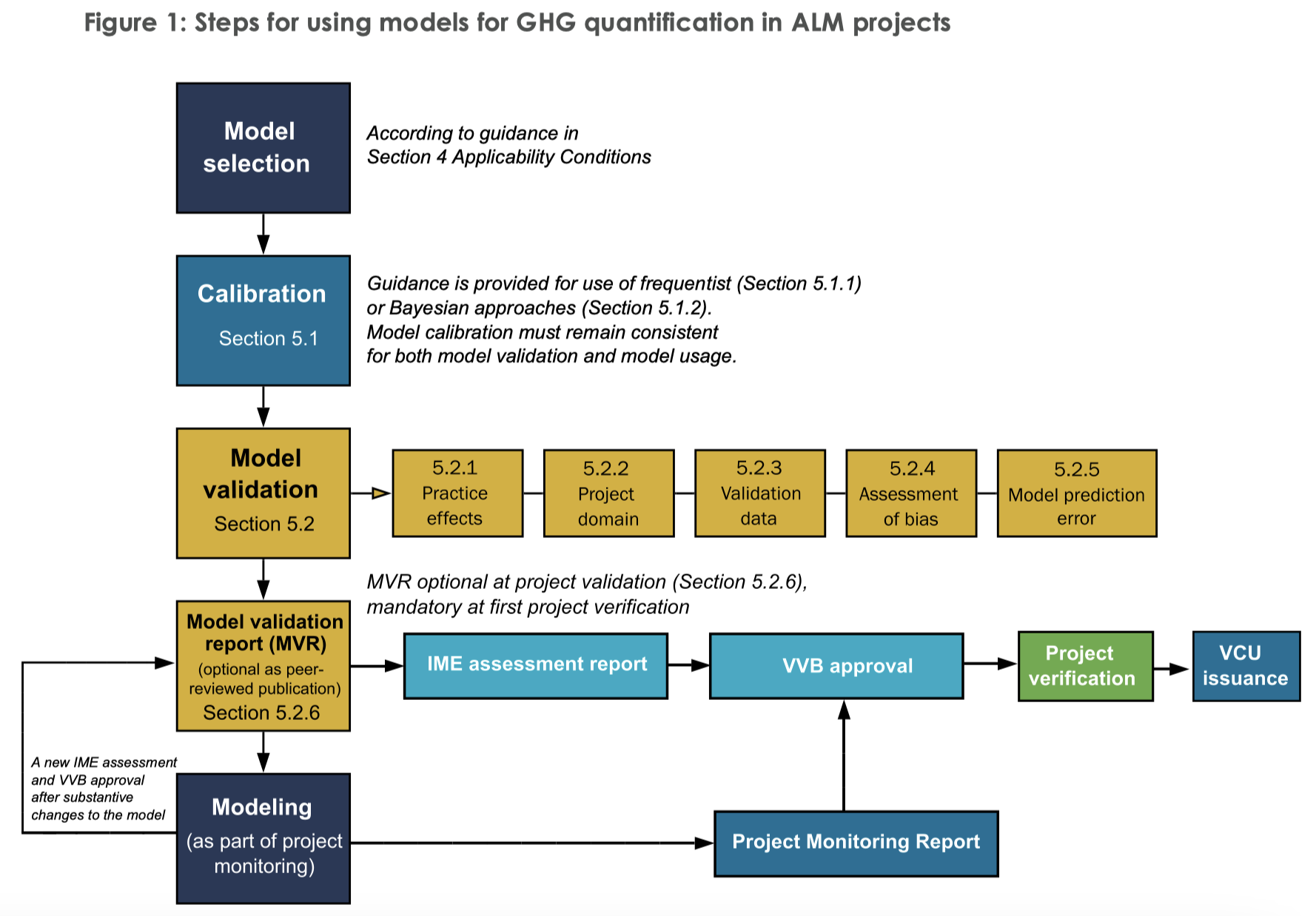
Below is a summary of each step:
Applicable Conditions (Model Selection)
Third-party availability, reliability, and reproducibility of the model are required.
Selecting a model with a proven track record should generally be acceptable.
Model Calibration
No specific guidance on the method is provided.
Care must be taken in data usage (cross-validation is not permitted).
Model Validation
Detailed requirements are set for the data sets that can be used for validation.
Finding data sets that meet these requirements is a challenge.
Regarding accuracy, freedom from bias and correct calculation of prediction intervals are required.
Let's look at these in more detail.