Recent Topics on Forest Credits: Verra's ABACUS and PCU (Projected Carbon Unit)
This article is an automatically translated version of the original Japanese article. Please refer to the Japanese version for the most accurate information.
This is sustainacraft Inc.'s 8th Newsletter.
This time, we're delivering it with a slightly different structure.
Verra has recently been considering the operation of a new label for high-quality Carbon Credits called ABACUS. The pre-consultation for this was open until August 7th, and our company submitted feedback. In the first section of this letter, we will introduce the questions posed and the feedback we provided.
The second section will cover Projected Carbon Units (PCU). This concept was announced by Verra at a side session during COP26, and concrete discussions have begun, with a public consultation held from May of this year. We believe PCUs will have a significant impact on Voluntary Carbon Market transactions.
PickUp Section
ABACUS pre-consultation
(Source: Verra)
Discussions covered topics like matching for dynamic baselines and leakage, which we also touched upon in our 7th letter. While we didn't answer all questions and some answers weren't direct, here we'll briefly introduce what was discussed and our responses.
There are various arguments, such as whether monoculture plantations should be excluded in areas where primary forests do not exist. Also, with population growth leading to increased demand for food and timber, and supply struggling to keep up, some argue that highly efficient plantations can actually be positive from a biodiversity perspective when viewed broadly, questioning the need for such strict leakage monitoring.
Overall, we hope that these initiatives will lead to a positive cycle where higher quality forest credits increase their transaction price in the market, which in turn enables more forest projects that were previously not financially viable at lower prices.
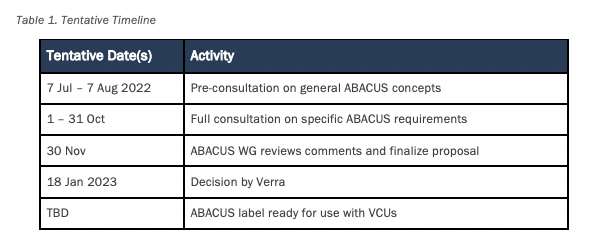
The current projected schedule is as follows, with a public consultation planned for October, based on this pre-consultation.
(Below are machine-translated versions of both questions and answers)
- 1) Carbon Stock Proxy Metrics
Dynamic baseline methodologies require a cost-effective, remotely observable proxy for carbon stock over time in the control plot. This metric is used to match control plots before project implementation and for proportional additionality measurement during project implementation (though the metric does not need to be the same before and after project implementation). No single remote sensing metric or index perfectly represents carbon stock over time across all geographies and ecosystems. How can the label define minimum quality thresholds for carbon stock proxies as new sensors, remote sensing products, and technological innovations become available?
Optical-based vegetation indices considered in new ARR methodologies, such as NDFI, cannot adequately indicate carbon volume. Furthermore, requiring the use of very high-resolution satellite imagery for repeated biomass estimation in control plots would be cost-prohibitive. In this sense, long-wavelength L-band and P-band radar satellites suitable for vegetation monitoring, such as NASA's NISAR and ESA's BIOMASS, could be valuable sources of information for biomass estimation. NASA's NISAR and ESA's BIOMASS are expected to become operational in the near future, and NISAR adopts an open data policy. Radar satellite images are not affected by weather, making them particularly effective in regions with frequent cloud cover.
While radar satellites alone have saturation issues, making it difficult to estimate high-density biomass, this should not be a problem as ARR control plots may not have dense vegetation.
Additionally, combining information from satellite LiDAR (GEDI, and MOLI in the future) with radar data is expected to enable remote sensing estimations that balance cost and accuracy.
- 2) Sampling Design
ABACUS envisions matching project virtual plots (which may be distinct from project plots inventoried for carbon removal) with a population of the best-matched control plots from a specified donor pool region. Given the need to minimize uncertainty and computational burden, how should the label specify the quantity, density, and spatial size of project virtual plots and the quantity and spatial size of matched control plots for each?
A methodology that eliminates arbitrariness is needed, as results can vary significantly depending on which reference pool is used for matching. Therefore, it would be effective to somehow demonstrate the robustness when a particular reference pool is selected. In this regard, we believe that computational burden will not be a serious problem.
- 3) Performance Assessment
What metrics should projects use to assess and report the goodness of match between each project virtual plot and its population of control plots? Is weighting each control plot by its similarity to the project virtual plot sufficient?
First, it is important to publish guidelines on which covariates should be used to evaluate the quality of matching.
While available data varies by country and region, guidelines that require adding information with the highest possible resolution and accuracy are desirable.
Whether to include time-series covariates should also be discussed. Climate conditions and distance to roads are inherently time-varying variables, so the matching mechanism may need to account for their temporal variations.
When performing matching using propensity scores, it is necessary to verify whether the accuracy of the model is sufficient. Otherwise, inverse selection will not be adjusted, and bias will remain. It is also desirable to confirm whether the distribution of covariates is similar among the matched plots (see comment on inverse selection in 4).
- 4) Inverse Selection
A dynamic baseline represents the counterfactual scenario without intervention in the project area if the project and control plots have similar reforestation tendencies without carbon market incentives. However, plots with a high reforestation tendency may be more likely to participate in carbon market projects, leaving a donor pool of control plots with a low reforestation tendency. How can the label reasonably manage this risk of inverse selection?
Adjusting for such inverse selection is one of the central topics in project evaluation, and several approaches exist for this problem. One common approach is propensity scores (Rosenbaum and Rubin, 1983).
Inverse selection can be adjusted by modeling reforestation tendencies using covariates and finding a match between each project's virtual plot and control(s) that are similar in their estimated propensity scores.
Further consideration is needed on what data should be used to model reforestation tendencies, but past satellite imagery data would be one option.
Reference: Rosenbaum, P. R., & Rubin, D. B. (1983). The central role of the propensity score in observational studies for causal effects. Biometrika, 70 (1), 41-55.
- 5) Implementation Barrier Test
In addition to the dynamic baseline requirement, the label will require projects to pass an implementation barrier test. What provisions would make for a meaningful implementation barrier test?
(No answer)
- 6) Proof of Expected Carbon Credits
What objective and verifiable evidence of expected Carbon Credits should be required prior to project commencement?
(No answer)
- 7) Monoculture
Are there any circumstances under which monoculture plantations planted for commercial harvest purposes can effectively demonstrate additionality? How should the label define monoculture plantations for exclusion purposes based on additionality? Are exclusions appropriate for systems that naturally occur in extensive single-species forest stands, and how should this exemption be defined?
Even if a project implements monoculture plantations planted for commercial harvest, credits should only be granted if the project would not be financially viable without the credits. This can be verified by investigating growing conditions such as terrain slope, soil characteristics, and normal land use in surrounding areas.
- 8) Leakage
ABACUS will require projects to mitigate the displacement of agricultural and silvicultural production by enhancing productivity elsewhere in the surrounding landscape and eliminate leakage. Should projects be able to compensate for displaced production by enhancing the production of a different commodity? Should the area in which projects can compensate for displaced production be limited, and how? Are there any specific productivity enhancement methods that should be excluded?
(No answer)
- 9) Well-adapted
Carbon in natural systems is more durable when vegetation is well-adapted to the project region. Considering rapidly changing climate conditions, how should the label quantitatively define and verify that introduced species are “well-adapted”?
It is very difficult to identify tree species compositions with low mortality rates in a rapidly changing environment. Before that, shouldn't there at least be a database accumulated that can quantitatively verify which tree species compositions have adapted to a given environment in the long term (i.e., achieved low mortality rates)? We expect carbon program registries like Verra to require appropriate disclosure of information for each registered project and to make that knowledge publicly available.
Projected Carbon Unit
(Source: Verra)
The VCUs (Verified Carbon Units) that Verra has issued until now were only issued after results had been verified. While this offers the advantage of certainty because actual achievements are confirmed, it leaves a financing problem for Project Developers.
In contrast, the concept of PCU has been explored, which involves issuing provisional units based on future projections, and then converting them into traditional VCUs once results are verified. At a COP26 side event, the concept was announced very concisely with the following slide, and I remember being shocked by the immense impact this would have on the Voluntary Carbon Market. Originally, this concept had been under consideration since around 2020 under the name Early Finance Carbon Unit (EFCU).
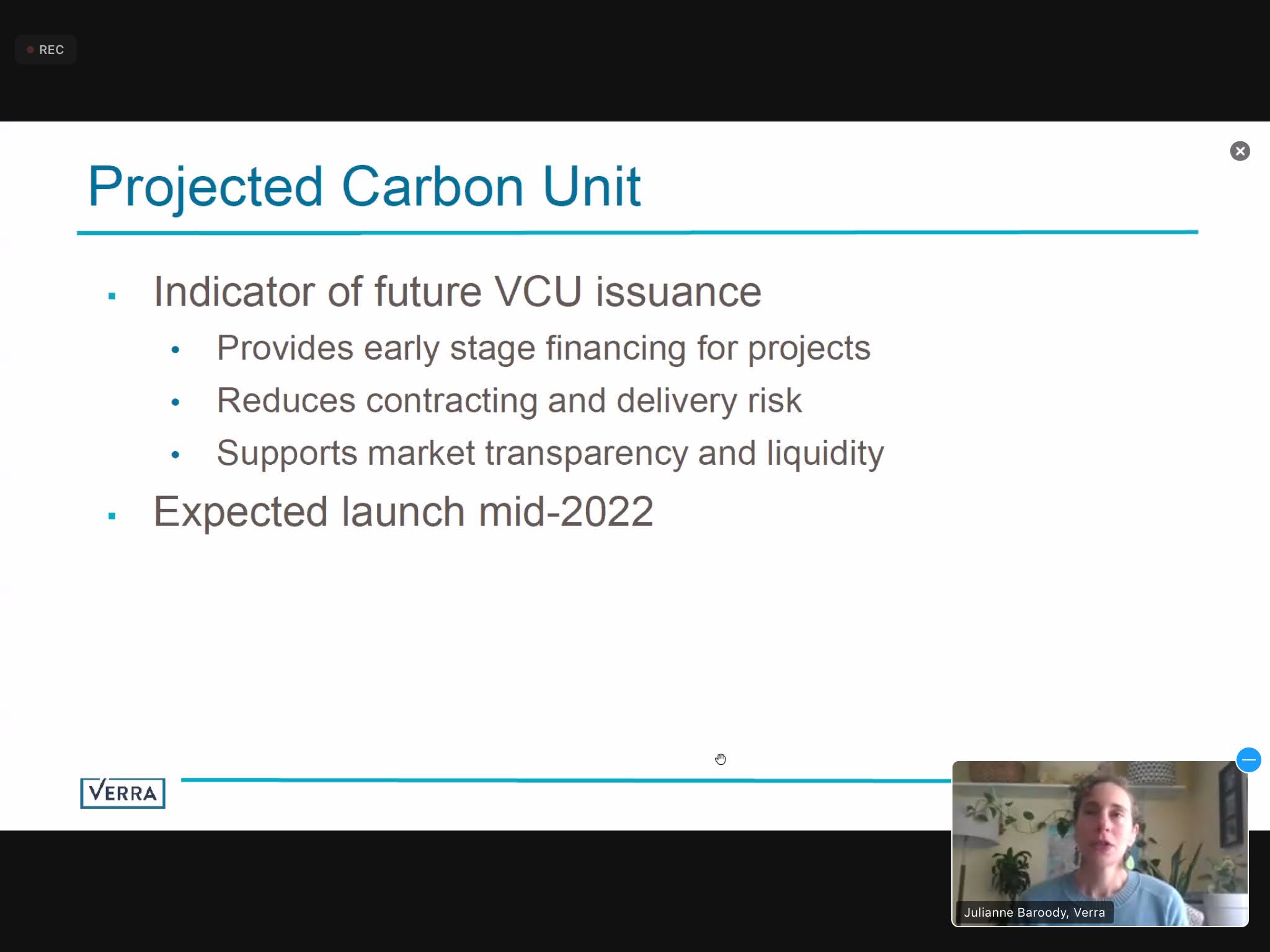
An announcement regarding PCUs following public comments is scheduled for September, so we will cover it again in this letter once the official details are released.
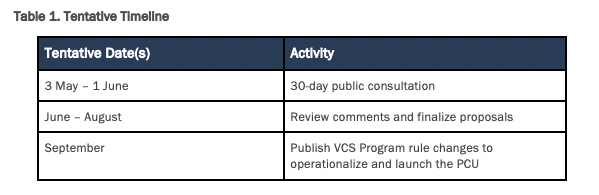
Here, we will introduce the current design considerations for PCUs and the questions that have been raised.
In the introduction, the benefits for Project Developers and Buyers are summarized as follows:
- Project Developers can secure early investment for their projects. PCUs are particularly useful for Afforestation, Reforestation and Revegetation (ARR) projects, which require substantial upfront investment and decades of implementation to verify large Emission Reductions. PCUs will also be useful for technology-based Emission Reduction projects that face very high startup costs.
- Credit Buyers and investors will have Verra's backing for contractual agreements, thereby reducing contracting and delivery risk. By increasing transparency and buyer confidence, PCUs can enable further investment in climate action, boost the supply of credits and liquidity in environmental markets, potentially leading to further GHG mitigation. Buyers also benefit from an accounting perspective, as they can hold the asset on their corporate financial statements (balance sheet). Finally, major corporations state that by holding PCUs, they can demonstrate that their project investments are expected to generate a certain volume of ERR of the appropriate vintage towards achieving Net Zero targets and other climate commitments. The use of PCUs can prevent criticisms of Greenwashing directed at companies that have ambitious GHG reduction targets but lack credible evidence to show that they have made the necessary investments to achieve those targets.
At the time of COP26, there were discussions that the SEC (Securities and Exchange Commission) was skeptical of PCU treatment in the context of financial product regulation. However, Verra's current announcement states that the SEC is "unlikely to take an interest." On the other hand, given that PCUs are clearly intended to appear on corporate financial statements (balance sheets) as stated above, the tax implications in Japan would need to be clarified.
Next, we will introduce the current proposed design of PCUs, focusing on the delivery risk in case of underperformance, which is considered a major point of contention.
2.6 VCU Delivery in Case of Underperformance
This is likely the most concerning part for Buyers. Since PCUs are issued based on future projections, there is a risk if the actual Emission Reductions / Removals are smaller than anticipated. Verra's current design anticipates a "first-come, first-served basis" in such cases. They argue that if a project is deemed to be underperforming as planned, Buyers can choose to purchase only the initial reliable portion, which in turn generates a price signal for the PCU tranche, leading to effective pricing for PCU tranches. Sections 2.9 and 2.10 describe the types of transactions anticipated under these assumptions.
The idea of a first-come, first-served basis was also a point of contention in the 2020 consultation under the name Early Finance Carbon Unit (EFCU), with half of the respondents in favor and half against. This is expected to remain a significant topic of discussion.
The following questions are open for public consultation:
1) Is the proposed PCU design (Section 2) expected to enable early project investment and help PCU Buyers reduce contracting and delivery risk and facilitate credible communication of progress toward Net Zero targets and other climate commitments?
2) Do you have any concerns regarding the usability or environmental integrity of the proposed PCU design (Section 2)? If so, what are those concerns, and what adjustments should be considered to further strengthen the proposed PCU design?
3) The proposed maximum PCU allocation period for NCS sequestration (removal) projects, including Afforestation/Reforestation projects, is 40 years. Do you agree with this timeframe for NCS removal projects? If not, do you believe a longer timeframe (e.g., 60 years) or shorter timeframe (e.g., 20 years) is more appropriate, and what is your rationale?
4) The proposal sets the PCU allocation period for non-NCS (engineered) sequestration (removal) projects at a maximum of 40 years, taking into account the significant upfront investment required for these projects (e.g., Direct Air Carbon Capture & Storage) to deploy. However, unlike NCS sequestration projects, these engineered projects can deliver Emission Reductions soon after becoming operational. Do you agree with this timeframe for engineered removal projects? If not, do you believe a longer timeframe (e.g., 60 years) or shorter timeframe (e.g., 20 years) is more appropriate, and what is your rationale?
5) The PCU allocation period is described as a fixed timeframe with a start and end date. Should Project Proponents have the option to extend a project’s PCU allocation period, subject to re-validation of relevant project documents? For example, after 5 years of project initiation and re-validation of key parameters, including the project’s ERR forecast, Proponents might be able to extend the PCU allocation period for another 5 years.
6) Is the update for PCU implementation (Section 3) clear? Do you have any suggestions to clarify or better define how PCUs will be implemented within the VCS Program?
7) Considering that PCUs would allow Project Proponents to allocate and transfer carbon units earlier in the project development cycle than otherwise possible, should Project Proponents or VVBs provide additional information not yet required in the VCS Project Design Document and Validation Report templates (Section 3.5) to ensure PCUs are based on robust projections?
News from sustainacraft
● Announced the start of a joint research project with the National Institute for Environmental Studies and Hitotsubashi University.
- Press Release (prtimes, National Institute for Environmental Studies)
● Featured in the Chemical Daily (August 24th morning edition).
Closing remarks
This letter covered Verra's ABACUS and PCU (Projected Carbon Unit). Going forward, we plan to also introduce more immediate and lighter content like this.
There are many issues that need to be discussed for the Voluntary Carbon Market to circulate effectively in Japan, such as the debate on Carbon Credit quality, disclosure guidelines for utilized credits, and the treatment of PCUs. We are also engaged in activities to create venues for such discussions. If you are interested, please contact us via our form.
This concludes sustainacraft's Newsletter #8. This newsletter aims to provide information on NbS in Japanese, approximately bi-weekly to monthly.
Our company profile document is available here for your reference.
Disclaimers:
This newsletter is not financial advice. So do your own research and due diligence.