Supply Chain Analysis of Six Major LIB Metals: Monopoly Status by Country and Company
This article is an automatically translated version of the original Japanese article. Please refer to the Japanese version for the most accurate information.
Translation (English)
Source: MDPI "Mapping the Supply Chain of Lithium-Ion Battery Metals from Mine to Primary Processing by Country and Corporation" (Background Information)
Overview
This report provides a detailed mapping of the 2024 supply chains for six critical minerals essential to lithium-ion batteries (LIBs): lithium, nickel, cobalt, manganese, aluminum, and copper. The analysis reveals that while copper and aluminum have relatively diversified supply sources, lithium and cobalt are highly concentrated within specific countries and corporations. In particular, the report highlights a "midstream bottleneck," where refining and processing stages are overwhelmingly concentrated in China, regardless of where the mining occurs.
Key Points
1. Significant Differences in Market Concentration by Mineral
Analysis using the Herfindahl-Hirschman Index (HHI) indicates that cobalt (3214) and lithium (1241) exhibit high levels of concentration, whereas aluminum (312) and copper (457) have competitive and decentralized market structures. Nickel and manganese fall in the middle, showing signs of increasing dependence on specific countries as production expands in Indonesia and Africa.
2. Chinese Dominance in the Midstream (Processing Stage)
Even when mining (upstream) takes place in countries like Australia, Chile, or the Democratic Republic of the Congo, much of the material is sent to China for refining. For example, while lithium mining is relatively distributed, Chinese companies hold a dominant share in the processing stage into battery-grade chemicals, representing a major vulnerability in the supply chain.
3. Vertical Integration and Strengthening of Dominance by Specific Corporations
For each mineral, a small number of multinational corporations control the majority of global supply. With CMOC (China) holding a nearly 40% share in cobalt and Tsingshan Group maintaining over a 30% share in nickel—driven by its expansion in Indonesia—a structure has become established where specific companies exert immense influence over pricing and supply stability.
Background
With the proliferation of electric vehicles (EVs) and battery energy storage systems (BESS), demand for LIBs is surging. Securing a stable supply of critical raw materials has become a top priority for national energy security. However, the distribution of mineral resources is geologically biased. Furthermore, because establishing refining infrastructure requires massive investment and stringent environmental measures, the industry is naturally prone to dependence on specific regions and companies. This report was developed to provide a quantitative baseline (2024 baseline) for policymakers and researchers to identify supply chain vulnerabilities and formulate diversification and risk mitigation strategies.
Details
By Mineral: Market Concentration and Key Players (2024 Data)
| Mineral | Global Production | Key Producing Countries (Share) | Leading Company (Market Share) | HHI (Global) |
|---|---|---|---|---|
| Cobalt | 290 kt | DR Congo (76%) | CMOC (39.37%) | 3214 (High) |
| Lithium | 225 kt | Australia (39%) | Sinomine (17.82%) | 1241 (Medium) |
| Nickel | 3,700 kt | Indonesia (59%) | Tsingshan Group (30.27%) | 1150 (Medium) |
| Manganese | 21.67 Mt | Gabon (36.5%) | Eramet (31.38%) | 2096 (Medium) |
| Copper | 20.29 Mt | Peru (30.5%) | Volcan (10.99%) | 457 (Low) |
| Aluminum | 72 Mt | China (59.7%) | Chinalco (9.86%) | 312 (Low) |
Structural Characteristics of the Supply Chain
- Correlation between Geographical and Corporate Concentration:
- Cobalt mining is dominated by the Democratic Republic of the Congo (DRC), with operations established under Chinese companies (such as CMOC) and Glencore.
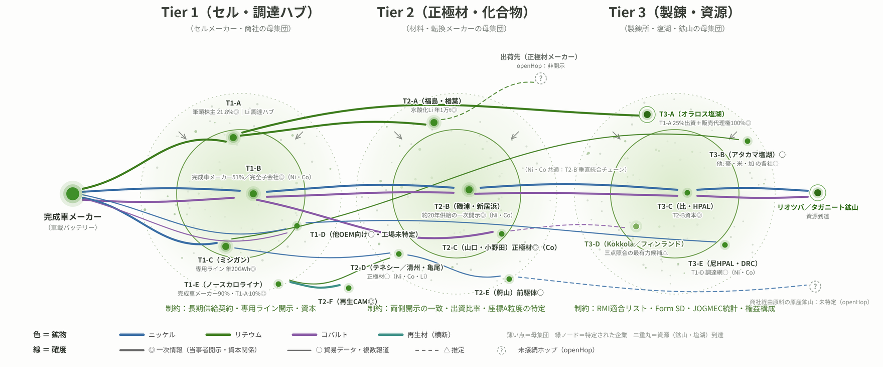
- Nickel production in Indonesia has grown to account for over half of the global total, much of which is tied to refining facilities like HPAL (High-Pressure Acid Leach) plants funded by Chinese capital.
- Midstream Vulnerability:
- Lithium raw materials (spodumene concentrate and brine) are transported to China after extraction to be processed into lithium carbonate and lithium hydroxide. This concentration of processing means that Chinese policy changes or economic conditions pose a risk that could ripple through the global EV industry.
- Sectors where Diversity is Maintained:
- For copper and aluminum, stages from mining to refining are distributed globally, making a monopoly by a specific country or company unlikely. However, as aluminum smelting requires low-cost electricity, it remains highly sensitive to energy price fluctuations.
Summary
This study clearly demonstrates the asymmetry between "diversified extraction" and "concentrated processing" within the LIB supply chain. Looking forward, the keys to enhancing supply chain resilience will be promoting recycling and alternative technologies for cobalt and manganese, and expanding refining capacity for nickel and lithium outside of current hubs (China and Southeast Asia). Policymakers are required to not only secure mining locations but also to make strategic investments and build partnerships toward the diversification of refining and processing stages.
Our company provides "Tracecraft," a supply chain intelligence service designed to address sustainability and geopolitical risks. If you are interested in quantifying dependency risks on specific suppliers or countries beyond Tier 1, or performing risk assessments of upstream smelters and mines, please contact us below.
 sustainacraft